A Tanzania safari is well-suited to travellers in their 55s, 60s, 70s and even 80s, provided the trip is built around a shorter northern-circuit itinerary (4–7 days), a mid-range lodge base, a private 4×4 with a single window seat per person, and short driving days averaging 3–4 hours behind the wheel. The main considerations are altitude at Ngorongoro Crater (rim at 2,286 m), malaria prevention, and a realistic pace — not the safari itself.
I get a version of the same question from adult children every month: “Can my mother, who is 72, actually do this? Or should we look at a river cruise instead?”
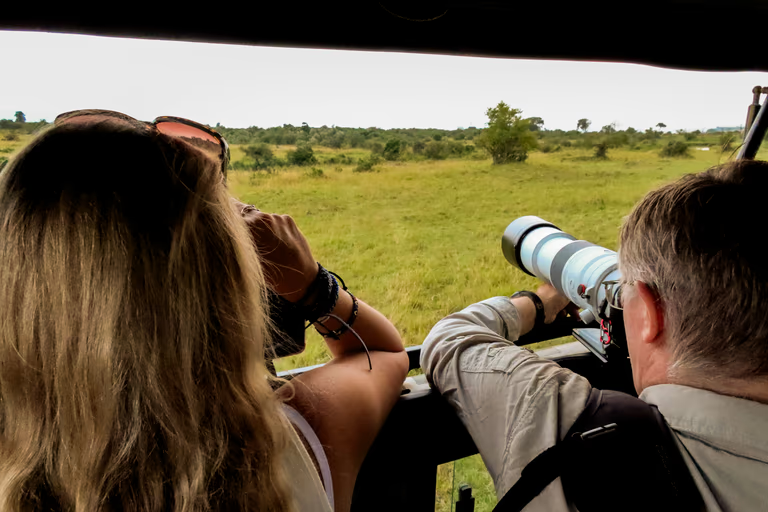
The honest answer is that most people in their 60s and 70s do a Tanzania safari more comfortably than a European city break. There is no walking involved. No stairs to climb. No cobblestones. You sit in a well-cushioned 4×4, driven slowly, and wildlife comes to you.
But there is a version of this trip that goes badly for older travellers — usually because someone built the itinerary the way they’d build one for a 35-year-old. Long drives back-to-back. A campsite in Serengeti with no bathroom. A 12-day marathon of parks. That is not the trip I’m going to recommend to you.
This guide walks through what a Tanzania safari actually feels like day-to-day when you’re over 60: how many hours you’re really in the vehicle, the altitude question at Ngorongoro, what to sort with your doctor before you fly, which parks work best, and what a genuinely comfortable trip should cost. Nothing invented, nothing softened — this is what I tell clients on our WhatsApp calls before they book.
Is a Tanzania Safari a Good Idea After 55?
Yes — in most cases, more comfortably than travellers expect. The mechanics of a safari suit older bodies well. You are seated for the wildlife-viewing part of the day, in a vehicle designed for the terrain, on flat park roads with your guide making all the decisions. There is no hiking. Elevation is modest across the Northern Circuit except at Ngorongoro Crater rim, and even there we’re talking about a few hours at altitude, not overnight exertion.
In 14 years of guiding, I’ve had clients as old as 84 have some of the best safaris I’ve ever run. What made those trips work wasn’t age — it was the itinerary. Short driving days. Mid-range lodges with real beds and hot water. A private vehicle so we could pause, turn around, or shorten a game drive without negotiating with strangers. And a guide who could read when someone wanted to keep going and when they were quietly ready to head back to the lodge.
What Actually Makes It Work for Older Travellers
Four things separate a safari that suits a senior traveller from one that grinds them down:
- A private vehicle, not a shared group tour. On a group joining safari, you move on the group’s schedule. If four other travellers want to stay another hour at a lion sighting and you’re stiff, hungry, or need a bathroom, tough. On a private safari, you decide.
- A window seat with real space. In our 4×4 Land Cruisers, we run a maximum of four passengers when families or friends want to share, which gives every traveller two windows and a full row. For most senior clients I recommend two people maximum in the back — you sit across from each other with an entire bench each.
- A driving day capped at 3–4 hours behind the wheel (not counting game drives, which are gentle and paused every few minutes).
- Ground-floor lodge rooms, or a lodge with a lift — something I brief every lodge booking on for senior clients.
The Kind of Trip That Doesn’t Work
Skip anything that combines two or three of these: 10+ days end-to-end, camping in mobile tents, back-to-back full-day drives between parks with no rest day, and Serengeti-only itineraries that force one very long transfer day each direction. That’s not a safari built for you — that’s a safari built for a backpacker on a budget, sold to the wrong client. If an operator is quoting you that trip, push back.
What a Safari Day Actually Looks Like
Most travellers picture a safari as a long, exhausting day in the sun. It isn’t. A well-run day for a senior client is closer to five hours of activity split into two clean sessions, with a proper lunch break and afternoon downtime.
Here is what a typical day inside a park looks like from the driver’s seat.
The Morning
You’ll wake around 6:00 to 6:30 with coffee brought to your room. Breakfast is served early — usually 6:30 — because the animals are most active in the cool first hours after sunrise. This is the only “early” part of the day, and most senior travellers tell me they’re already awake anyway from the time zone shift.
We’re on the game drive road by 7:00 or 7:30. In Tarangire and Lake Manyara, the park gate is 5–15 minutes from most lodges. In central Serengeti, you’re inside the park the moment you leave your camp.
The Vehicle Matters More Than Anything Else
This is the single most under-discussed piece of a senior safari. In 14 years I’ve watched more good trips get compromised by a bad vehicle than any other factor.
A proper safari 4×4 for older travellers has:
- Individual bucket seats with real cushioning and headrests, not a shared bench with a thin cover.
- Pop-up roof so you stand only when you want to, and sit fully protected the rest of the time.
- Charging ports at each seat for cameras, phones, and any medical devices.
- A cooler stocked with cold water, refilled at the lodge each morning.
- Suspension recently serviced. African roads are rough. A tired suspension is what leaves passengers sore.
At Affordable International Travel, we run our senior client trips in our newest Toyota Land Cruiser fleet specifically because the ride difference is significant. If you’re comparing operators, ask them the model year of the vehicle you’ll actually be in — not the shiny one on their website.
How Long You’re Really in the Seat
Game drive time is not the same as “sitting still” time. On a normal park day, we might be inside the park for four to five hours, but we stop the vehicle every few minutes — for a herd of elephants, a leopard sighting, a photograph, or simply because the light is good. Long uninterrupted driving is confined to the transfer days between parks, and we work hard to keep even those under four hours where possible.
Here’s a realistic breakdown of a day at Tarangire National Park, one of the easiest parks for senior travellers:
| Time | What’s Happening | Effort Level |
|---|---|---|
| 6:30 AM | Coffee delivered, dress, breakfast at lodge | Very low |
| 7:15 AM | Depart lodge, 10-min drive to park gate | Very low |
| 7:30 AM | Enter park, start game drive | Low — seated |
| 10:00 AM | Short stop at a picnic site (bathroom, stretch) | Low |
| 12:30 PM | Picnic lunch at a designated site under baobabs | Low |
| 1:30 PM | Optional: continue game drive OR return to lodge | Your choice |
| 3:30 PM | Back at lodge, rest, shower, siesta | None |
| 6:30 PM | Sundowner drinks by the pool | None |
| 7:30 PM | Dinner at lodge | None |
Total time in the vehicle: about 4.5 hours, with two natural breaks.
That is a full safari day. It is not physically demanding.
The Transfer Days Are Where Fatigue Shows
Between parks — say, moving from Tarangire to the Ngorongoro highlands — you’ll spend three to four hours on the road. This is where clients feel it. My rule for senior travellers: never stack two consecutive transfer days. We build in a full park day between every long drive, so the body has time to reset.
The Health Realities No One Explains Properly
Every operator’s website tells you “consult your doctor.” That’s the correct advice, but it’s useless if you don’t know what to actually ask. Here’s what I brief senior clients on before every trip.
The Altitude Question at Ngorongoro Crater
This is the most misunderstood health point on a Tanzania safari. Ngorongoro Crater sits at meaningful elevation. The rim, where all the lodges are, is at 2,286 metres (7,500 feet) above sea level. The crater floor, where you drive during the game drive, is lower — 1,700 metres (5,577 feet).
For context, 2,286 metres is roughly the altitude of Aspen, Colorado. It’s not Kilimanjaro-level altitude, but it is enough to cause mild headaches, shortness of breath on stairs, or a broken first night’s sleep for travellers who don’t spend time above sea level at home. According to the Ngorongoro travel guidance, the crater rim sits around 2,200–2,400 metres, which can cause mild headaches, fatigue, or shortness of breath in some visitors.
For most senior travellers this is a manageable inconvenience, not a health risk. What I do for clients with heart or lung conditions:
- Choose a lodge in Karatu (30 minutes below the crater rim, at lower elevation) instead of a rim lodge — you still visit the crater but sleep lower.
- Limit crater floor time to a half-day rather than a full day.
- Keep the crater visit later in the itinerary — day 4 or 5, not day 1 — so you’re acclimatised to Tanzania’s general elevation first.
Talk to your cardiologist or pulmonologist specifically about spending one to two nights at 2,300 metres if you have any concerns. Most will clear you without hesitation. A few will suggest supplemental oxygen at the lodge, which top-end Karatu properties can arrange.
Malaria and Mosquitoes
Every one of Tanzania’s major safari parks sits in a malaria zone, including Serengeti, Ngorongoro’s lower elevations, Tarangire, and Lake Manyara. The CDC classifies malaria as a serious and potentially deadly illness, and travellers who develop a fever during or up to a year after visiting a malaria-risk area should seek immediate medical attention and disclose their travel history.
For senior travellers this means two things. First, you’ll need a prescription antimalarial — usually Malarone (atovaquone-proguanil), doxycycline, or mefloquine. Malarone is the standard for older clients because it’s gentle on the stomach and has fewer interactions with common medications. Second, bring long-sleeved shirts and lightweight long trousers for evenings, use a DEET or picaridin repellent, and sleep under the mosquito nets provided at every lodge and camp we book.
Vaccinations to Sort Before You Fly
The CDC does not generally recommend yellow fever vaccination for travel to Tanzania itself, but proof of yellow fever vaccination is required for travellers arriving from countries with yellow fever transmission risk, including airport transits or layovers of more than 12 hours in those countries. This catches out travellers routing through Addis Ababa or connecting via West African hubs.
Beyond the yellow fever question, the standard vaccination checklist for a Tanzania safari includes routine boosters (measles/MMR, Tdap, polio, seasonal flu, COVID-19 as current), and typhoid and hepatitis A for food and water safety. See a travel medicine clinic at least six weeks before departure — some vaccines need time to take effect.
The Medications You’re Already Taking
Bring more of your regular prescription medications than you think you’ll need. My rule: pack your daily supply for the whole trip in your carry-on, plus a full backup supply in your checked luggage. If your suitcase gets held up in Addis or Doha for a day, you don’t want that to be a medical emergency.
Split your medications into a small daily pill organiser and keep it accessible in the vehicle. On safari, days blend together and time zones are confusing — a labelled organiser saves you from doubling a dose or missing one entirely.
Travel Insurance That Actually Matters
The one line item that’s not optional: air medical evacuation insurance that covers Tanzania. Standard travel insurance often does not. You want a policy from a specialist provider (Global Rescue, Medjet, or a comprehensive plan from a major insurer with confirmed Tanzania coverage) that will fly you to Nairobi or back home in a medical emergency. This is not a Tanzania-specific worry — it’s what any responsible traveller over 60 should carry for any long-haul international trip.
The Best Parks for Older Travellers (And One to Skip)
Tanzania has more than a dozen national parks and conservation areas managed by the Tanzania National Parks Authority (TANAPA) and the Ngorongoro Conservation Area Authority. For senior travellers, five parks matter, and one is often oversold.
Tarangire National Park — The Easiest on the Body
Tarangire is my first-park recommendation for almost every senior client. The roads inside the park are among the smoothest in Tanzania. The park is only two hours from Arusha, so it’s a natural first stop. And the wildlife density in dry season is exceptional — huge elephant herds, giraffe, zebra, and often lion in the tree branches. You can have a genuinely great safari day here without ever driving more than 30 minutes at a stretch.
Lake Manyara National Park — The Half-Day That Works
Lake Manyara is small — you can cover it comfortably in a half-day. That makes it perfect as a transition park, either on the drive up to the Ngorongoro Highlands or on the way back down. Excellent birding, tree-climbing lions when you’re lucky, and a compact circuit road that doesn’t wear anyone out.
Ngorongoro Crater — The One Everyone Wants to See
The crater is the single most photographed image in Tanzania, and yes, you should go. See the altitude discussion above. Keep your crater floor visit to a half-day (four to five hours) rather than a full day, because the descent road is steep and rough, and the crater gets dusty and warm on the floor.
Serengeti National Park — The Trade-off
Serengeti is enormous. Getting there from Arusha means a full day of driving (about 8 hours), or a 90-minute charter flight from Arusha airport for around $290–$350 per person one-way. For senior clients I strongly recommend the flight in at least one direction. It saves an entire exhausting travel day and lets you land in central Serengeti in time for an afternoon game drive. If Serengeti is on your list, fly in, drive out — or fly both ways.
Which Park to Skip
For most travellers over 65 on a first-time safari, I’d skip Ruaha and Nyerere (Southern Circuit). They’re spectacular parks — but they require an extra internal flight or a very long drive from Dar es Salaam, and the road network inside is rougher than the Northern Circuit. Save them for a second trip.
Here’s how I’d rank the Northern Circuit parks for senior-traveller suitability:
| Park | Distance from Arusha | Suitability | Best For |
|---|---|---|---|
| Tarangire | 2 hours | Excellent | Elephants, day one arrival |
| Lake Manyara | 2 hours | Excellent | Half-day birding, tree-climbing lions |
| Ngorongoro Crater | 3 hours | Very good with pacing | Big Five in a single half-day |
| Serengeti (Central) | 8 hours by road / 90 min flight | Good if you fly | Big cats, Great Migration |
| Ruaha (Southern) | Full flight + long drive | Skip on first trip | Return travellers, remote wildlife |
How Long Should the Safari Actually Be?
The trip length question matters more for senior travellers than for anyone else, because the difference between a 5-day and a 10-day itinerary is not linear — it’s exponential in fatigue.
The Sweet Spot: 6 to 7 Days
Six or seven days on the Northern Circuit is where the experience peaks for senior travellers. That gives you Tarangire, Ngorongoro Crater, Lake Manyara, and either a fly-in to Serengeti or an extended stay at one park. You see the Big Five. You get to know your guide. You have one built-in rest day. And you fly home before physical fatigue sets in.
Our 7-day Northern Circuit itinerary is what I recommend to about seven out of ten senior clients. It’s the version we’ve refined over hundreds of bookings specifically because it hits every major experience without any brutal driving days.
The Minimum That Works: 4 Days
A 4-day trip can genuinely work — Tarangire, Manyara, and a Ngorongoro Crater visit. You’ll see enormous amounts of wildlife. What you skip is Serengeti. For travellers over 75, or anyone with mobility concerns, or those combining the safari with Zanzibar, this is often the better choice.
Why 10+ Days Often Backfires
I’ve seen this pattern too often to sugar-coat it. Adult children book a 12-day safari for their parents thinking “they should see everything while they’re there.” By day 8 the client is exhausted, the guide is having to shorten every game drive, and the last three days feel like a chore. The wildlife highlights don’t compound after day 7 — they blur together. Better trips are shorter trips repeated a few years apart.
If you want more than a week in Tanzania, combine 6 days of safari with 4 days on Zanzibar’s coast. The beach change is restorative in a way another park never is.
Accommodation: Camping, Lodge, or Something Between
There is a persistent myth that camping “adds authenticity” to a Tanzania safari. It does — for travellers in their twenties. For most senior clients, a mid-range lodge is the correct choice, and I’ll explain why.
Why Camping Is Usually the Wrong Call
Tanzania has three tiers of camping: public campsites (basic, shared bathrooms, thin mattresses), private mobile camps (comfortable but still tented), and luxury tented camps (excellent, but at the same price as top lodges anyway). Public campsites are what most budget operators mean when they say “camping safari.” I do not recommend them for travellers over 60.
You’re getting up in the night for a bathroom trip across a dark campsite. Sleeping on a mattress thinner than what most clients use at home. Managing a shared bathroom queue at 6 AM. And any pre-existing back or knee condition will announce itself by day three.
For a comparison of Tanzania’s camping safari options vs lodge safaris, we’ve written a full breakdown — but the short version for senior travellers is: don’t.
What “Mid-Range Lodge” Actually Means on the Ground
A mid-range lodge in Tanzania is comparable to a good three-star hotel in Europe or a solid Marriott in the US. You get a private room with an ensuite bathroom, hot running water, a proper bed with real linens, electricity, a mini-fridge in most cases, and a restaurant serving buffet or set-menu meals. Most lodges have a pool. Some have a small gym.
Our standard senior client trip uses mid-range lodges across the whole itinerary — no downgrades, no compromise nights.
The One Lodge Feature That Matters Most
Ask the operator specifically: is my room on the ground floor, or is there a lift? Many lodges have room layouts that require stairs to reach the accommodation blocks, sometimes uneven stone paths. This is fixable but only if we know before booking. I make this a standard question on the pre-trip form for every client over 60.
Other features that matter more than travellers expect:
- Mosquito nets over the beds (standard at all reputable lodges).
- A generator that stays on overnight so bathroom lights work at 3 AM.
- A doctor on call or a medical clinic within 30 minutes — most Karatu, Manyara, and Serengeti lodges qualify.
What This All Costs — A Real Breakdown
Let me give you the numbers travellers actually want. Senior client trips at AIT typically sit in a specific price band because the itineraries are built for comfort rather than budget-extreme.
For a 6-day private mid-range lodge safari covering Tarangire, Lake Manyara, Ngorongoro Crater and a short Serengeti extension, expect a per-person price in the range of $2,400 to $3,400 based on two travellers sharing a room, everything included except international flights, Tanzania visa ($100), and tips. Solo travellers pay a supplement of roughly $400–$700 depending on the lodge tier.
What’s included in that price at AIT:
- All park fees and government levies (about 30–35% of the total quote is park fees alone)
- Private 4×4 Land Cruiser with pop-up roof and professional guide
- Full-board accommodation across all lodges
- Bottled water throughout the trip
- Airport transfers from Kilimanjaro International Airport (JRO) to Arusha or Moshi
What’s not included, and what you should budget separately:
- Tanzania eVisa: $100 per person for US, UK, and most EU passport holders. Apply through the official Tanzania Immigration eVisa portal before travel.
- Tips: $30–$40 per traveller per day for the guide, and $10 per day for lodge staff. On a 6-day trip, budget roughly $200–$250 per person in cash for tips.
- Travel insurance with medical evacuation: $200–$500 per person depending on your provider and health profile.
- Optional Serengeti fly-in: $290–$350 per person one-way. For senior travellers I strongly recommend budgeting for this.
Where to Spend More, Where to Save
If you’re deciding where to invest an extra $500 in your trip, put it into the fly-in flight to Serengeti before you put it into an upgraded lodge. Skipping the 8-hour drive is worth more to a senior traveller than a slightly nicer bathroom.
Conversely, if you’re trying to keep costs down, the honest savings come from travelling in shoulder season (November, or late March through May) rather than peak dry-season months. Shoulder-season rates run 15–25% below peak. The wildlife is still excellent, and the crowd density is dramatically lower, which for older travellers is a genuine quality-of-experience gain — fewer vehicles queuing at every sighting.
For a full breakdown, see our complete Tanzania safari cost guide which walks through every line item in the pricing model.
The 8-Week Countdown: Practical Preparation
Here’s what I send every senior client four to eight weeks before travel. Use this as your own checklist.
8 Weeks Out
- Book a travel medicine appointment. Discuss malaria prophylaxis, boosters, and any medications you’re already on that might interact.
- Confirm your passport has at least six months’ validity from your return date and at least four empty pages.
- Buy travel insurance with confirmed medical evacuation coverage for Tanzania.
- Apply for your Tanzania eVisa through the official government portal.
- Ask us — or your operator — which specific lodges are booked and whether ground-floor rooms are held for you.
4 Weeks Out
- Start your antimalarial prescription per your doctor’s schedule. Malarone begins 1–2 days before entering the malaria zone. Doxycycline starts 1–2 days before as well. Mefloquine starts 2–3 weeks before because reactions need time to surface at home rather than in the field.
- Break in the shoes you’ll be wearing on safari. Nothing new goes on the trip.
- Do a “trial pack” of your daily medications into pill organisers and check nothing runs short.
1 Week Out
- Notify your bank of your travel dates so cards don’t get frozen.
- Print physical copies of your itinerary, insurance policy, eVisa confirmation, and emergency contact list. Phones die. Print doesn’t.
- Pack medications in your carry-on with a backup in checked luggage.
- Confirm airport pickup details with your operator. At AIT we send a WhatsApp confirmation the day before your arrival with your guide’s name, phone number, and photo.
Day of Arrival
You’ll land at Kilimanjaro International Airport (JRO). Immigration is straightforward if your eVisa is pre-approved. Your guide will meet you outside baggage claim with a name sign and drive you either to Arusha (1 hour) or Moshi (45 minutes) to your first-night hotel. Most senior clients spend one night acclimatising before the safari begins the next morning. That night is worth it — a good sleep before day one changes the whole trip.
Traveling Solo, as a Couple, or With Adult Children
Different configurations produce different trips. A few notes on each.
Solo Travellers Over 55
Perfectly common at AIT. Roughly a quarter of my senior clients travel alone. What changes: you’ll pay a single supplement of $400–$700 for the private room, and I’ll assign a guide who is comfortable with quieter travel — some clients want conversation all day, some want silence and reflection, and a good guide reads that within the first morning. Solo senior safari travel in Tanzania is safe. You are never alone in the vehicle, at the lodge, or on any part of the itinerary.
Couples
Most of my senior trips are couples travelling together. The most important thing here is honesty in the planning conversation about differing energy levels. If one spouse tires faster than the other, we build in half-day options — one goes on the afternoon game drive, one rests at the lodge with the pool and a book. Everyone has a better trip when we design this in from the start rather than pretending both travellers have identical stamina.
With Adult Children (or Grandchildren)
Multi-generational trips are a joy but require thought. The key: don’t let anyone’s individual pace dictate the group’s pace. If Dad wants a full-day drive but Grandma wants an early lodge return, the guide splits the day — this is exactly what having a private guide and vehicle allows. Trips where three generations traveled together are among the most rewarding safaris I’ve ever guided.
If you’re planning a family trip that includes a senior traveller and younger children, our family safari page walks through the additional considerations for kids on safari, which stack alongside the senior-traveller considerations here.
Is there an age limit for a Tanzania safari?
No — Tanzania has no age restriction for safari participation. In practice, the oldest client I’ve personally guided was 84, and she completed a full 6-day Northern Circuit itinerary without incident. What matters far more than age is mobility, general health, and stamina for sitting in a vehicle for a few hours at a time. A traveller in their 80s with good cardiovascular health and a comfortable itinerary will do better than a sedentary traveller in their 50s on a 12-day marathon.
Do I need to be physically fit to do a Tanzania safari?
Not particularly. A safari is not a hike. You need to be able to walk short distances (from the lodge room to the dining area, from the vehicle to a picnic table), climb into a 4×4 with a step-up, and sit for periods of 2–4 hours at a stretch. There is no trekking, no long walks, and no elevation gain on a standard game-drive safari. If you can manage a shopping trip in a large mall at home, you can manage a Northern Circuit safari.
Will the altitude at Ngorongoro Crater be a problem?
For most senior travellers, no. The crater rim sits at 2,286 metres (7,500 feet), similar to ski towns like Aspen. Mild altitude effects — a light headache, disturbed sleep on the first night — are possible but usually pass within 24 hours. For travellers with heart or lung conditions, or on beta-blockers, discuss with your doctor before travel, and consider basing at a Karatu lodge (lower elevation) rather than a crater rim property.
What is the best time of year for senior travellers?
Late June through October is peak dry season — the most reliable wildlife viewing and the most comfortable weather (cool mornings, warm days, low humidity). For senior travellers I also strongly recommend January through early March, which combines great wildlife with dry weather and fewer crowds. Avoid April and early May unless you’re comfortable with rain and muddy roads — the long rains do soften the experience.
Should I choose a group safari or a private one?
Private, every time, for senior travellers. Group joining safaris are 20–30% cheaper but you sacrifice control over pace, seating, break times, and vehicle quality. A private safari lets you decide when to head back to the lodge, when to skip a section, and how long to linger at a sighting. For older clients the pace control alone is worth the price difference.
What happens if I get sick or injured on safari?
Every itinerary AIT operates is within reach of medical care. In Arusha, Moshi and Karatu there are well-equipped private hospitals. Serengeti has emergency evacuation by charter flight — arranged within a few hours in a real emergency. Your guide carries a first-aid kit and a satellite communication device in remote areas, and every senior client is briefed on the evacuation plan on day one. This is where your medical evacuation insurance comes in — buy it, keep the policy number in your phone and printed in your bag
Can I combine the safari with Zanzibar without exhausting myself?
Yes, and I recommend it for senior clients who want more than a week away. Six days of safari followed by three or four days on Zanzibar’s northern beaches is a genuinely restorative combination. You end the trip lying still, not driving hard. Fly from Arusha to Zanzibar direct — the flight is 90 minutes and skips a very long ground transfer.
The Bottom Line
A Tanzania safari after 55 is not a compromise trip or a scaled-back version of what younger travellers get. Built correctly, it’s actually more comfortable than most European holidays — you spend most of your day in a well-cushioned vehicle, at a lodge with a real bed, on a schedule you control.
The trip works when it’s built around four principles: a private vehicle, mid-range lodge accommodation, driving days capped at 3–4 hours, and an itinerary of 4 to 7 days on the Northern Circuit rather than a 10+ day marathon. Skip the camping. Take the fly-in to Serengeti. Get your medical evacuation insurance sorted before you fly. And find an operator willing to build the trip around your pace rather than sell you a package built for someone else.
Affordable International Travel has run trips for travellers in their 55s, 60s, 70s, and 80s from 38 countries — 600+ happy clients and 340+ completed safaris across the Northern Circuit. Every senior itinerary is designed around the specific pace, health considerations, and comfort priorities of the client, not a template.
If you’re weighing whether this is the right trip for you or a parent, message me directly on WhatsApp — +255 740 453 344 — and I’ll answer your questions honestly, no sales pitch. We can talk through your health situation, pace preferences, and the specific parks that would suit you best before you commit to anything.