A Tanzania safari with kids works best for children aged 6 and up, though under-5s can enjoy shorter trips in Tarangire and Ngorongoro. The safest, most rewarding parks for families are Tarangire, Lake Manyara, Ngorongoro Crater, and the central Serengeti. Budget around $250–$450 per person per day. Children aged 5–15 pay 50% of adult park fees, and under-5s enter for free.
In 14 years guiding families across Tanzania, I’ve watched a lot of parents worry themselves through the planning stage — Will the kids be safe? Will they be bored? Is it worth the money? — only to see them cry the day they leave, because their children saw a lion drink from a puddle three metres from the vehicle. A Tanzania safari with kids is one of the few holidays that lives up to the version parents imagine in their head. But only if you plan it right.
This guide is not written from a desk. It comes from my logbook of 900+ safari clients — the families whose trips went beautifully, and the ones where a five-year-old’s meltdown at 11 a.m. in Serengeti taught me something. Below is exactly what I tell parents when they message me on WhatsApp: which parks work, which ages struggle, what it costs, what to pack, and how to keep everyone healthy in a country where malaria is real but manageable. No fluff. Real numbers.
Is a Tanzania Safari with Kids Actually a Good Idea?
Yes — and I’ll tell you honestly why some safaris with kids don’t work, so yours does.
Kids who see the Serengeti at the right age come home changed. They talk about it for years. They point at every giraffe on TV. But the safaris that fail almost always share the same three mistakes: parents pick the wrong parks (too much driving, too little animal action), they book a shared group vehicle (no flexibility for a bored toddler or a bathroom emergency), and they try to cover too much ground in too few days.
A Tanzania safari works for children when the wildlife is close and constant, the drives between parks are short, and the family has their own vehicle. Those three conditions are what separate a life-changing trip from a $6,000 mistake.
As a TATO-member operator (Tanzania Association of Tour Operators), we design family itineraries around exactly those three constraints — I’ll cover how below.
What’s the Best Age for a Tanzania Safari?
The honest answer: 6 is the sweet spot, but children as young as 3 can enjoy a well-planned trip.
Here’s how I think about it after guiding hundreds of families:
| Age Band | Realistic Trip Length | Best Parks | What to Expect |
|---|---|---|---|
| Under 3 | Not recommended | — | Malaria risk, long drives, and limited stimulation outweigh benefits. |
| 3–5 | 3–4 days maximum | Tarangire, Ngorongoro Crater, Lake Manyara | Short game drives (2–3 hours), lodge with a pool, plenty of downtime. |
| 6–9 | 5–7 days | Tarangire + Ngorongoro + Central Serengeti | The classic sweet spot. Kids remember it clearly. Bring binoculars. |
| 10–13 | 7–10 days | Full Northern Circuit or Southern Circuit | Old enough for long drives, curious enough for cultural add-ons. |
| 14–17 | 7–12 days | Anywhere, including Zanzibar or Kilimanjaro day treks | Teens engage deeply if the itinerary respects their pace. |
I’ve had a 4-year-old sit in awe for 20 minutes watching elephants at the Tarangire River. I’ve also had an 8-year-old fall asleep between two lion sightings in Central Serengeti because we’d been driving since dawn. Age matters less than pacing.
If you’re travelling with a child under 6, keep the trip to three or four days and stick to parks where wildlife is close to the road. That means Tarangire and Ngorongoro Crater — where you don’t have to drive an hour to find animals.
Which Tanzania Parks Are Best for a Safari with Kids?
For families, the four parks that consistently deliver are Tarangire, Lake Manyara, Ngorongoro Crater, and the central Serengeti. I recommend them in that specific order.
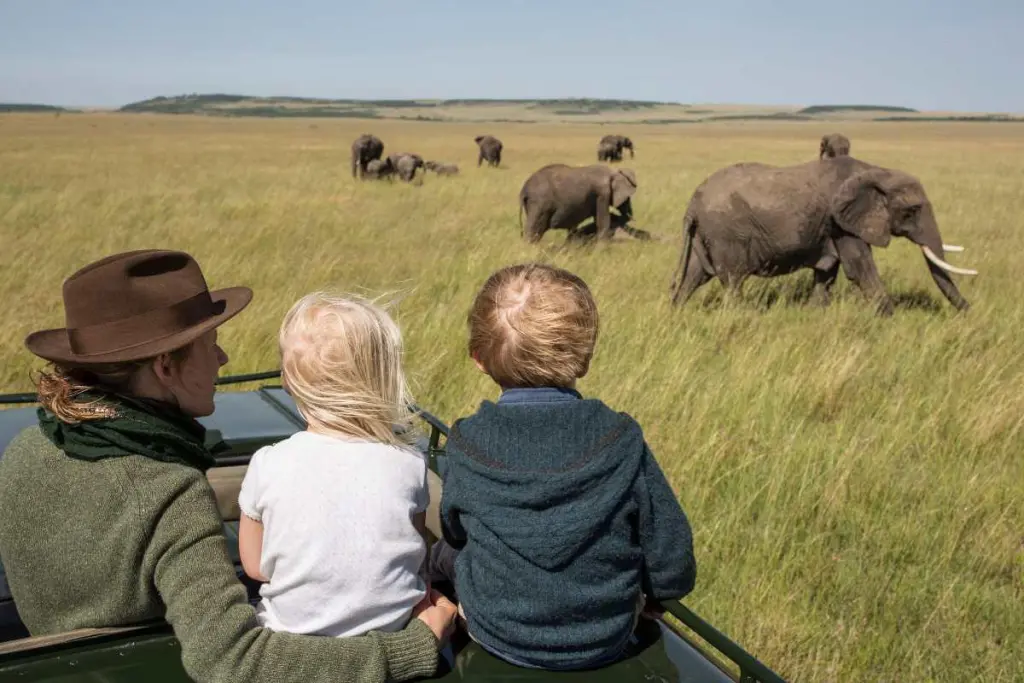
Tarangire National Park. In dry season (June–October), the Tarangire River becomes a magnet for elephant herds — I have counted 300 elephants at one crossing point in September. Kids love elephants above anything else. Game drives here don’t need to be long; two hours out from the lodge is often enough to see baboons, giraffes, zebras, and elephants at close range.
Lake Manyara National Park. A compact park you can cover in half a day. Tree-climbing lions if you’re lucky, thousands of flamingos at the lake edge, and a forest section with troops of blue monkeys that entertain even the fidgetiest six-year-old. Great as a warm-up park on day one.
Ngorongoro Crater. The single best park for a family that wants to see everything in one day. The crater floor concentrates lions, elephants, buffalo, rhinos, hippos, hyenas, and wildebeest into 260 square kilometres. Sightings are almost guaranteed. Ngorongoro is managed separately from TANAPA by the Ngorongoro Conservation Area Authority (NCAA), and the crater vehicle fee is a flat $295 per vehicle — worth every dollar for a family.
Central Serengeti (Seronera). Only recommend this for kids 6 and above. The park is vast, and the drives between wildlife hotspots can stretch to two or three hours. But Seronera itself has a permanent water source, which means resident lions, leopards in sausage trees, and cheetahs on the plains all year round. Skip the northern and western Serengeti with young kids — too remote, too much driving.
Parks I would not recommend for young families: Ruaha, Katavi, Nyerere (Selous), and the western Serengeti. Fantastic parks, but the vehicle time between sightings is punishing for children.
For a full breakdown of parks and what’s included in a package, see our Tanzania safari packages page.
How Much Does a Tanzania Safari with Kids Cost?
A family safari in Tanzania typically costs $250–$450 per person per day, with kids aged 5–15 paying 50% of adult park fees and children under 5 entering parks free of charge.
Here’s the cost breakdown Rehema, our Operations Manager, gives families when they ask:
| Cost Component | Adult (2026) | Child 5–15 | Under 5 |
|---|---|---|---|
| Serengeti park fee (per day) | ~$82.60 incl. VAT | ~$23.60 incl. VAT | Free |
| Tarangire / Lake Manyara fee | ~$59 incl. VAT | ~$18 incl. VAT | Free |
| Ngorongoro conservation fee | ~$70.80 incl. VAT | ~$23.60 incl. VAT | Free |
| Ngorongoro crater vehicle fee | $295 per vehicle per day (flat) | — | — |
| Lodge accommodation (mid-range) | $150–$280/night | Often 50% of adult rate | Usually free sharing parents’ room |
| Guide, vehicle, fuel | Included in package | Included | Included |
For a family of four (two adults, two children ages 8 and 11) doing a classic 5-day Northern Circuit safari, expect a total package cost between $4,500 and $7,200, depending on lodge tier and season. That includes all park fees, a private 4×4 Land Cruiser with a certified guide, full-board lodge accommodation, and airport transfers from Kilimanjaro (JRO) or Arusha.
Two ways families cut costs without cutting quality: travel in the green season (mid-March to May) when lodge rates drop 20–40%, or add a fifth family member so vehicle costs split further. A full breakdown of what drives the price is on our Tanzania safari cost page.
Where Should Families Stay on a Tanzania Safari?
For families with young children, I recommend mid-range lodges over both budget camping and ultra-luxury properties.
Budget camping safaris are wonderful for adventurous couples — I run them often — but I don’t recommend them for children under 10. The bathroom facilities are shared, hot water is limited, and a five-year-old at 3 a.m. hearing hyenas outside the tent is not always a good time.
Mid-range lodges hit the sweet spot: private ensuite rooms, hot showers, kids’ menus at dinner, and — critically — a swimming pool for the hot mid-day hours between game drives. Look for lodges that offer connecting rooms or family suites; most reputable operators, including us, book families into these by default. Details on what a mid-range lodge experience looks like are on our Tanzania lodge safari page.
A few specific lodge features to ask about when booking:
- Pool access. Non-negotiable for kids in dry season.
- Kids’ meal options. Not every lodge offers them; ask specifically.
- Distance from park gate. A lodge inside or right at the edge of the park means less driving each morning.
- Early dinner service. Kids fade by 7 p.m.; lodges that serve at 6:30 make the whole trip easier.
How Do You Keep Kids Healthy on a Tanzania Safari?
Three health topics matter most for a family safari in Tanzania: malaria prevention, vaccinations, and food/water safety. The good news is that all three are well-understood and easy to manage with a bit of preparation.
Malaria. Every safari park in northern Tanzania sits below 1,800 metres, where malaria is a year-round risk. According to the CDC and travel-medicine guidance, malaria prophylaxis is recommended for all Tanzania destinations at altitudes below 1,800 metres, with the same recommendations for young children as for adults, except that dosages are weight-based and doxycycline should be avoided in children.
Malarone (atovaquone-proguanil) is the most family-friendly option; paediatric tablets are available and your family doctor will calculate the dose by weight. Combine tablets with long sleeves at dusk, DEET-based repellent (or picaridin for younger kids), and lodges with mosquito nets or screened windows.
Vaccinations. Yellow fever is not required for direct flights to Tanzania from Europe, the US, or Canada, but it is required if you transit through a yellow-fever country like Ethiopia.
Confirm your routing before you fly. Beyond that, the standard recommended vaccinations are Hepatitis A, Typhoid, Tetanus, and up-to-date MMR (measles-mumps-rubella) — which the CDC recommends for children 12 months and older before international travel, with a single dose for children 6–11 months. See a travel-medicine clinic 6–8 weeks before you fly. Full country-specific guidance is on the CDC’s Tanzania travel health page. TripPrep
Food and water. Bottled water only — for drinking and brushing teeth. Mid-range lodges filter their water, but I still tell families to stick to sealed bottles. Peel fruit yourself. Avoid raw salads outside lodges. Bring oral rehydration salts and children’s paracetamol from home; both are available in Tanzania, but you don’t want to be searching for a pharmacy in Karatu at 9 p.m.
What Should You Pack for a Tanzania Safari with Kids?
A short, opinionated list — 14 years of watching families under-pack and over-pack:
Do bring:
- Neutral-coloured clothes (khaki, olive, brown). Avoid black and dark blue — tsetse flies are attracted to them.
- Long-sleeve shirts and long trousers for early mornings and dusk.
- A warm fleece per child. Ngorongoro Crater rim mornings can drop to 8°C.
- Wide-brim hats and reef-safe sunscreen (SPF 50+).
- DEET or picaridin insect repellent — child-strength formulations for kids under 12.
- Binoculars per child — this single item transforms game drives.
- A small day pack for each child with a colouring book, wildlife bingo card, and a bottle for water.
- Antibacterial wipes, hand sanitiser, oral rehydration salts.
- Passport with at least 6 months validity and 2 blank pages per traveller.
Skip:
- Bright colours and heavy jewellery.
- Drones (banned in national parks without a permit).
- Large hard-shell suitcases (soft-sided duffel bags are easier to fit in a Land Cruiser).
How to Actually Enjoy Long Game Drives with Kids
This section is the one I wish someone had written for me before my first family trip. Here is what actually works on the road:
Depart early. 6 a.m. game drives sound painful with kids, but the first two hours produce 80% of the wildlife sightings, and children are always more alert at sunrise than they are at 11 a.m. Come back to the lodge by 10:30 for pool time and lunch. Head back out at 4 p.m. for the golden-hour drive.
Split long transit days. If your itinerary moves from Ngorongoro to Serengeti in one go — six hours on the road — break it up with a picnic lunch at the Olduvai Gorge museum. Kids get to walk, ask questions, and stop asking “how much longer?”
Turn the vehicle into a classroom. I keep a printed animal-track chart in every vehicle. When kids can identify hyena prints on a road at 8 a.m., they engage differently for the rest of the drive.
Use the pop-top roof for the boring stretches. Nothing kills kid engagement faster than sitting in a shaking Land Cruiser looking at yellow grass for 40 minutes. Let them stand up under the roof and be the “spotter.” Give the job importance.
Book a private vehicle. I know it costs 20–30% more than a group joining safari, but for families it is not a luxury — it is the single decision that determines whether the trip is enjoyable. Bathroom stops. Snacks. A meltdown at 11 a.m. Nothing about a shared vehicle survives the reality of travelling with a six-year-old.
Meet the guide. Ask your operator to send a photo and bio of the guide before the trip so kids know who is picking them up. It removes the strangeness of day one. Families we host often book directly through our team page after chatting with us on WhatsApp.
Is a Tanzania safari safe for kids?
Yes, when the trip is planned by a licensed operator and led by a certified guide. In our 340+ completed safaris across 38 countries of origin, we have never had a serious safety incident with a child. The two rules that matter most are: stay in the vehicle unless your guide invites you out, and follow lodge protocols after dark (walk-arounds with a ranger, not solo). Guides certified by the Tanzania Association of Tour Operators are trained specifically in family safety.
What’s the minimum age for a Tanzania safari?
There is no legal minimum age — kids of any age can enter Tanzania’s national parks. But practically, I don’t recommend safari for children under 3 because of malaria risk and the length of game drives. For children 3–5, keep the trip short (3–4 days) and stick to parks where wildlife is close to the road, like Tarangire and Ngorongoro. Under 5s enter all TANAPA parks free of charge.
Do kids get bored on safari?
Some do, some don’t — the difference is almost entirely down to itinerary design. Kids get bored when drives are long, wildlife is sparse, and there’s no downtime at the lodge. They stay engaged when drives are short (2–3 hours), sightings are frequent (elephants, giraffes, zebras in the first 30 minutes), and afternoons include pool time or a cultural stop. Give each child a pair of binoculars and a wildlife checklist — engagement doubles.
Can babies and toddlers go on a Tanzania safari?
Technically yes, but I honestly advise against it for children under 3. Malaria prophylaxis is complicated for infants, long game drives are hard on toddlers, and most lodges have age restrictions on children under 6 in the main dining areas. If you must travel with a toddler, choose Tarangire and Ngorongoro only, book a lodge with a family suite and pool, and keep the total trip under four nights.
How long should a family safari be?
For kids under 6, three to four nights. For kids 6–10, five to seven nights. For older kids and teens, seven to ten nights, potentially with a Zanzibar beach extension at the end. Longer isn’t always better; I’ve seen a well-planned 5-day safari beat a rushed 10-day one every time. If you want to add beach time after the safari, our Tanzania safari and Zanzibar combos work well for families with kids 6 and up.
When is the best time to take kids on a Tanzania safari?
Late June through early October gives you the driest weather, easiest wildlife spotting, and no risk of muddy roads — but it’s also peak season, so lodges cost more. My insider pick for families is mid-January to mid-February, calving season in the southern Serengeti. Kids see baby wildebeest and zebras being born; predators are highly active. Lodge rates are 20–30% lower than July/August, and school-holiday families can travel without missing term time.
What if my child gets sick on safari?
Every safari lodge we work with has a first-aid kit and communication with the nearest clinic. Ngorongoro, Arusha, Karatu, and Moshi all have well-equipped medical facilities. Our vehicles carry first-aid kits and satellite phones for remote areas. For anything serious, Flying Doctors evacuation insurance is inexpensive (~$25 per person for two weeks) and I recommend every family buys it before flying to Tanzania.
Should we book a private safari or a group joining safari with kids?
Private, without question, if your budget allows. A group joining safari saves 20–30% but ties your family to a shared vehicle’s schedule, other travellers’ preferences, and no flexibility for bathroom stops or a mid-morning nap. For a family, the private vehicle is not a luxury — it is what makes the trip work.
Plan Your Family Safari with Someone Who’s Done It 900 Times
The families that come back and tell me their kids talk about the trip years later all share one thing in common: they planned early, chose the right parks, and travelled with a guide who knew when to push and when to pull back. That is the whole game.
If you are thinking about a Tanzania safari with kids in 2026, message me directly on WhatsApp at +255 740 453 344 or email info@affordableinternationaltravel.com. Tell me your kids’ ages, when you want to travel, and roughly what you want to see — I will build you an honest itinerary and send it back within 24 hours. No pressure, no upselling.
Ask Zawadi which parks are right for your kids → WhatsApp +255 740 453 344