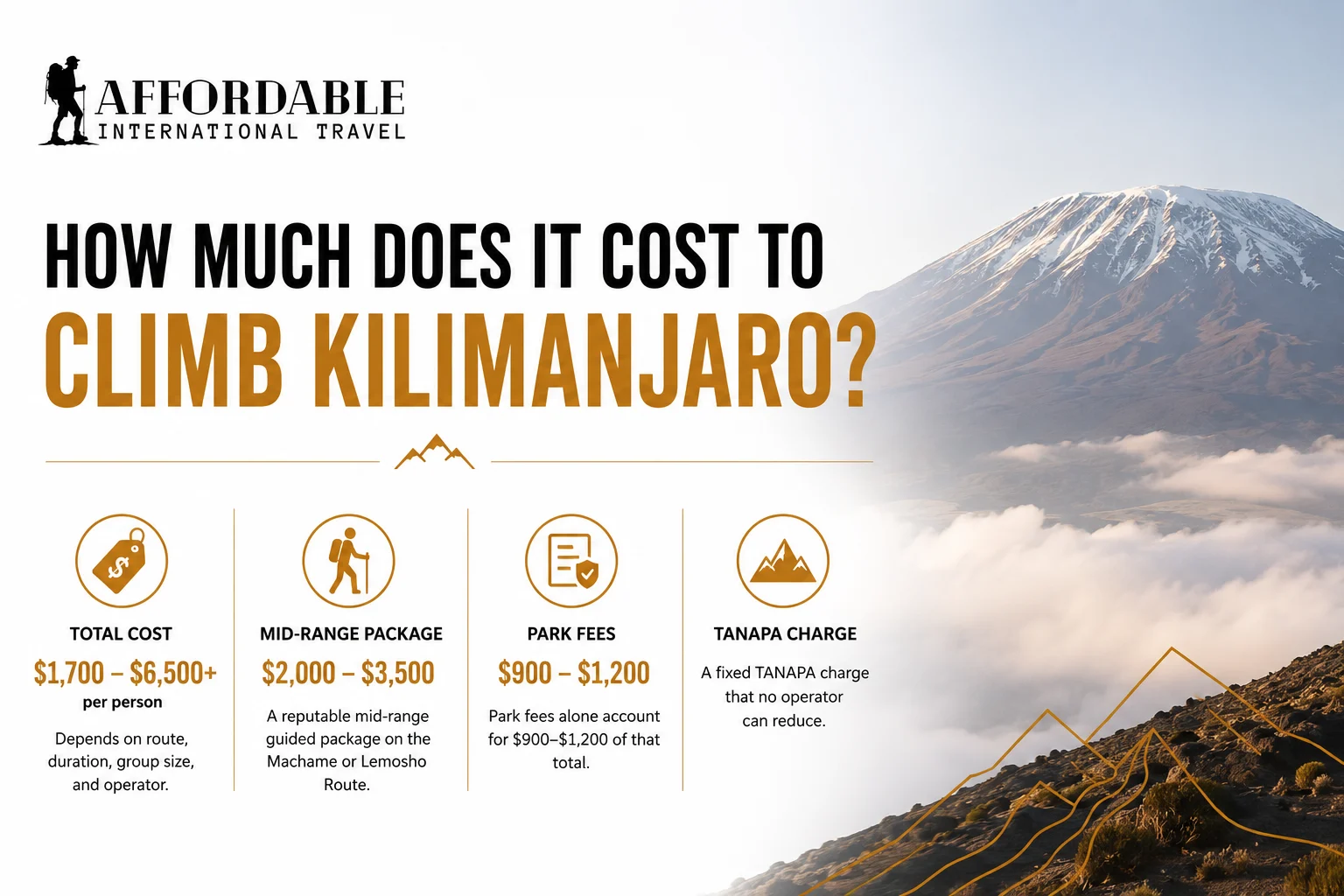
Quick Answer: The cost to climb Kilimanjaro ranges from $1,700 to $6,500+ per person, depending on route, duration, group size, and operator. A reputable mid-range guided package on the Machame or Lemosho Route typically costs $2,000–$3,500. Park fees alone account for $900–$1,200 of that total — a fixed TANAPA charge that no operator can reduce.
You’ve done the research. You know you want to climb Kilimanjaro. Now you’re trying to figure out whether the prices you’re seeing online are real, inflated, or suspiciously low.
In 11 years guiding climbers to Uhuru Peak, the question I answer more than any other is: “Why do prices vary so much for what looks like the same climb?”
This guide answers that question honestly — and breaks down every cost involved, from the Tanzania National Parks Authority (TANAPA) park fees that are fixed by law, to the crew wages and camp logistics that operators handle very differently.
I’ll also translate the numbers into GBP and South African rands, so climbers from the UK and Southern Africa can plan their budgets clearly.
By the end, you’ll know exactly what a Kilimanjaro climb should cost, what to cut without sacrificing safety, and what the cheapest quote on Google is actually leaving out.
What Does It Actually Cost to Climb Kilimanjaro Per Person?
The short answer: a complete, guided Kilimanjaro package from a reputable, licensed Tanzanian operator costs between $2,000 and $3,500 per person for most popular routes. That covers park fees, certified guides, porters, meals on the mountain, camping equipment, and all TANAPA charges.
Here’s how the market breaks down by operator tier:
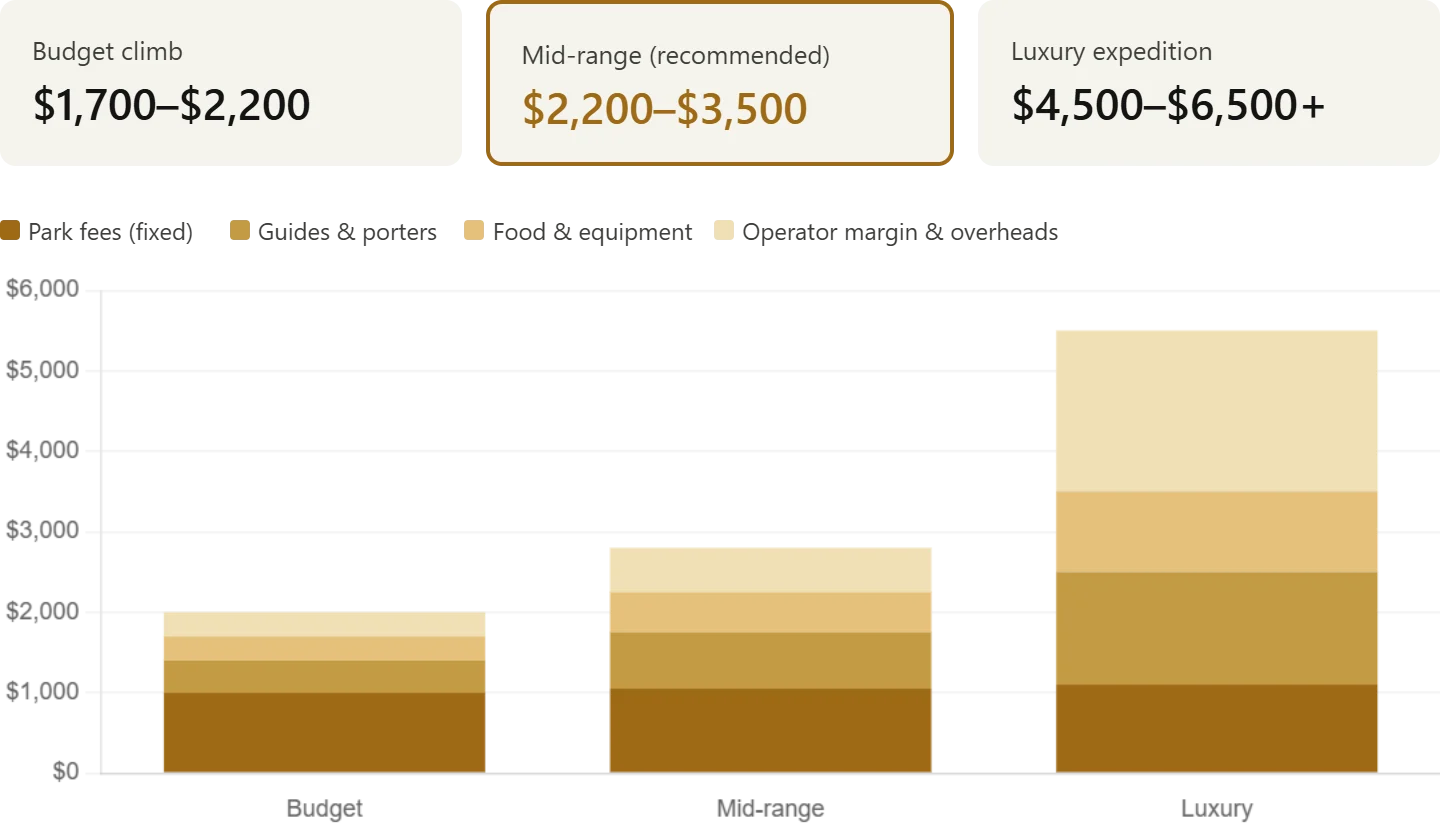
Budget packages exist — and some are offered by legitimate local operators making smart cost decisions. At this price, you’re typically in a group of 6–10 climbers, with shared camping equipment and basic but sufficient trail food. The risk at this tier isn’t the price itself. It’s whether the operator is cutting costs in areas that matter: guide experience, porter welfare, and safety equipment.
At Affordable International Travel, our Kilimanjaro climb packages start from $2,000 per person — which sits at the upper end of the budget tier and the entry point of mid-range. That’s a deliberate decision I’ll explain later in this guide.
Mid-Range Climbs ($2,200–$3,500)
This is where most serious climbers should be looking. A mid-range package on a reputable operator includes a TWMA-certified lead guide, a proper guide-to-porter ratio (roughly 1 guide and 3 porters per climber), nutritious hot meals three times a day, quality tents, and a pulse oximeter check every morning and evening. These are not luxury perks — they are the baseline for a safe, successful summit attempt.
Table comparing Kilimanjaro routes by duration, typical cost at AIT, difficulty, and summit success rate
| Route | Duration | AIT price from | Difficulty | Best for |
|---|---|---|---|---|
| Machame | 6–7 days | $2,000 | Moderate | First-timers, scenery |
| Rongai | 5–6 days | $2,000 | Moderate | Quieter experience, north side |
| Lemosho | 7–8 days | Contact us | Moderate | Best acclimatisation, remote start |
| Marangu | 5–6 days | Market rate | Easier | Hut accommodation |
AIT prices are per person. Route durations affect total park fees, which are charged per day by TANAPA.
Luxury Kilimanjaro Expeditions ($4,500–$6,500+)
Luxury operators offer private treks, premium camping furniture, electricity at camp, private chefs, and a very high guide-to-climber ratio. These are excellent products — but for most climbers, the mid-range tier delivers the summit result without the markup. After 108 summits, I can tell you: the mountain doesn’t care if your sleeping pad cost $50 or $500.
What Makes Up the Cost? The Kilimanjaro Price Breakdown
Understanding the cost breakdown is the single best thing you can do before getting a quote. It lets you compare operators fairly — and spot where corners are being cut.
TANAPA Park Fees and Permits
Table of TANAPA park fee components for a Kilimanjaro climb, showing conservation fee, camping fee, rescue fee, and VAT
Conservation fee
~$70/day
per person, per day
Camping fee
~$50/night
per person, per night
Rescue fee
~$20
one-time, per person
VAT
18%
on most TANAPA charges
Source: TANAPA 2023/2024 tariff schedule. Fees subject to annual revision. Paid electronically at park gate through TANAPA’s GEPG system.
This is the part most travellers don’t realise: nearly 40–50% of what you pay for a Kilimanjaro climb goes straight to the Tanzanian government as park fees. The daily conservation fee, overnight camping charges, and a one-time rescue fee add up fast. According to TANAPA’s current tariff schedule, park fees account for roughly 50–60% of your total climb cost. For a 7-day Machame Route climb, a 6-day climb typically incurs around $720 in daily park charges before fixed fees and VAT, totalling around $950–$1,100 per person.
That number cannot be negotiated down. Any operator quoting you a full package for $800 is either not paying their park fees correctly — a serious problem — or asking you to pay them separately on arrival.
Guides, Porters, and Crew Wages
This is where the real difference between a $1,800 package and a $2,800 package actually lives.
A Kilimanjaro climb requires a significant support team. For two climbers on a 7-day route, you need a lead guide, an assistant guide, a cook, and around six to seven porters. Lead guides earn $80–$150 per day depending on experience and operator quality. Assistant guides earn $50–$80 per day, while cooks receive similar compensation. Porters earn $30–$50 per day from reputable operators who follow ethical labour guidelines.
As a TWMA Certified Mountain Guide and a Tanzanian myself, I’m direct about this: if an operator is paying their porters less than the minimum set by the Kilimanjaro Porters Assistance Project (KPAP), they are underpaying Tanzanian workers to subsidise your low package price. That is not a deal — it is a transfer of cost onto the people doing the hardest work on the mountain.
AIT pays all crew at or above KPAP standards. It is non-negotiable for us as a TATO (Tanzania Association of Tour Operators) member company.
Food, Equipment, and Camp Logistics
A properly run Kilimanjaro camp on a 7-day route includes three hot meals a day, afternoon tea, and supplementary snacks — roughly 21 full meals per climber. Quality ingredients, a skilled cook, fuel, and the equipment to prepare food at altitude cost money. The difference between a $3-per-person camp meal and a $10 one shows at 4,600 metres when your body is fighting altitude and needs real energy.
Equipment — tents, sleeping mats, foam pads, dining tents — also reflects operator investment. Budget operators use aging gear. We replace ours on a regular rotation.
How Much Does It Cost to Climb Kilimanjaro by Route?
Machame Route Cost
The Machame Route is the most popular route on the mountain and AIT’s most booked Kilimanjaro package. At 6–7 days and roughly 62 km of trail, it offers the best balance of acclimatisation, scenery, and cost. Our Kilimanjaro Machame Route packages start from $2,000 per person, which includes all park fees, certified guides, porters, meals, and camping.
After 108 summits, I consistently see higher success rates on 7-day Machame compared to 6-day — the extra acclimatisation day at Karanga Camp makes a measurable difference.
Rongai Route Cost
The Rongai Route approaches from the north, making it drier, quieter, and a very different experience from the southern routes. It suits climbers who want fewer crowds and a gentler gradient on the ascent. Our Kilimanjaro Rongai Route packages also start from $2,000 per person at 5–6 days. Budget climbs via the Marangu or Machame routes start around $1,700–$2,300 across the market, while mid-range guided treks average $2,500–$4,000.
Lemosho Route Cost
The Lemosho is the route I personally recommend for first-time climbers who are serious about summiting. It’s 7–8 days, begins in a remote section of the western rainforest, and provides the most gradual altitude gain of any route. That’s why it has the highest summit success rates across the industry. It costs more — expect $2,400–$3,500 from a reputable operator — because the longer duration means more park fees and more crew days. Contact us directly for AIT Lemosho pricing.
Marangu Route Cost
The Marangu Route is the only route with permanent hut accommodation rather than tents. At 5–6 days, it’s the shortest option, which keeps park fees lower. Market prices run $1,700–$2,800. Note that the Marangu is also the route with the lowest average summit success rate — not because it’s harder, but because 5 days is genuinely tight for acclimatisation.
How Much Does It Cost to Climb Kilimanjaro from the UK (in Pounds)?
Cost to climb Kilimanjaro in pounds is one of the most searched questions from UK travellers, so I’ll answer it directly.
At current exchange rates (approximately £1 = $1.27 USD), here’s what the core package costs translate to in GBP:
- Budget climb (5–6 days): $1,700–$2,200 ≈ £1,340–£1,735
- Mid-range climb (6–7 days): $2,200–$3,500 ≈ £1,735–£2,756
- Luxury expedition: $4,500–$6,500 ≈ £3,543–£5,118
When budgeting for the full Kilimanjaro trip experience including flights, you should generally be prepared to spend around $5,000 (approximately £3,500). That broader figure accounts for your flight from the UK to Kilimanjaro International Airport (JRO), which typically costs £500–£1,000 return depending on season and departure city, plus gear, travel insurance, and tips.
The exchange rate shifts daily. All operators quote in USD because that is the standard currency for Tanzanian tourism — but your bank or travel card handles the conversion at current rates when you pay.
If you’re planning a Kilimanjaro trip from the UK and want a full cost itemisation in pounds, WhatsApp our team directly — Tumaini can send you a detailed breakdown within 24 hours: +255 740 453 344.
How Much Does It Cost to Climb Kilimanjaro in South African Rands?
For South African climbers, Kilimanjaro is one of Africa’s most accessible adventure bucket-list goals — just a short hop to Kilimanjaro International Airport.
At approximate current rates (roughly R18–R19 to $1 USD), the core climb packages translate as:
- Budget climb: $1,700–$2,200 ≈ R30,600–R41,800
- Mid-range climb (recommended): $2,200–$3,500 ≈ R41,800–R66,500
- Luxury expedition: $4,500+ ≈ R85,500+
Flights from Johannesburg or Cape Town to Kilimanjaro International Airport (JRO) typically cost R6,000–R16,000 return on carriers including Kenya Airways, Ethiopian Airlines, and Precision Air. Combined with a mid-range package and reasonable extras, South African climbers should budget R55,000–R90,000 total for the full trip.
Again: all operators quote and charge in USD. The ZAR conversion is a planning tool. Always use a live exchange rate calculator before finalising your budget.
What Additional Costs Should I Budget for?
A Kilimanjaro package quote covers the mountain. Here are the costs that sit outside of it:
International Flights
From the UK, return flights to Kilimanjaro Airport (JRO) or Nairobi (NBO, with a short connection) range from £500 to £900 in economy. Book via London Heathrow or Manchester for the best options. From South Africa, Johannesburg to Kilimanjaro is approximately R7,000–R14,000 return.
Tips for Guides and Porters
Tipping on Kilimanjaro is not optional — it is the industry standard and a critical part of crew compensation. Tips typically run $150–$350 per climber depending on route length and service quality. Bring this in USD cash. We provide suggested tip breakdowns with every booking. Tanzaniatripservice
Gear and Personal Equipment
You do not need to buy an entire kit. A good operator (including AIT) can advise on what to rent in Moshi and what to bring from home. Key items — trekking poles, gaiters, hiking boots — are worth bringing if you own them. Rental gear in Moshi for the full kit runs roughly $80–$200. If you’re buying boots and a sleeping bag specifically for this trip, budget $200–$500 for quality kit.
Travel Insurance
Every reputable operator requires travel insurance that covers high-altitude trekking and helicopter evacuation. This is non-negotiable — a Kilimanjaro evacuation without insurance can cost $15,000 or more. A quality policy covering Tanzania and altitude trekking typically costs $80–$300 depending on your home country and coverage level.
Tanzania Visa and Airport Transfers
Tanzania offers a visa on arrival for most nationalities — currently $50 USD. A transfer from Kilimanjaro Airport to Moshi (the base for most Kilimanjaro climbs) costs $25–$50 and can be arranged through your operator.
If you want to combine your climb with a Tanzania safari, our Tanzania safari packages or day trips from Moshi can be added to your itinerary — the Serengeti and Ngorongoro Crater are 4–5 hours from Moshi and pair naturally with a Kilimanjaro trip.
Why Cheap Kilimanjaro Climbs Cost You More in the End
Here is the practical reality. After 11 years on this mountain, I have seen the pattern repeat itself many times.
A climber books a $1,200 package from an operator they found through a price comparison site. The package is technically legal — park fees are paid, a guide is present. But the guide has limited altitude medicine training. The porters are underpaid and carrying overloaded packs. There’s no pulse oximeter at camp. The food is poor quality, and the group moves too fast because there are too many clients per guide.
The climber turns back at Stella Point — 200 vertical metres short of Uhuru Peak — because altitude sickness they might have managed with better acclimatisation and support forces them down.
They’ve now spent $1,200 on a trip that didn’t summit, potentially bought a second trip, and experienced a genuinely harder and less safe time on the mountain.
Budget operators might offer trips for under $2,000, but many cut corners by underpaying porters, providing inadequate food, or skipping essential safety measures. This isn’t a blanket rule against lower prices — it’s a warning to read exactly what is included, and to ask specifically about guide certification, porter wages, and medical equipment.
AIT’s 94% Kilimanjaro summit success rate isn’t an accident. It’s the result of TWMA-certified guides, proper acclimatisation schedules, daily health monitoring, and 11 years of knowing this mountain route by route.
How AIT Prices Its Kilimanjaro Climbs
We are based in Moshi — at the base of Kilimanjaro — in the NSSF Commercial Complex, Kilimanjaro Region, Tanzania 25000. Being a local, 100% Tanzanian-owned operator means we don’t mark up through a Western booking agent or reseller. What you pay goes directly to the team, the equipment, and the park.
As a member of TATO (Tanzania Association of Tour Operators) and certified by the TWMA (Tanzania Wildlife Management Authority), AIT operates under Tanzania’s official tourism licensing framework. Our guides — including myself — are certified and locally trained.
Our Kilimanjaro packages start from $2,000 per person and include:
- All TANAPA park fees and permits
- TWMA-certified lead guide and assistant guide
- Trained cook and porters paid at ethical rates
- All meals on the mountain (breakfast, lunch, dinner, tea)
- Camping equipment (tents, sleeping mats, dining tent)
- Pulse oximeter monitoring at every camp
- Pre-climb briefing and gear check in Moshi
- Post-climb certificate ceremony
What’s not included (industry standard): international flights, personal travel insurance, tips, personal gear, and Tanzania visa.
You can also meet the AIT guides and team before booking — we believe transparency about who is leading your climb matters.
How much does it cost to climb Kilimanjaro in USD per person?
A complete, guided Kilimanjaro package from a reputable operator costs between $2,000 and $3,500 per person for most popular routes (Machame, Rongai, or Lemosho). Park fees alone account for $900–$1,200 of that, set by TANAPA and non-negotiable. Budget packages start around $1,700 but involve trade-offs in guide quality, porter welfare, and safety support. Very cheap packages below $1,500 should be treated with significant caution.
What is the average cost to climb Kilimanjaro?
The cost to climb Mount Kilimanjaro typically ranges from $1,950 to $6,000+ per person, depending on the type of package you choose. The realistic average for a safety-appropriate mid-range guided climb sits around $2,500–$3,000. That figure reflects the mandatory park fees, professional crew, and operational infrastructure required for a responsible ascent.
How much does it cost to climb Kilimanjaro in pounds (from the UK)?
At current exchange rates (~£1 = $1.27), a mid-range Kilimanjaro climb package costs approximately £1,700–£2,750 for the trek itself. Add return flights from the UK (£500–£900), travel insurance (£100–£250), tips (£120–£275), and gear, and your all-in budget from the UK is typically £2,800–£4,500.
How much does it cost to climb Kilimanjaro in South African rands?
At current exchange rates (~R18–R19 per $1 USD), a mid-range guided Kilimanjaro package costs approximately R41,000–R66,500 for the climb itself. Including return flights from Johannesburg or Cape Town (R7,000–R14,000), tips, insurance, and incidentals, South African climbers should budget R55,000–R90,000 in total.
What is included in a Kilimanjaro package?
A complete package from a reputable operator includes all TANAPA park fees and permits, a certified lead guide and assistant guide, porters, a camp cook, all meals on the mountain (typically 3 meals per day plus tea), tents and camping equipment, safety monitoring (pulse oximeter checks), and airport and hotel transfers within Tanzania. International flights, travel insurance, personal gear, and gratuities for the crew are almost always excluded and must be budgeted separately.
Why is climbing Kilimanjaro so expensive?
The single biggest cost driver is the mandatory TANAPA park fee structure. A non-resident climber pays approximately $70 per day in conservation fees plus $50 per night in camping fees — totalling $950–$1,300 in government charges for a standard 6–8 day climb before VAT. Add crew wages for the 8–12 people required to support a safe ascent, food, equipment, and logistics, and the price is not arbitrary. It reflects the real infrastructure of a high-altitude expedition in a regulated national park.
Is it cheaper to book a Kilimanjaro climb in Tanzania directly?
Yes, in most cases. Booking directly with a licensed Tanzanian operator like AIT removes the Western agency markup, which can add 15–30% to your package price. Being in Moshi means our overhead is lower, our relationships with national park authorities are direct, and our crew is locally employed and managed. You can reach us by WhatsApp at +255 740 453 344 for a direct quote without intermediary fees.
Do I need travel insurance to climb Kilimanjaro?
Yes — and not just any travel insurance. Your policy must specifically cover high-altitude trekking above 5,000 metres and emergency helicopter evacuation. Without this, a rescue from the mountain can cost $15,000+ out of pocket. Most reputable operators, including AIT, will ask to see proof of adequate insurance before your climb begins.
Conlcusion
The cost to climb Kilimanjaro is significant — there is no way around that. The mandatory park fees set by TANAPA, the crew required for a safe ascent, and the logistics of feeding and equipping a team on Africa’s highest peak make this a real investment.
What that investment gets you, at the right price point, is one of the most extraordinary experiences of your life. Uhuru Peak at 5,895 metres. Sunrise over the clouds. Standing on the roof of Africa.
The key takeaways to carry into your research:
- Park fees are fixed at $900–$1,200+ and cannot be reduced by any operator
- Mid-range packages ($2,000–$3,500) offer the right balance of safety, success rate, and value
- Cheap packages are cheap because of cuts to crew pay, food, and equipment — not efficiency
- Book directly with a licensed Tanzanian operator to avoid agency markups
- Budget for tips, insurance, gear, and flights on top of your package quote
If you want a transparent, itemised quote from our team in Moshi — in USD, GBP, or ZAR — talk to Tumaini directly on WhatsApp: +255 740 453 344, or visit our Kilimanjaro climbing page to review our current routes and packages.
We’ve guided over 600 travellers from 38 countries and completed 340+ safaris and climbs from our base here in Moshi. We’ll give you a real price — not a marketing number.