A first-time Tanzania safari is most rewarding as a 4- to 6-day Northern Circuit trip covering Tarangire, Ngorongoro Crater and the Serengeti. Budget travellers should plan USD 1,800–2,800 per person for the safari itself on a shared group itinerary, plus around USD 250–350 for a visa, vaccines and trip insurance. The best months are June to October and January to February.
Most first-time Tanzania safari travellers arrive with two competing fears: the trip will cost more than they expected, and they will somehow do it wrong. After fourteen years guiding clients across Tarangire, Ngorongoro, Lake Manyara, Arusha National Park and the Serengeti, I can tell you that almost no one ruins their first safari. What people regret is more specific. They book too short a trip. They visit in the wrong month for what they wanted to see. They choose an operator on price alone and find out at the gate that park fees were not included. Every one of those mistakes is avoidable with a single afternoon of reading.
This first time Tanzania safari guide walks you through every decision you actually need to make — trip length, parks, season, real costs, what to pack, the entry paperwork, and how to spot an operator worth booking with. I have written it the way I brief our own clients before they fly: practically, with real numbers, and without the marketing gloss that fills most safari blogs. By the end you will know what to ask, what to budget, and what a good first safari looks like.
How long should your first Tanzania safari be?
A first Tanzania safari needs at least four days on the ground to be worth the long flight, and most first-timers do best on a five- to six-day Northern Circuit trip. Two days will get you to one or two parks, but you spend most of that time driving rather than watching wildlife. Seven days is the upper limit before the same landscape starts to feel repetitive — beyond that, you want to add Zanzibar or a Kilimanjaro climb, not more game drives.
Here is how the trip-length decision actually plays out in our quotes. Three days is enough for Tarangire plus the Ngorongoro Crater — a strong starter trip that misses the Serengeti. Four days adds Lake Manyara or stretches into the southern Serengeti.
Five days reaches the central Serengeti, which is where most of the iconic wildlife footage you have seen on television was filmed. Six and seven days let you spend two nights in the Serengeti, which is the single biggest upgrade you can make to a first safari — one night is never enough in a park that takes six hours to cross.
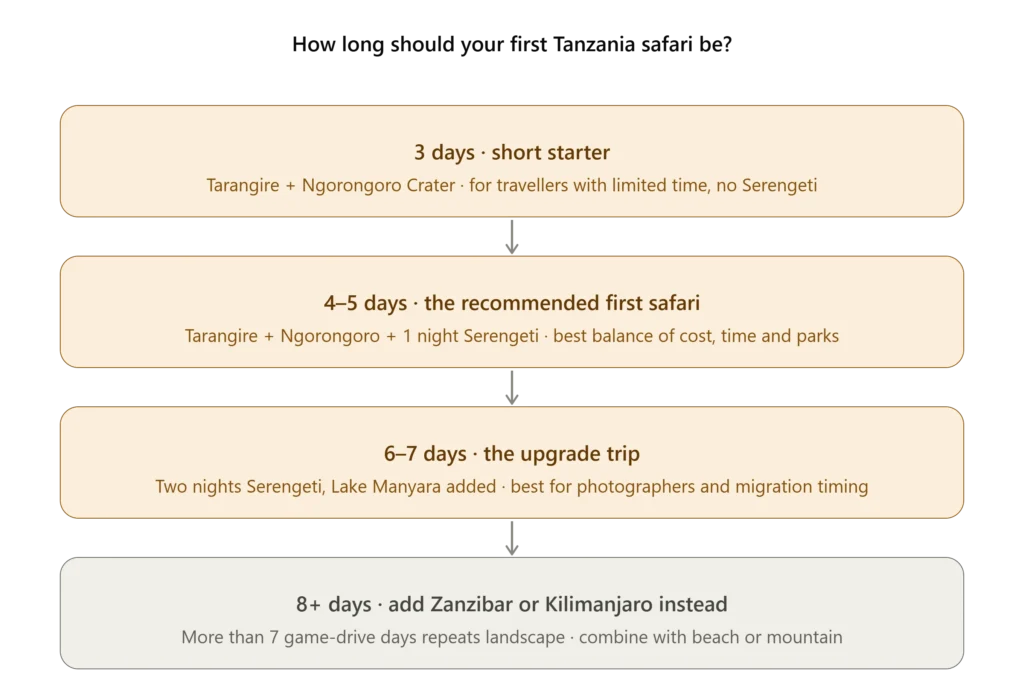
The mistake I see most often is the three-day booking — usually from someone who only has a week of leave and lost two days to flights. If that is you, a three-day safari is still better than no safari, but understand that you will be choosing between Serengeti and Ngorongoro, not visiting both.
For travellers who can stretch to five or six days, Affordable International Travel’s most-booked first-timer itineraries are 4 Days Tarangire, Ngorongoro Crater and Serengeti at USD 1,800 per person and 5 Days Tarangire, Ngorongoro Crater and Serengeti at USD 2,000 per person on a shared group basis.
Which Tanzania safari parks should a first-timer visit?
A first Tanzania safari should include Ngorongoro Crater and the Serengeti at minimum, with Tarangire added when budget and time allow. These three parks together deliver every animal a first-timer hopes to see, in three completely different landscapes that keep the trip from feeling repetitive.
Ngorongoro Crater is the most reliable Big Five sighting on the continent. Inside the 260-square-kilometre caldera you have a fenced-in concentration of lions, elephants, buffalo, hippos, and the densest population of black rhinos in northern Tanzania. The crater rim climbs to 2,300 metres and the floor sits 600 metres below, which is why morning game drives down into the crater feel like descending into another country.
The Ngorongoro Conservation Area is managed separately from the national parks system by the Ngorongoro Conservation Area Authority, which is why fees and rules differ slightly from TANAPA parks. You can read more on our Ngorongoro Crater safari page.
The Serengeti is the headline act. At 14,750 square kilometres it is bigger than half a dozen European countries, and the Great Migration of nearly two million wildebeest and zebra moves across it in a yearly clockwise loop. From December to March the migration calves in the southern Serengeti’s short-grass plains.
From June to August the herds cross the Grumeti River in the western corridor and start north towards the Mara River. Even outside migration months the central Serengeti, the Seronera Valley, holds enormous resident populations of lion, leopard, cheetah and every plains animal you can name. You can browse our Serengeti National Park safari options for current departure dates.
Tarangire is the most underrated park on the circuit. From July to October its 2,850 square kilometres support some of the largest elephant herds in East Africa — fifty- and sixty-strong groups are normal — alongside Tarangire’s signature baobab forests. I bring almost every first-time client through Tarangire as the warm-up park on day one because the wildlife is dense enough to deliver an instant safari experience after a long flight.
Lake Manyara is the optional fourth park. At only 330 square kilometres it is small enough to game-drive in half a day, and its specialities are tree-climbing lions, large flamingo flocks in the wet season, and one of Tanzania’s largest baboon troops. You can fit Manyara into a four- or five-day trip without lengthening the drive between Ngorongoro and the Serengeti. The full set of options is laid out on our Tanzania safari destinations page.
What does a first-time Tanzania safari really cost in ?
A first-time Tanzania safari on a budget shared group itinerary costs roughly USD 1,800–2,800 per person for four to six days. Mid-range with private vehicle and lodges runs USD 2,800–4,500 per person. Luxury starts around USD 6,000. These figures are land-only — international flights, visa, vaccinations and travel insurance sit on top.
This is the section I most often defer to my colleague Rehema Amani Ngalawa, our Safari Operations Manager. She has processed more than 500 safari and Kilimanjaro bookings, negotiates our lodge contracts, and pays the park fees on her phone every morning.
As she puts it, the number one mistake she sees in first-time enquiries is people comparing operator quotes line by line without understanding that the park fees are roughly the same for everyone — what differs is the vehicle, the guide, the camp tier and the operator margin.
Park fees alone are a substantial fraction of the trip. The Tanzania National Parks Authority (TANAPA) currently charges around USD 70 per adult per 24-hour conservation fee for the Serengeti and around USD 50–60 for Tarangire and Lake Manyara, with 18% VAT typically applied.
Ngorongoro Conservation Area Authority fees for the crater run higher — around USD 70 per person plus a separate crater service fee, payable through the Government Electronic Payment Gateway. You can verify the latest published TANAPA tariffs on the official Tanzania National Parks site at tanzaniaparks.go.tz. Treat the figures in this article as ranges; Rehema confirms the exact applicable fees on every quote we send.
The chart shows why a USD 700 two-day safari is honest pricing and a USD 999 five-day Serengeti safari is not. Park fees alone for a five-day Northern Circuit trip touching Tarangire, Ngorongoro and the Serengeti are roughly USD 500–600 per person before anyone is paid for the truck, the fuel, the guide, the cook or the tent.
Operators who advertise pricing below the actual park-fee floor are almost always cutting a corner somewhere — uncertified guides, midnight border-crossing vehicles, lodges so far from the parks that you spend a third of the trip driving.
What sits on top of the safari itself is reasonably predictable. Tanzania’s tourist visa is USD 50 for most nationalities and USD 100 for United States passport holders, payable to Tanzania Immigration through the official portal.
International round-trip flights from Europe to Kilimanjaro International Airport (JRO) run USD 800–1,400 in most seasons; flights from North America USD 1,400–2,200. Travel insurance with medical evacuation cover is non-negotiable and runs USD 100–200 for a two-week trip. Tipping is expected — plan USD 20–30 per day for the driver-guide and around USD 10–15 per day combined for camp staff.
When is the best time for a first-time Tanzania safari?
The best time for a first-time Tanzania safari is June through October, when daytime weather is dry, the bush is thinner, and animals concentrate around the few permanent water sources. January and February are the second-best window — the southern Serengeti is full of newborn wildebeest calves and the predators that follow them, and visitor numbers are lower than in the peak July–September weeks.
The country has two rainy seasons. The long rains run from late March through May and the short rains from November to early December. I generally tell first-time clients to avoid mid-March to mid-May. Some roads inside the parks become impassable, several lodges close for refurbishment, and the migration is hard to track in tall green grass.
The short rains in November are far gentler — usually short afternoon showers followed by clear skies — and the lower visitor count and shoulder-season pricing make November a strong value-driven choice. Rehema can usually find 15–25% lower lodge rates in November compared to peak July.
The Great Migration is a moving target. December through March the herds calve and graze in the southern Serengeti and Ndutu plains, which is the best window for predator action because newborn calves draw lions and cheetahs in. April and May the herds drift northwest. June and July they cross the Grumeti River. August and September they pile up on the Mara River for the famous crocodile crossings.
October they push back south. If a migration river crossing is the single thing you came for, you need to book a July–September trip and be in the right part of the Serengeti — that requires planning a year ahead and a Serengeti-focused itinerary. For everyone else, the migration is a bonus, not the trip’s purpose.
For Big Five and general wildlife viewing, every month except mid-March to mid-May works. Tarangire is at its absolute best in dry season (July–October) when the elephant herds gather along the Tarangire River. Ngorongoro Crater is consistently excellent all year — the crater is its own micro-ecosystem and weather inside it changes slowly.
What does a typical day on safari actually look like?
A safari day begins at first light. The driver-guide knocks on your room or tent at 0530, hot drinks are ready by 0600, and the vehicle is rolling out of the gate by 0630 — predators hunt early and we want to be in the park before they move into shade. Game drives in the morning are the most productive of the day. I have had lions on a kill before sunrise in Tarangire more times than I can count, and that almost never happens at 11:00.
The morning drive runs three to four hours. We stop where the wildlife is. I read tracks at every dry crossing, listen for alarm calls from impala and baboons, and follow the safari channel that drivers use to share leopard and cheetah sightings. Around 09:30 we break for breakfast — either back at camp if the park gate is close, or a packed breakfast at a designated picnic site if we are deep in the Serengeti. There is no schedule in the bush. If we are with a leopard in a sausage tree, breakfast waits.
Midday is the quiet part of the safari and the part most first-timers misunderstand. Between 12:00 and 15:30 the heat is high, the wildlife is in deep shade, and game viewing drops off sharply. This is when you eat lunch, nap, swim if your lodge has a pool, write postcards or back up your camera cards. The schedule is not a vacation flaw — it tracks how the wildlife behaves. Forcing a drive through midday returns thin sightings and exhausts the guide for the afternoon when it matters again.
The afternoon drive begins around 15:30 and runs until 18:00 or 18:30, when the parks close. This is the second productive window — animals return to water, predators wake up, and the light goes golden in a way that ruins every other landscape you have ever photographed. We are back at camp by dark. Dinner is around 19:30, sometimes around a fire if we are tented. Generators usually shut down by 22:00 and the camp goes quiet under a sky with no light pollution at all.
What you need to pack and prepare for your first safari
Pack light, pack neutral, and pack for cold mornings. The pop-top game drive vehicle is open to the wind at 0630 and the Ngorongoro Crater rim sits high enough to be properly cold before sunrise. Even in July you will want a fleece and a light puffy jacket for the first hour of each day. By 10:00 you will be in a short-sleeved shirt.
Colours matter more than first-timers realise. Stick to neutrals — khaki, olive, sand, soft brown. Avoid bright white (shows dust), bright red and blue (visible to insects), and any pattern with hard black and white stripes (tsetse flies are attracted to dark contrast).
Pack a brimmed hat, a buff or scarf for the dust on Serengeti tracks, polarised sunglasses, sturdy closed shoes for camp walks, and a swimsuit if your lodges have pools. Laundry is available almost everywhere, so six days of clothes is plenty for a ten-day trip.
For documents you need a passport valid at least six months past your return date with two blank pages, your visa or visa grant notice (printed and digital), proof of onward travel, your yellow fever certificate if you are transiting through a yellow-fever country, and a printed copy of your travel insurance with the emergency assistance number.
For the camera kit, bring a zoom lens with at least 300mm reach if you have one — wildlife photographs at 200mm look like distant brown dots. A beanbag for stabilising on the vehicle door beats a tripod for game drives.
Soft luggage is required if any part of your trip uses small bush flights, which is common for fly-in Serengeti packages. Hard suitcases will be refused — duffel bags or soft holdalls only, usually under 15kg per person. Confirm with your operator whether your itinerary has a luggage cap.
Visa, vaccinations, and entry requirements for Tanzania
Every international visitor to Tanzania for tourism needs a visa, and most should apply online before flying. The ordinary single-entry tourist visa costs USD 50 and is valid for stays of up to 90 days. United States passport holders are required to apply for the multiple-entry visa at USD 100. You apply through the official Tanzania Immigration eVisa portal at visa.immigration.go.tz — submit the form, pay by card, and the grant notice arrives by email within around ten business days. Print the grant notice and bring it with your passport to immigration on arrival. Application processing can take longer in peak booking months, so apply at least three weeks before departure.
Some nationalities require what Tanzania Immigration calls a referral visa, which is pre-approved by the Commissioner General of Immigration and can take up to six weeks to process. The current referral list is published on the immigration portal. If you are not certain, check the official Tanzania Immigration site before booking your flight — the visa rule is the one variable that can derail an otherwise solid trip.
For vaccinations, yellow fever is the only legally enforced requirement and only if you are arriving from a country with risk of transmission, or you have transited for more than twelve hours through such a country. Tanzania itself is not a yellow-fever country, so a direct flight from Europe or North America does not require the certificate.
Most travel medicine clinics also recommend, but do not require, hepatitis A and B, typhoid, tetanus, and an up-to-date measles booster. Anti-malarial prophylaxis is strongly recommended for any safari area; consult your GP or a travel clinic six to eight weeks before departure. The CDC’s destination page for Tanzania at wwwnc.cdc.gov/travel is the cleanest single source for current health advice.
Travel insurance with medical evacuation cover is not legally required but no responsible operator will let you board a vehicle without it. Wildlife emergencies are rare; vehicle accidents on the long park drives, altitude problems on add-on Kilimanjaro climbs, and stomach issues from contaminated water are not. Make sure your policy covers safari activities, medical evacuation by air, and trip cancellation.
How to choose a Tanzania safari operator you can actually trust
Choose a Tanzania safari operator the way you would choose a surgeon — by credentials, track record and the conversation you have with them, not by the lowest price on the comparison site. The country has roughly 600 licensed tour operators and an unknown number of unlicensed bookers reselling other people’s trips.
Many of the cheapest quotes you will see online come from the latter category and the gap shows up at the park gate when fees turn out to be excluded, or on day three when the vehicle breaks down with no replacement plan.
First, check that the operator is a member of the Tanzania Association of Tour Operators (TATO). TATO membership requires proof of business registration, public liability insurance, and a tourism business licence from the Tanzania Tourist Board. Any reputable operator will show you the membership number on their website footer. Second, check that their guides are licensed by the Tanzania Wildlife Management Authority (TWMA) — every TWMA-certified guide carries an identification card and you should feel comfortable asking to see it.
Third, read recent reviews on TripAdvisor or Google rather than testimonials hosted on the operator’s own site. The honest signal is the volume of recent reviews — an operator with 200+ TripAdvisor reviews from the last two years and a 4.5+ rating is doing the job consistently. An operator with eight reviews from 2019 is probably reselling.
Fourth, judge them by their response to your enquiry. A good operator answers within a working day with a written itinerary, a clear breakdown of what is and is not included, the vehicle type, the guide name when possible, and the lodge or camp names with specific tier ratings — not “good quality budget camp”. Watch for what is missing: if the quote does not separately list park fees, government VAT, and concession fees, you cannot compare it to anyone else’s quote honestly.
Finally, ask one specific question: what happens if our vehicle breaks down? An operator who runs a fleet has a real answer — replacement vehicle dispatched within four to six hours from Arusha — and an operator who subcontracts does not. We at Affordable International Travel operate from NSSF Commercial Complex, Moshi, Kilimanjaro Region, Tanzania 25000, and you can meet our guides and ask any of these questions in person before you book if you have time on your first day. You can also start that conversation by WhatsApp at +255 740 453 344.
Eight mistakes first-time Tanzania safari travellers make
In fourteen years guiding clients on first safaris I have seen the same mistakes often enough to write them down. None of these will ruin your trip, but every one of them costs money or wildlife minutes that the next first-timer can keep.
First, booking too short a trip. Three days of game drives after a fifteen-hour flight is a punishment. Four days is the minimum that earns you the cost of getting here.
Second, choosing the wrong month for the experience they wanted. If you came for migration river crossings, you came in July to September or you did not come at all. Read the section on timing above before locking in dates.
Third, overpacking. Soft duffels under 15kg are usually a contractual requirement on fly-in trips, and even on the road circuit a smaller bag fits better in a Land Cruiser stocked with five other people’s bags.
Fourth, comparing operator quotes line-by-line without checking what is included. The cheapest quote is almost always the one that excludes park fees. Always ask whether all TANAPA and NCAA fees are inside the price.
Fifth, expecting the wildlife to perform on demand. Tarangire’s elephants are reliable, Ngorongoro’s rhinos are reliable, the Serengeti’s lions are reliable. A specific leopard in a specific tree is not. A guide who promises sightings is overpromising.
Sixth, refusing to sit still during midday. Pushing through the heat at 13:00 in Tarangire is how you end the day exhausted and undersighted. Trust the schedule.
Seventh, undertipping the driver-guide. The guide is the single biggest variable in how much of the wildlife you actually see. Tip USD 20–30 per day from the group; we share that with the cook and porters in our camping itineraries.
Eighth, skipping Ngorongoro to save the park fees. The crater is the single highest-density Big Five experience on the planet. If you have come this far, you have come for Ngorongoro. Cut a Serengeti night before you cut the crater day. Our team of guides at Affordable International Travel will tell you the same.
Is a Tanzania safari safe for first-time travellers?
Tanzania is one of the safer African safari destinations and the country has been welcoming first-time safari travellers for decades. Inside the parks you are with a TWMA-licensed guide and an enclosed vehicle the entire time; outside the parks, the safari corridors of Arusha and Moshi run on tourism and police presence around tourist routes is visible. Standard travel precautions apply — keep valuables in your camp safe, avoid walking alone after dark in town centres, and stick to bottled or filtered water. We have brought 600+ travellers from 38 countries through these parks without a wildlife incident.
How much should I tip on a Tanzania safari?
The standard guideline is USD 20–30 per day for your driver-guide from the group as a whole (not per person), plus around USD 10–15 per day for camp staff combined where applicable. On a five-day camping safari with a cook and a driver-guide, a couple should plan to leave around USD 200–250 in tips at the end of the trip. Tip in USD cash, ideally in clean unmarked notes. Tip envelopes are appreciated but not required.
Can you do a Tanzania safari in 3 days?
You can, and many first-timers do, but a three-day Tanzania safari has to choose between the Serengeti and the more accessible parks. The best three-day option from Arusha or Moshi is Tarangire plus the Ngorongoro Crater, which gives you elephants, Big Five and the dramatic crater landscape. Adding the Serengeti in three days is technically possible but produces a punishing schedule with limited game-drive time. If you can stretch to four or five days, do.
Should I book a private safari or join a group?
Group safaris are the most cost-effective way to see Tanzania for a first-timer. A shared 4×4 holds six passengers and the cost split brings the per-person price down by 30–40% compared to a private vehicle. The trade-off is you cannot stop on impulse — six people share the schedule. A private safari is worth the premium for families with young children, photographers who need long stops, or honeymooners. For most first-time travellers, the group option delivers the same wildlife at materially lower cost.
Do I need vaccinations to go on a Tanzania safari?
Tanzania does not require any vaccination for direct arrivals from non-yellow-fever countries. Yellow fever certification is only required if you have transited a yellow-fever country for more than twelve hours. Most travel medicine clinics recommend hepatitis A, typhoid, and an updated tetanus booster, plus malaria prophylaxis for safari areas. Talk to a travel doctor six to eight weeks before departure — that lead time matters for vaccines that need multiple doses.
What is the difference between a budget and luxury safari in Tanzania?
The wildlife is the same — every Tanzania safari uses the same parks, the same roads, and broadly the same guides. What differs is the comfort layer. A budget safari uses public campsites or basic lodges, shared 4×4 vehicles, and standard meals. A mid-range safari uses permanent tented camps or three-star lodges, private vehicles for couples, and proper restaurants. A luxury safari uses Serengeti tented camps with private decks, exclusive vehicles, and butler service. The animals do not care. Choose based on how much comfort matters to you after a day in the dust.
Can I combine a Tanzania safari with Kilimanjaro or Zanzibar?
Yes, and most clients staying longer than a week do exactly this. A common 10-day combination is a five-day safari followed by a five-day Zanzibar beach extension, with an internal flight between Arusha and Zanzibar. A 12- to 14-day combination adds a six- or seven-day Kilimanjaro climb to either end of the safari — most climbers do the mountain first while their legs are fresh. We coordinate every leg of these trips internally so the airport transfers, internal flights and luggage transitions stay on one operator’s accountability.
How far in advance should I book a Tanzania safari?
For peak season (July to September) book at least six to eight months ahead — the best lodges and Serengeti camps fill that early. For January–February migration calving season, book five to six months ahead. For shoulder months (May, November) and off-peak (April), two to three months is usually enough. Last-minute bookings inside a month are possible but you lose access to the better camps and the cheapest seat-in-vehicle group departures. If your dates are fixed, lock in early.
Conclusion
A first Tanzania safari is not a complicated trip to plan well. Choose four to six days minimum, build the itinerary around Ngorongoro Crater and the Serengeti with Tarangire as the warm-up park, travel in June–October or January–February, budget realistically against the park fees in the cost breakdown above, and book with a licensed operator who can answer the practical questions in writing. Get those five decisions right and the wildlife takes care of the rest.
The advice in this first-time Tanzania safari guide reflects fourteen years of leading travellers through these same parks. If you want to talk it through with someone who has driven the routes and knows which camp is good in November versus August, I am happy to do that directly.
You can reach me through Affordable International Travel at NSSF Commercial Complex, Moshi, Kilimanjaro Region, Tanzania 25000, or by WhatsApp on +255 740 453 344. Tell me your dates, your budget bracket and what wildlife you most want to see, and I will tell you honestly what is possible.