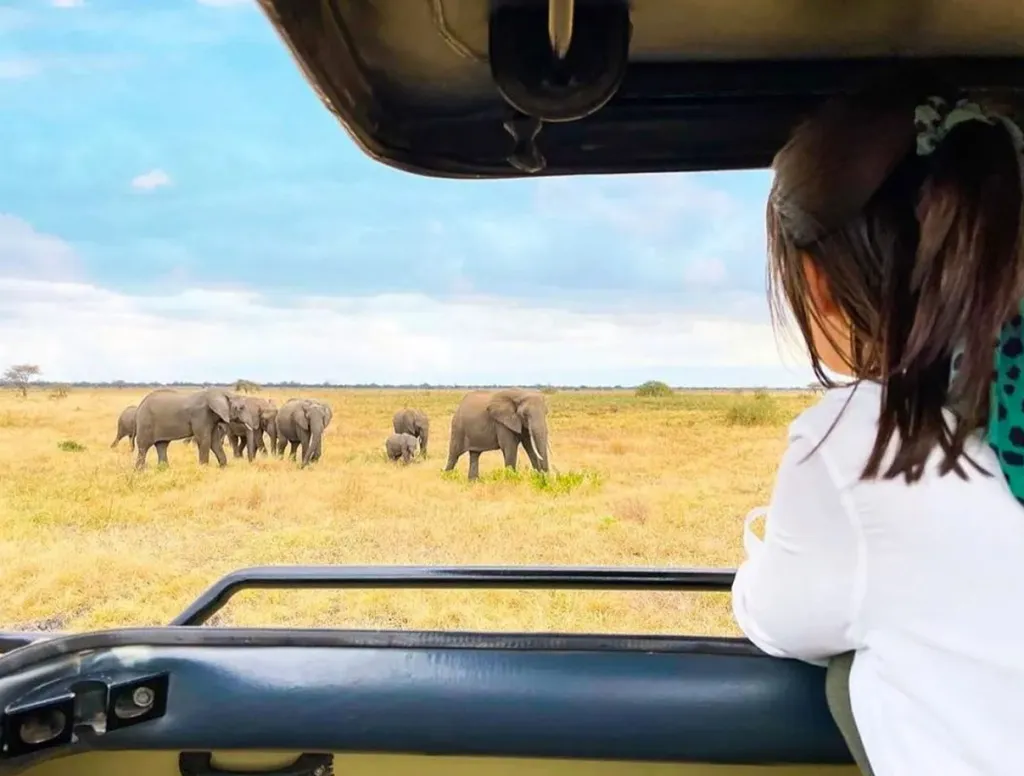
Tanzania is one of the safest, most rewarding safari destinations for solo travellers. Daily costs run roughly $180–$350 per person on a small-group safari and $350–$650 on private, with a lodge single supplement of $40–$120 per night at budget level. The Northern Circuit — Tarangire, Ngorongoro, and Serengeti — is the best first solo safari.
You want to do a Tanzania safari. You’re going alone. And before you book, you want straight answers: will it be awkward, will it be expensive, and will it be safe?
I’ve guided over 900 clients through Tanzania’s parks across 14 years — and roughly one in five booked alone. Some were on their first international trip. Others had done thirty countries before mine. Most landed at Kilimanjaro International Airport quietly nervous about being the only one without a partner on the safari vehicle.
Almost all of them flew home saying it was one of the best trips of their lives.
This guide is the honest version of what to expect on a Tanzania safari for solo travellers in 2026 — what it actually costs, how the single supplement works, whether you should join a group or go private, which parks suit a first solo trip, and the practical safety picture on the ground. Nothing dressed up. Nothing skipped over.
Is Tanzania a good choice for a solo safari?
Yes — and arguably the best on the African continent.
Tanzania makes solo safaris work for three reasons most travellers don’t realise until they get here.
First, the operator model is fully guided. You don’t drive yourself, you don’t navigate parks, you don’t pitch your own tent unless you choose to. You’re with a licensed guide and a driver-mechanic from hotel pickup to airport drop-off. That one fact removes around 80% of the friction other solo travel destinations carry.
Second, group safaris are common and well-organised. Small-group safaris of 4–6 travellers in a single 4×4 Land Cruiser are the standard budget product. You’ll meet other solos on almost every departure I’ve run.
Third, the safari industry is tightly regulated. Parks are managed by the Tanzania National Parks Authority (TANAPA). Operators are licensed by the Tanzania Tourist Board. Guides like myself are certified under the Tanzania Association of Tour Operators. As a TATO-member operator, every guide on our team has been vetted, background-checked, and continuously assessed.
The honest trade-offs
Solo safaris have three real downsides I tell every client about before they book:
- The single supplement on lodges is real and adds up
- Dinner on a private safari can feel solitary at lodges
- Last-minute solo bookings into peak-season departures are harder than couples bookings
None of these are dealbreakers, but they’re worth planning around — which is what the rest of this guide does.
How much does a solo Tanzania safari really cost?
A solo Tanzania safari in 2026 costs roughly $180–$350 per person per day on a small-group budget safari and $350–$650 per day on a fully private safari. The difference is the vehicle, the guide-to-client ratio, and the lodge tier.
The number most solo travellers feel ambushed by isn’t the daily rate — it’s the single supplement.
What is the single supplement, and why do solos pay it?
Lodges and tented camps in Tanzania price rooms per person, assuming two travellers share. When you book alone, you occupy a room that was meant to earn double revenue. The lodge charges what’s called a single supplement — typically:
- Budget lodges: $40–$120 per night
- Mid-range lodges: $150–$300 per night
- Premium tented camps: $250–$500+ per night
This is the lodge’s policy, not the operator’s markup. Every operator in Tanzania passes it through. Operators who hide it in the total price aren’t doing you a favour — they’re inflating the daily rate to bury it.
Pricing ranges to be confirmed against 2026 lodge contracts before publish — talk to Rehema in operations for current figures.
Three real ways to reduce or avoid the single supplement
In order of how often they work:
1. Join a small-group set-departure safari.
Most operators, ours included, run a willing-to-share policy: you pay the per-person rate, and we pair you with another solo of the same gender on the same departure. If no pair is available, you either pay a reduced supplement or get a private tent at the operator’s cost. This is the cheapest way for solos to access lodges. Confirm the pairing policy in writing before paying any deposit.
2. Choose camping over lodges.
Public campsites inside TANAPA parks charge per tent, not per person. A solo in their own dome tent pays roughly the same per night as a couple. Drop in accommodation cost: 40–60%.
3. Travel in low season.
April, May, and November are Tanzania’s green seasons. Many lodges waive the single supplement entirely to fill rooms. Wildlife viewing stays strong — the Great Migration is calving in southern Serengeti through March, and Tarangire is full of resident elephants year-round.
For a full breakdown of how the per-day numbers actually build up — park fees, vehicle costs, lodge tiers, tips — see the Tanzania safari cost guide Rehema maintains with current figures.
Group safari or private safari — what’s right for a solo?
In 14 years guiding, roughly 70% of the solo travellers I’ve taken out have been happier on a small-group safari. The other 30% should pay for private. Here’s how to tell which one you are.
Choose a small-group safari if:
- This is your first time in East Africa
- You enjoy meeting people from different countries
- Budget is a genuine constraint (under $2,500 for the safari portion)
- You want company at lodge dinners
- You’re flexible on departure dates
A typical group of 4–6 travellers fits comfortably in our 4×4 Land Cruisers with a guaranteed window seat each. You’ll spend 8–10 hours a day together — most groups exchange WhatsApp numbers by day three.
Choose a private safari if:
- You’re a serious photographer or birder and want full control of the pace
- You have specific dietary needs or accessibility requirements
- You’re marking something — a 50th birthday, a sabbatical, a post-divorce solo trip
- You sleep poorly and need control over wake-up times
- Budget allows ($4,500+ for 5–7 days)
On a private safari, the vehicle, the guide, and the itinerary are yours. You can sit at any sighting for as long as you want. You can ask to skip a park you’re not interested in. You can change tomorrow’s start time over dinner tonight.
The middle option most solos miss
If neither extreme fits, ask your operator about private vehicle with standard lodging. You get a private vehicle and guide every day, but stay in regular shared lodges (no exclusive camp). It costs 30–40% less than full private and is what I’d book myself if I were a solo on a $3,500 budget.
Is it safe to do a Tanzania safari alone?
Yes. Tanzania safaris are one of the safest forms of solo international travel I know of — safer than backpacking in many parts of Europe, Asia, or the Americas.
Three safety questions every solo asks me, with honest answers.
Is it safe from wildlife?
In 14 years guiding and over 900 clients, I have never had a client injured by wildlife. Not bitten, not chased, not nudged.
Park rules are strict. You stay in the vehicle at all times in national parks except at designated picnic sites monitored by rangers. Walking safaris exist in parts of Tarangire and the Serengeti but only with an armed TANAPA ranger.
Lodges and camps in unfenced wilderness areas — common in Serengeti — operate a 24-hour askari system. You don’t walk to your tent at night; a guard escorts you. Standard practice. No exceptions.
Is it safe in towns and cities?
Arusha, Moshi, Karatu, and Mwanza — the towns you’ll pass through — are normal African urban centres. Pickpocketing exists, mostly in markets and crowded bus stations. Violent crime against tourists is rare and concentrated in a few specific areas I wouldn’t route a client through.
The three rules I give every solo client: don’t walk alone after 9 pm, don’t flash a phone in Arusha’s main bus stand area, and use your operator’s airport transfer rather than a street taxi. Follow those and urban safety risk drops below most Western cities.
For current advisories before booking flights, the UK Foreign Office Tanzania page and the US State Department Tanzania page are the two authoritative sources to check.
Is it safe specifically for solo female travellers?
Yes. The female clients I’ve guided overwhelmingly describe Tanzania as feeling safer than they expected. The guide-led model removes most of the situations where women travelling alone elsewhere face harassment.
You will receive attention — curious questions from villagers, friendly greetings, occasional flirty conversation from young men. Almost none of it carries threat. The Tanzanian cultural norm is that women travellers are treated as guests.
Practical advice: dress modestly in towns (knees and shoulders covered is enough), consider a fake wedding ring if it makes you more comfortable, and trust the female staff at lodges — they will tell you exactly which streets to avoid in any town.
Which parks are best for a first solo safari?
For a first solo Tanzania safari, stick to the Northern Circuit — the same parks experienced safari travellers also book, for good reason. Infrastructure is strong, vehicle access is reliable, and the wildlife density is the best in East Africa.
The honest park ranking for a first-time solo
1. Ngorongoro Crater. The single most reliable wildlife day in Tanzania. Lions, elephants, zebra, wildebeest, and a strong chance of black rhino in one day, all inside a collapsed volcanic caldera. As a solo, this is the day you’ll remember.
2. Serengeti National Park. Worth at least two nights. The Great Migration is here from June through October. Even outside migration season, the Serengeti has the highest predator density in Tanzania — lion sightings on most game drives.
3. Tarangire National Park. Underrated. Largest elephant herds in northern Tanzania, fewer crowds than Serengeti, and the best park to break up a long drive day. A strong dry-season choice (June–October).
4. Lake Manyara National Park. A solid half-day park. Good first stop after Arusha. Tree-climbing lions, flamingos seasonally, and a groundwater-forest ecosystem unlike the other three.
A realistic 5-day solo Northern Circuit itinerary
This is what I’d book if I were a first-time solo client on a $2,500–$3,500 budget:
- Day 1: Pickup from Arusha or Kilimanjaro Airport → Lake Manyara half-day game drive → Karatu overnight
- Day 2: Full-day Ngorongoro Crater → Karatu overnight
- Day 3: Drive to central Serengeti → afternoon game drive → Serengeti camp overnight
- Day 4: Full day in the Serengeti → Serengeti camp overnight
- Day 5: Morning game drive → drive back to Arusha → flight out
Five days is the realistic minimum to get four solid game-drive days. For full Migration tracking — calving in the south or river crossings in the north — plan 7–8 days. Browse the full range on the Tanzania safari packages page for set-departure dates and pricing.
Practical tips I give every solo client
The things that don’t make it into safari brochures.
Get the window seat in writing.
On small-group safaris of 6+, ask in writing for a guaranteed window seat. Reputable operators include this as standard; some don’t, then surprise you on day one.
Bring USD cash for tips.
Solos tip the guide and cook themselves — you can’t split with a partner. Budget roughly $20–$25 per day for the guide and $10–$15 per day for the cook on a group safari, and a bit more on private. Bring it in clean USD bills printed after 2013.
Pack one luxury item.
Solos miss home more than couples do. The one thing you love — a particular tea, a novel, a small Bluetooth speaker for the lodge balcony — pays back in mood by day three.
Take the night sky seriously.
In the Serengeti, especially at unfenced public campsites, the night sky is part of the safari. Step outside your tent (escorted by the askari) for ten minutes after dinner. It’s one of the things solos talk about most when I see them off at the airport.
Get the operator’s WhatsApp before you fly in.
You’ll have signal in most lodges. Knowing you can WhatsApp the operations office at any hour matters more for solos than for couples. Our team responds 24/7 — that’s a deliberate operations call for exactly this reason.
If you’re unsure which itinerary or group departure fits, message me directly on WhatsApp at +255 740 453 344. I’ll tell you honestly whether a group, private, or hybrid trip is right for you.
Is Tanzania safe for solo female travellers?
Yes. Tanzania ranks among the safest African countries for solo female travel, and the guided-safari model makes it one of the safer solo travel options globally. The female clients I’ve guided report low harassment levels, well-managed lodge security, and respectful interactions throughout the safari. Standard sensible precautions apply: dress modestly in towns, avoid solo walking after dark in cities, and use your operator’s transfers rather than street taxis. On the safari itself you’re with a licensed guide, in a tracked vehicle, in tightly regulated national parks — the safety conditions are tighter than most international holidays.
How much extra does a solo traveller pay for a Tanzania safari?
On lodge safaris, the single supplement adds roughly $40–$120 per night at budget lodges and $150–$400 per night at mid-range or premium camps. On a 5-day budget lodge safari, expect $200–$600 in single supplement charges on top of the per-person rate. You can avoid it almost entirely by joining a small-group set-departure safari with a willing-to-share policy, choosing camping over lodges, or travelling in green-season months — April, May, and November — when many lodges waive single supplements to fill rooms.
Can I share a tent with another solo to save money?
Yes, on most set-departure group safaris this is the default option for solos. Operators, including Affordable International Travel, run a willing-to-share booking: you pay the per-person rate and we pair you with another solo of the same gender on the same departure. If no pair is available, you either pay a reduced supplement or get an upgraded private tent at the operator’s cost. Always confirm the pairing policy in writing before paying any deposit, and ask what happens if no pair is found.
What’s the best month for a solo Tanzania safari?
For first-time solos, June, July, and September are the strongest months. Weather is dry, wildlife concentrates around water, and small-group departures run more frequently — meaning lower or zero single supplements. October is also excellent. If your priority is the cheapest possible safari, target April, May, or November: green-season prices drop 20–30%, the Northern Circuit is still very good, and single supplements are often waived. Avoid the second half of November through mid-December if you dislike rain.
Can I combine a Tanzania safari with Kilimanjaro as a solo traveller?
Yes, and it’s one of the most popular solo trip structures we see. The two activities work well together logistically — both are guided, both start from Moshi or Arusha, and the recovery rhythm is natural. Allow at least 12 days total: 7–8 for Kilimanjaro and 4–5 for safari. Solos save money on a combined trip because you reduce flight costs and only pay the single supplement on safari nights, not climb nights — Kilimanjaro camping is priced per tent. See the full Kilimanjaro climbing routes for details.
Do I need a special visa as a solo traveller?
No — solo travellers use the same Tanzania tourist visa as everyone else. Most nationalities can apply for the eVisa online (around $50 for most countries, $100 for US passport holders) on the official Tanzania Immigration eVisa portal. Apply 2–3 weeks before travel. Visa-on-arrival is available at Kilimanjaro International Airport but adds 30–60 minutes of queueing. Always confirm current requirements on the Tanzania Tourist Board website before booking flights, as visa policies update periodically.
What happens if I get sick on safari alone?
Every reputable operator carries a full first-aid kit, and most guides are trained to at least Wilderness First Aid level. For anything beyond minor stomach issues, the safari is paused and you’re driven to the nearest clinic — Karatu, Arusha, or Mwanza, all reachable within 2–4 hours from any Northern Circuit park. Arusha has functional private hospitals — Selian Lutheran Hospital and Mount Meru Regional Hospital — used routinely by tourists. Travel insurance with full medical evacuation cover is non-negotiable for solos. Book it before you fly, not after.
Final thoughts
A solo Tanzania safari is one of the most logistically simple, safe, and memorable solo trips you can plan. The guided model removes most of the risk that solo travel elsewhere carries. Small-group departures remove the loneliness. The single supplement is real but reducible. And the Northern Circuit — Ngorongoro, Serengeti, Tarangire, Manyara — delivers everything a first-time safari traveller comes for.
The short version:
- Budget $180–$350 per day on small-group; $350–$650 on private
- Join a willing-to-share set-departure to reduce the single supplement
- Safety is well-managed; standard sensible precautions are enough
- 5 days is the realistic minimum for the Northern Circuit
- April, May, and November are the cheapest months
If you want a straight, honest recommendation based on your dates, budget, and what you actually want out of the trip, message me directly. I’ll tell you which park combination and group size makes sense for you. Not a sales pitch. A real conversation.