Quick Answer: Pack for a Tanzania safari in three neutral-coloured layers: a warm fleece or jacket for cold morning drives, breathable shirts and trousers for hot afternoons, and a wide-brim hat. Bring binoculars, a headlamp, sunscreen, insect repellent, malaria tablets and any personal medication. Use one soft duffel bag, not a hard suitcase, and keep it under 15 kg.
Most travellers overpack for their first Tanzania safari, then discover the two things they actually needed — a warm layer and a decent pair of binoculars — were the two things they skimped on.
In 14 years guiding and more than 900 clients later, I’ve watched people haul 25 kg suitcases into a Land Cruiser at 6 a.m., shivering in a t-shirt because nobody told them the Ngorongoro Crater rim sits above 2,300 metres and mornings there are genuinely cold.
This packing list fixes that. It tells you exactly what to bring on a Tanzania safari, what to skip, and — the part almost every online list ignores — how your bag changes between the dry season and the green season.
Everything here comes from the vehicle, not a catalogue: real colours that work in the bush, the layers that survive a temperature swing of 20°C in a single game drive, and the customs rule that can get items confiscated at the airport before your safari even starts.
What Should You Actually Pack for a Tanzania Safari?
Pack light, pack soft, and pack in layers. Those three rules decide 90% of a good safari kit before you get to any specific item.
Light, because most game drives mean long hours in a vehicle and short walks to your tent or room — you don’t need a different outfit for every day. Soft, because a rigid suitcase does not fit in a safari vehicle’s cargo space, and if any part of your trip involves a small bush plane, hard cases are refused outright. Layered, because a Tanzania morning and a Tanzania afternoon feel like two different countries.
Here is the temperature reality nobody warns you about. A June game drive in the Serengeti can start at 8°C before sunrise and hit 30°C by midday. You leave camp in a fleece and a hat; three hours later you’re in a short-sleeve shirt with the fleece stuffed under the seat. One warm outer layer, one or two breathable middle layers, and a base layer covers every scenario the parks throw at you. If you build your kit around that, the rest is detail.
What Clothes Should You Pack for a Tanzania Safari?
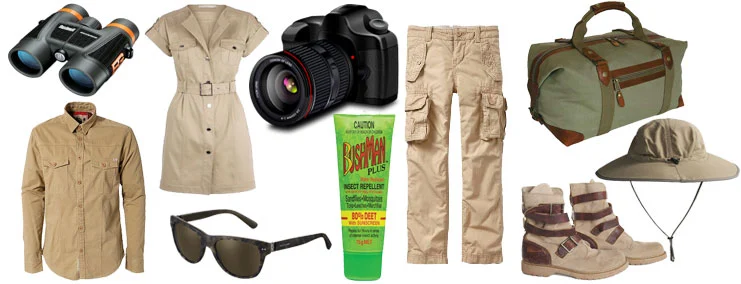
Bring neutral, earth-toned clothing you can layer: khaki, olive, beige, brown, and soft grey. These colours don’t spook wildlife, don’t show dust, and don’t turn you into a target for insects the way brighter shades can.
Which colours work — and the two to avoid
Two colours cause real problems in the bush. Bright white looks filthy within an hour of a dusty game drive and reflects light in a way that can make skittish animals nervous.
Dark blue and black attract tsetse flies — the flies are drawn to those exact shades, and a tsetse bite is a sharp, memorable thing you’ll want to avoid in areas like Tarangire, where I route many of our drives. Stick to the earth tones above and you sidestep both problems at once.
Camouflage-pattern clothing deserves its own warning, and it’s on the skip list further down — in Tanzania, camo is associated with the military and civilians are not meant to wear it.
The layering system that handles a 20-degree swing
Build every safari outfit from three parts:
- Base layer: breathable short- and long-sleeve shirts (long sleeves double as sun and insect protection).
- Mid layer: a fleece or light sweater for the first and last hour of each drive.
- Outer layer: a wind- and light-rain-resistant jacket. In the green season, make this properly waterproof.
Convertible trousers that zip into shorts earn their place here — cold at dawn, hot by ten, and you never dig through your bag to change.
How many of each should you actually bring?
For a standard safari, you need far less than you think, because most camps and lodges offer a same-day or next-day laundry service:
- 3–4 shirts (mix of short and long sleeve)
- 2 pairs of safari trousers (convertible if possible)
- 1 fleece or warm mid-layer
- 1 jacket
- 1 wide-brim hat
- 1 pair of closed walking shoes plus sandals for camp
- Underwear and socks for 4–5 days, then rely on laundry
A four-day and a ten-day safari need almost the same clothing, thanks to that laundry service. The extra days add nothing but weight if you let them. If you’re travelling with children, our note on how a family safari in Tanzania is planned covers the small adjustments — spare layers and more of everything for the youngest travellers.
Dry Season vs Green Season: How Does Packing Change?
Your packing list shifts noticeably between Tanzania’s two seasons. The dry season (roughly June to October) is cold in the mornings and dusty; the green season (roughly November to May) is warm, humid, and wet in short bursts. Pack for the wrong one and you’ll be uncomfortable for your whole trip.
Dry season (June–October)
This is peak season, and the cold catches people off guard. Add a warmer fleece, a beanie or buff for early drives, and a light scarf to keep dust off your face — the tracks in Serengeti and Tarangire throw up a lot of it in the dry months. A dust-proof cover or dry bag for your camera matters more now than at any other time of year. You’ll rarely need heavy rain gear, but a packable light jacket is still worth carrying.
Green season (November–May)
The mornings are milder, so you can drop the heaviest layer, but rain becomes the planning factor. Bring a genuinely waterproof jacket, quick-dry trousers and shirts, and a waterproof cover for your bag and camera. Afternoon showers in the green season are short and heavy — usually an hour, then the light after the rain is some of the best photography of the year. A small pack of biodegradable wet wipes handles the mud. Insect repellent matters more in these warmer, wetter months, so pack enough.
What Safari Gear and Accessories Are Worth the Space?
A few pieces of gear separate a good safari from a frustrating one. These earn their place in a light bag.
- Binoculars. The single most under-packed item. A pair of 8×42 binoculars per person — not shared — changes what you see. A leopard 300 metres off in a sausage tree is a smudge to the naked eye and a full animal through binoculars. If you buy one thing before your trip, buy these.
- Headlamp or small torch. Camps run on limited power and paths are unlit at night. Hands-free light beats a phone torch every time.
- Power bank. Many tented camps only run generator power for set hours. A 20,000 mAh power bank keeps your phone and camera alive between charges.
- Camera and spare memory. Whatever camera you’re comfortable with, plus more storage than you think you need and a lens cloth for the dust.
- Universal adapter. Tanzania uses UK-style Type G three-pin plugs, 230V.
- Reusable water bottle. Most of our vehicles carry filtered or bottled water; a refillable bottle cuts plastic waste, which matters here more than most places.
Toiletries and a small personal health kit
Keep toiletries minimal and reef-safe where you can. Pack a high-SPF sunscreen (the equatorial sun is stronger than most visitors expect, even on cloudy green-season days), lip balm with SPF, a strong DEET or picaridin insect repellent, hand sanitiser, and any personal medication in its original packaging. Add basics for the road: rehydration salts, anti-diarrhoea tablets, plasters, and painkillers. Camps have first-aid kits and our guides carry them too, but your own small kit saves you asking.
What Documents and Health Items Must You Pack for Tanzania?
Some items aren’t optional — leave them behind and your trip stalls at the airport or the clinic. Sort these before anything else.
Documents: passport valid for at least six months beyond your travel dates, your Tanzania visa or eVisa confirmation, travel insurance documents that cover safari activities, flight details, and printed or offline copies of your itinerary. Carry a few passport photos for any on-arrival paperwork.
Malaria protection. Most of Tanzania below 1,800 metres — including the safari parks and Zanzibar — carries a high malaria risk, and health authorities recommend taking antimalarial tablets for the whole trip. Fill your malaria prescription before you leave home and carry enough for the entire length of your trip, since the specific tablet your doctor recommends may not be easy to buy here. Pack it with your other medication, not in checked luggage you might not see for a day.
Yellow fever certificate — only sometimes. This is the rule that confuses almost everyone. A yellow fever certificate is required for travellers arriving from — or transiting more than 12 hours through — a country with a risk of yellow fever transmission. If you fly in directly from a country with no yellow fever risk (most of Europe, the US, the UAE, and similar), you do not need one. If your route connects through an endemic country such as Kenya or Ethiopia, you do — even without leaving the airport. Check your exact routing and pack the yellow card if it applies to you.
This is planning guidance, not medical advice — book a travel clinic four to eight weeks before you fly, because the right vaccines depend on your health and your itinerary. The CDC’s Tanzania travel health page lists the current recommendations in full.
What Should You Leave at Home?
The “skip” list is where a local guide saves you real trouble. These items either get confiscated, break a local rule, or just waste space and weight.
- Single-use plastic bags. Tanzania has banned plastic carrier bags since 2019, and the ban applies to travellers — airport officers can confiscate plastic bags brought into the country. The narrow exception is the clear zip-lock bags used for toiletries: those are allowed, but you must keep them with you for the whole trip and take them home rather than discarding them in Tanzania. Pack toiletries in a reusable washbag and bring cloth or mesh bags for shoes and dirty laundry. This trips up first-timers more than any other rule — the nationwide plastic bag ban is real and enforced at entry. Follow AliceTripadvisor
- Camouflage clothing. In Tanzania, camo is reserved for the military and civilians shouldn’t wear it. Leave it home to avoid awkward questions.
- Drones. Tanzania restricts drone use heavily, and flying one in a national park without a permit is not allowed. Unless you’ve arranged permits in advance, leave the drone.
- Hard-shell suitcases. They don’t fit safari vehicles and are refused on bush flights. Use a soft duffel.
- Bright white, dark blue and black clothing. Covered above — dusty, or a tsetse magnet.
- Too many clothes. With daily laundry at most camps, a week’s wardrobe for a two-week trip is dead weight.
- Valuable jewellery and excess cash. You need very little, and less to worry about is better. Do bring some small-denomination US dollar bills, though — handy for tipping. Our guide to how much to tip your Tanzania safari guide explains the amounts and why small bills matter.
How Much Luggage Can You Bring on a Tanzania Safari?
Aim for one soft duffel bag under 15 kg (33 lb), plus a small daypack. That single limit shapes the whole list, and it’s not arbitrary — it comes from how safaris actually move.
Road safaris in a Land Cruiser have more room than a bush plane, but a soft bag still packs and stacks far better than a rigid case. If any part of your trip flies between parks on a light aircraft, the weight limit is strict — usually around 15 kg in a soft-sided bag, sometimes less depending on the carrier — and hard cases are simply not accepted. Packing to that limit from the start means you never have to repack or leave things behind at an airstrip.
Your daypack does the day-to-day work: camera, binoculars, water, sunscreen, a layer, and your documents. It rides on your lap or at your feet during drives, so keep it small enough to be useful.
If you’re combining your safari with a Kilimanjaro climb, ignore this weight guidance for the mountain portion — that’s a different kit entirely, and our Kilimanjaro climbing guides cover the route-by-route packing you’ll need up there.
The Complete Tanzania Safari Packing Checklist
Here’s the full list in one place, sorted by category. Print it, tick it, and keep it under 15 kg.
| Category | Bring | Notes |
|---|---|---|
| Clothing | 3–4 neutral shirts, 2 safari trousers, fleece, jacket, wide-brim hat | Earth tones only; layer for temperature swings |
| Footwear | Closed walking shoes, camp sandals, warm socks | Break shoes in before you travel |
| Season add-ons (dry) | Beanie/buff, dust scarf, camera dust cover | June–October mornings are cold and dusty |
| Season add-ons (green) | Waterproof jacket, quick-dry layers, waterproof bag cover | November–May afternoon rain is short but heavy |
| Optics & tech | 8×42 binoculars (one per person), camera, spare storage, power bank, headlamp, UK Type G adapter | Binoculars are the most under-packed item |
| Health | Malaria tablets, personal medication, sunscreen SPF 30+, SPF lip balm, insect repellent, rehydration salts, basic first-aid | Fill prescriptions at home |
| Documents | Passport (6+ months validity), visa/eVisa, insurance, itinerary, yellow card if routing requires it | Keep in your daypack, not checked luggage |
| Practical | Reusable water bottle, reusable washbag, cloth/mesh bags, wet wipes, hand sanitiser | Replaces banned plastic bags |
| Skip | Plastic carrier bags, camo, drones, hard suitcase, bright white/dark clothing, excess everything | Confiscation, local rules, or dead weight |
Whether you’re on a budget camping safari, where you’ll want a warmer sleeping layer, or a fully catered lodge trip, this core list holds. Camping just adds a few personal-comfort items; the clothing and the weight rule stay the same.
What colours should you avoid on a Tanzania safari?
Avoid bright white, dark blue, and black. White shows dust within an hour of a game drive and can unsettle skittish animals. Dark blue and black attract tsetse flies, whose bite is sharp and worth dodging in areas like Tarangire. Camouflage is also off the list — it’s reserved for the military in Tanzania. Stick to khaki, olive, beige, brown, and grey. These earth tones keep you comfortable, blend into the bush, and hide the inevitable dust between laundry days.
Can I bring plastic bags to Tanzania?
No — Tanzania has banned single-use plastic carrier bags since 2019, and the rule applies to travellers. Airport officers can confiscate them at entry. The one exception is the clear zip-lock bags used for toiletries and liquids: those are allowed, but you must keep them for the whole trip and take them home rather than throwing them away in Tanzania. Pack your toiletries in a reusable washbag and bring cloth or mesh bags for shoes and dirty laundry instead. This is the customs rule first-timers get caught out by most.
How much luggage can I take on safari?
Aim for one soft duffel bag under 15 kg (33 lb), plus a small daypack. Hard-shell suitcases don’t fit safari vehicles and are refused on light aircraft between parks. If your trip includes a bush flight, the weight limit is strict — usually about 15 kg, sometimes less depending on the airline — so pack to that limit from the start. Most camps offer laundry, so you can pack for four or five days and rewear, even on a two-week trip.
Do I need special clothing for the cold mornings?
Yes. Tanzania’s higher parks and the dry-season mornings are genuinely cold — a June drive can start near 8°C and reach 30°C by midday, and the Ngorongoro Crater rim sits above 2,300 metres. Bring a warm fleece, a jacket, and a beanie or buff for the first hour of each drive, then peel layers as the day warms. This is the single most common packing mistake I see: travellers arrive expecting only heat and shiver through their first sunrise game drive.
What’s the one thing most people forget to pack?
Binoculars — one pair per person, not one to share. Wildlife often sits far from the track, and a distant leopard, cheetah, or bird is a blur to the naked eye but a clear animal through 8×42 binoculars. Sharing one pair means someone always misses the moment. After 14 years guiding, it’s the item I most often wish clients had brought. If you buy one thing before your safari, make it a decent pair of binoculars.
Do I need a yellow fever vaccination for Tanzania?
Only in some cases. A yellow fever certificate is required if you arrive from — or transit more than 12 hours through — a country with yellow fever risk. Flying in directly from a country with no risk (most of Europe, the US, the UAE) means you don’t need one. But a connection through an endemic country like Kenya or Ethiopia triggers the requirement, even without leaving the airport. Check your exact routing, pack the yellow card if it applies, and see a travel clinic four to eight weeks before you fly for personalised advice.
Can I do laundry on safari?
Yes, most lodges and tented camps offer a same-day or next-day laundry service, often included or for a small fee. This is why you can pack light — four to five days of clothing covers even a long trip. One note: many camps ask you to hand over underwear and socks for machine washing rather than line-drying, for cultural reasons, or you can wash those small items yourself. Either way, you never need a fresh outfit for every day of your safari.
Pack Smart, Not Heavy
A good Tanzania safari packing list is short, deliberate, and built around a soft 15 kg bag. Get the few things that matter right and the rest takes care of itself:
- Layers in earth tones handle the 20-degree swing between a cold morning and a hot afternoon.
- Binoculars, a headlamp, and malaria tablets are the items you’ll regret leaving behind.
- Season decides the details — warm layers and dust protection in the dry months, waterproofs in the green ones.
- Skip the plastic bags, camo, drones and hard suitcase — they cause trouble or waste weight.
Pack this way and you’ll land in Kilimanjaro or Arusha ready for the first game drive, not scrambling. In 14 years and 900-plus clients, the ones who pack light and pack smart always have the better trip.
Planning your safari and not sure what your specific route needs? Ask Zawadi directly on WhatsApp: +255 740 453 344. Tell me your dates, parks, and whether you’re camping or in lodges, and I’ll tell you exactly what to bring. You can also browse our Tanzania safari tours or meet the team who’ll be with you in the vehicle.