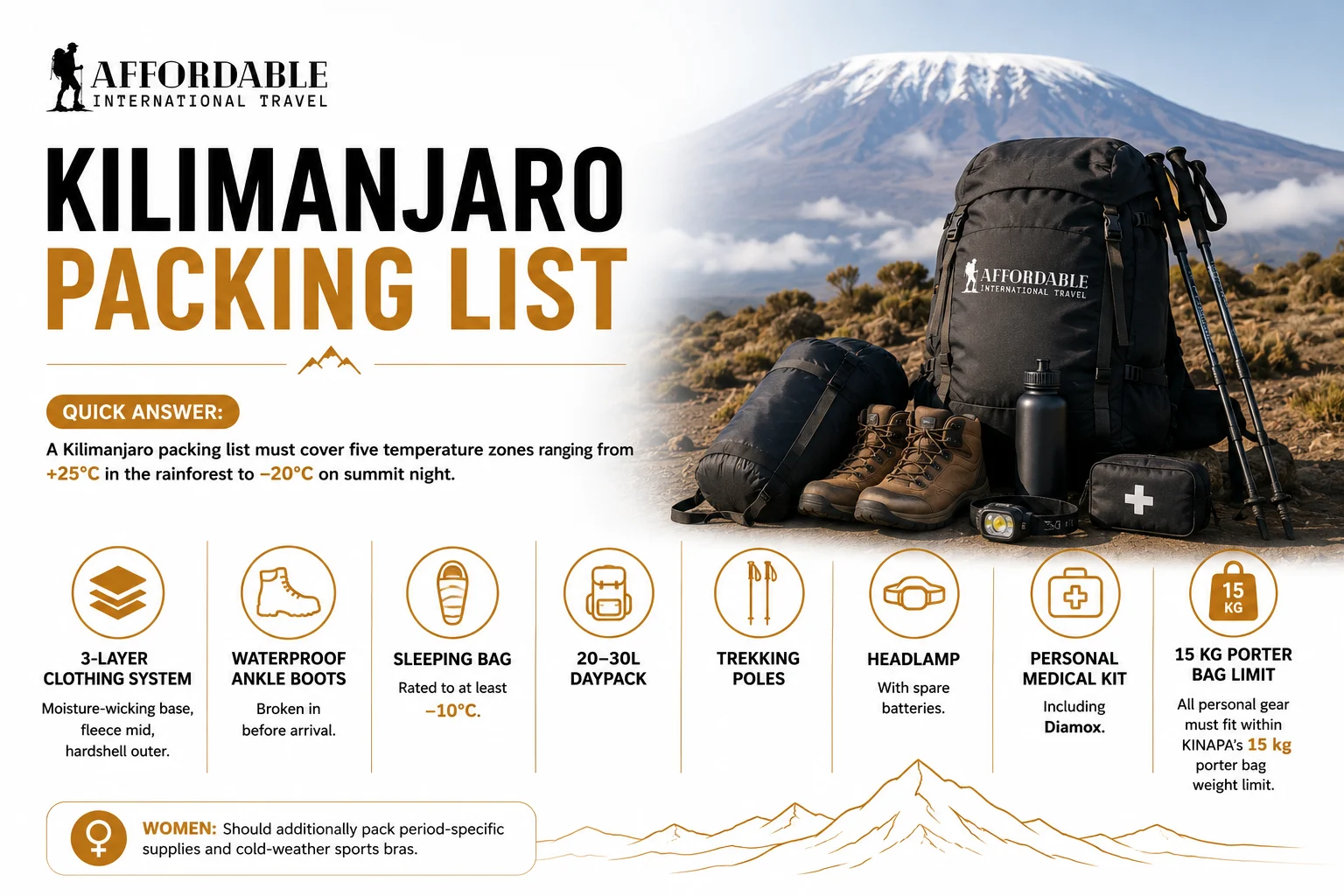
Quick Answer: A Kilimanjaro packing list must cover five temperature zones ranging from +25°C in the rainforest to −20°C on summit night. Core items include a 3-layer clothing system (moisture-wicking base, fleece mid, hardshell outer), waterproof ankle boots broken in before arrival, a sleeping bag rated to at least −10°C, a 20–30L daypack, trekking poles, a headlamp with spare batteries, and a personal medical kit including Diamox. All personal gear must fit within KINAPA’s 15 kg porter bag weight limit. Women should additionally pack period-specific supplies and cold-weather sports bras.
Most people who contact me about packing for Kilimanjaro have already made their first mistake: they’ve left it too late.
I’ve guided 108 summit attempts over 11 years. My overall success rate across all five routes is 91% — well above the mountain average. The gap between climbers who reach Uhuru Peak at 5,895m and those who turn around before it almost never comes down to fitness. It comes down to being cold, being wet, being unable to sleep, or having blistered feet. Every one of those is a packing problem.
This guide gives you every item on the list I hand personally to clients at Affordable International Travel, along with the reasoning behind each one. There’s a dedicated women’s section, a route-by-route note on what to adjust, a full medical kit breakdown, and a clear list of what to leave behind.
If you’re planning a Kilimanjaro climb with us, take a look at our Kilimanjaro climbing packages from Moshi first — then come back to this list and pack for your specific route and season.
Why Getting the Kilimanjaro Packing List Right Is Non-Negotiable
Kilimanjaro requires no technical climbing skill. No ropes, no crampon experience, no prior mountaineering background needed. What it demands, without exception, is preparation for five distinct climate zones within a single climb.
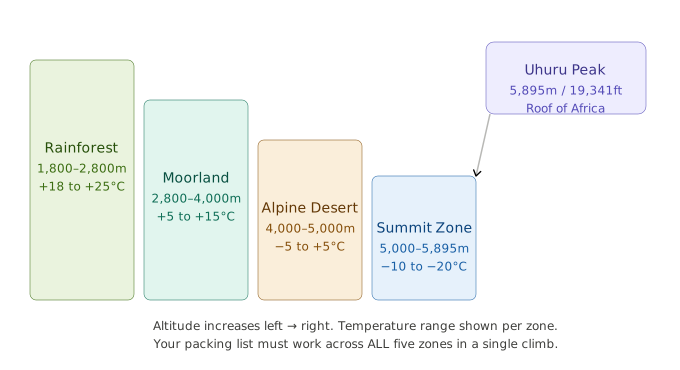
You begin in tropical rainforest at around 1,800m, where it’s humid and often 25°C by midday. Six or seven days later, you’re beginning your summit push from Barafu Camp at 4,673m, at midnight, in temperatures that can drop to −20°C with wind chill. In between, you pass through montane forest, open moorland, alpine desert, and glaciated arctic summit zone.
Your gear needs to handle all of it.
The porter bag weight limit set by KINAPA (Kilimanjaro National Park Authority) is strictly enforced at 15 kg. This is not a guideline — it is a regulation that protects porters from injury. Everything on your personal list must fit inside that limit. Your daypack (which you carry yourself) is separate and typically weighs 5–8 kg on the trail.
The Core Kilimanjaro Packing List: Clothing and Layers
The layering system is the backbone of every successful Kilimanjaro climb. Three layers, each with a distinct job. They work together; none of them works alone.
Base Layer: Moisture Management
Your base layer has one job — move sweat away from your skin. When sweat stays on your body and you stop moving at altitude, you get cold fast. Cotton fails catastrophically here. A wet cotton shirt at 4,500m is genuinely dangerous.
Use: Merino wool (Smartwool, Icebreaker) or quality synthetic (Patagonia Capilene, Salomon). Both dry quickly, both manage moisture, both resist odour across multi-day use.
What to pack:
- 2 long-sleeve base layer tops
- 2 pairs of thermal base layer bottoms
- 4–5 pairs of moisture-wicking underwear
- 4–5 pairs of wool-blend trekking socks (Darn Tough or Smartwool)
- 1–2 short-sleeve trekking shirts for the lower rainforest zone
Women’s note: Cold-weather sports bras designed for layering — without underwire — are essential. Underwire bras become painful under a heavy daypack over long days. Pack 2–3 moisture-wicking, non-padded sports bras. Seam placement matters: check them against your pack’s shoulder strap line before you leave home.
Mid Layer: Insulation
Your mid layer traps body heat. It sits between your sweating base and your protective shell, and it must add warmth without adding weight you’ll resent at 5,000m.
What to pack:
- 1 fleece jacket (200-weight minimum — Patagonia R2, Arc’teryx Kyanite, or equivalent)
- 1 lightweight down or synthetic insulated jacket (for camp use and summit approach)
- 1 fleece or softshell trousers for cold evenings at camp
- 1 warm mid-layer beanie (wool or fleece)
- 1–2 buff/neck gaiters (non-negotiable above 3,500m)
Outer Shell: Wind and Rain Protection
Your hardshell is your final defence against the mountain’s weather. Kilimanjaro generates its own weather systems. The Machame and Lemosho routes pass through a rain zone almost daily in wet season. On summit night, you face wind.
What to pack:
- 1 Gore-Tex or equivalent hardshell jacket (waterproof, not just water-resistant)
- 1 waterproof over-trousers
- 1 pair waterproof gloves (liner gloves underneath)
- Gaiters (essential on Machame, Lemosho, and Umbwe — protects boots from scree and mud)
Hiking Trousers
- 2 pairs of lightweight zip-off trekking trousers (not jeans; not leggings alone at altitude)
- 1 pair hiking shorts for the rainforest zone
Women’s specific note: Zip-off trousers with a full side zip are particularly practical for women on exposed ridgelines where toilet stops require speed and discretion. I’ve guided enough women to know this detail matters. Many recommend Fjällräven Keb Trousers and Craghoppers Kiwi Pro for Kilimanjaro specifically.
Kilimanjaro Footwear: The Detail That Ends Summits
After 11 years guiding on this mountain, footwear is the one category where I push back hardest on cutting costs. Feet carry you 5,895m. They need to be right.
Hiking Boots
You need waterproof, ankle-supporting hiking boots. Not trail runners. Not lightweight hikers. Not the boots you bought last week.
Requirements:
- Full waterproof membrane (Gore-Tex or equivalent)
- Ankle support — the descent from Stella Point to Barafu on loose volcanic scree is where ankles twist
- Broken in before you arrive — minimum 8–10 full hiking days in these specific boots
- Lacing system that holds across a 12+ hour summit day
Well-regarded options: Salomon Quest 4D GTX, La Sportiva Trango TRK, Scarpa Zodiac Plus GTX, Merrell Moab 3 Mid (for lighter-footed, narrower routes).
Critical travel tip: Wear your boots on the flight to Tanzania. Kilimanjaro International Airport (JRO) has a history of delayed checked baggage. If your boots arrive a day after you do and your climb starts in 24 hours, your summit is at serious risk. Your boots are the one item that cannot be borrowed, hired, or replaced overnight.
Additional Footwear
- Lightweight camp shoes (Crocs are genuinely popular — feet need relief after 8 hours of hiking)
- Thin liner socks worn under trekking socks to cut friction and prevent blisters
Bags and the 15 kg Porter Limit
Your Porter Bag (15 kg Maximum)
This is the large bag carried by your porter. Everything that goes into camp — sleeping bag, clean clothes, evening gear — lives here during the day. At each park gate on the way up, bags are weighed. Bags over 15 kg are turned back. This is not a guideline. It is a KINAPA regulation enforced to protect porters, and as a Tanzania Wildlife Management Authority (TWMA) certified operator, AIT takes it seriously.
Use a duffel bag, not a wheeled suitcase. Duffel bags are flexible enough for porters to load safely and carry on their heads. Most operators — including Affordable International Travel — provide a duffel bag; confirm when you book.
Your Daypack (Carried by You)
This is the bag on your back every single day. Size: 20–30 litres. It carries your water, layers you strip or add during the climb, snacks, camera, headlamp, and first aid basics.
Key features:
- Hip belt and sternum strap to distribute weight
- Hydration bladder compatible (optional but popular)
- Rain cover included or purchase separately
- External loops for trekking poles
Women’s note: Many women find unisex daypacks sit poorly on narrower female shoulder widths and create hip belt pressure in different places than on men. Women-specific packs (Osprey Tempest 20, Gregory Juno 24, Deuter Futura 22 SL) redistribute weight more comfortably for a 7-day carry. This is not a vanity difference — it affects your ability to breathe comfortably at altitude.
Kilimanjaro Sleeping Bag and Sleep System
Summit Camp (Barafu or Crater Camp depending on route) regularly reaches -15°C to -20°C at night. A thin 3-season sleeping bag is not adequate. I see this mistake more than almost any other.
Sleeping Bag
- Minimum rating: −10°C comfort / −20°C extreme
- Preferred: down fill for warmth-to-weight ratio; synthetic if you camp in wet conditions
- 4-season rated bags are ideal
- Check whether your operator provides sleeping bags (AIT does — confirm when booking)
Sleeping Mat
Most operators (including AIT) provide a sleeping mat inside tents. Confirm before packing one — it’s heavy and unnecessary if provided.
Tent
Provided by your operator. You do not pack a tent.
Kilimanjaro Trekking Poles
Trekking poles are not optional on Kilimanjaro. They reduce knee impact on the descent — particularly on the knee-grinding loose scree from Stella Point to Barafu — by up to 25%, and they improve balance on muddy moorland sections.
- Adjustable aluminium or carbon fibre poles
- Wrist straps (learn to use them correctly — most people don’t)
- Rubber tips for rocky sections, standard tips for soil
- Can be rented in Moshi if you don’t own a pair — ask us at the time of booking
Headlamp and Lighting
Summit night begins at midnight. You are walking in the dark for 5–8 hours depending on pace. A headlamp is not optional.
What to pack:
- 1 headlamp (minimum 200 lumens — Petzl Actik, Black Diamond Spot, Nitecore)
- 2 sets of spare batteries (cold temperatures drain batteries fast)
- 1 small backup torch
Fit your headlamp over your summit hat and balaclava before you leave home. Some people find their lamp doesn’t fit over a thick hat without adjustment. Find out before midnight at 5,000m.
Hydration Gear
At altitude, dehydration accelerates altitude sickness. You need to drink 3–4 litres per day on the mountain. Your hydration system makes that possible or difficult.
What to pack:
- 2 × 1-litre water bottles (Nalgene or similar, wide-mouth)
- OR a 3-litre hydration bladder (Osprey or CamelBak — doubles as easy trail access)
- Insulation sleeve for bottles (water bottles freeze above 4,500m)
- Electrolyte tablets or powder (significant sweating + altitude = electrolyte loss)
Practical tip: Your porters fill water containers each morning with treated water. By the time water reaches bottles, it’s safe to drink. If you use a bladder, the tube can freeze above 4,500m — blow air back through it after each sip to keep it clear.
Kilimanjaro Medical Kit and Medications
Altitude Sickness and Diamox
Acute Mountain Sickness (AMS) affects a significant proportion of climbers above 3,000m. Symptoms include headache, nausea, fatigue, and disrupted sleep. At its most severe it progresses to High Altitude Pulmonary Edema (HAPE) or Cerebral Edema (HACE) — both medical emergencies.
Diamox (acetazolamide) is the medication most commonly prescribed for AMS prevention and treatment. It works by stimulating breathing and accelerating acclimatisation. The standard preventive dose is 125–250mg twice daily, beginning 24 hours before significant altitude gain.
You must consult a doctor before taking Diamox. It is a prescription medication in most countries. There are contraindications (sulfa drug allergy, kidney conditions) that must be checked. AIT guides are Wilderness First Responder (WFR) certified and carry supplemental oxygen on all climbs, but Diamox must be prescribed and brought from home.
Personal Medical Kit
Pack the following in an accessible pouch in your daypack:
- Diamox (125–250mg, prescribed by your doctor)
- Ibuprofen and paracetamol (dual anti-inflammatory and pain relief)
- Blister kit: moleskin, adhesive bandages, sports tape, Compeed
- Blister prevention: Body Glide or similar
- Antihistamine (for unexpected reactions)
- Lip balm with SPF 50 (UV intensity at altitude is significant)
- High-SPF sunscreen (SPF 50 minimum)
- Sunglasses with UV400 protection (non-negotiable above 4,500m on glaciated sections)
- Rehydration sachets (ORS/electrolytes)
- Hand sanitiser
- Personal prescription medications with documentation
Women’s note on periods: Altitude, physical exertion, and significant schedule disruption can cause menstrual cycle irregularity during and after a Kilimanjaro climb. Some women find their period comes early; others experience delay. Hormonal contraceptives can interact with altitude physiology — discuss with your doctor before the trip. \
Pack sufficient period supplies for your full trip duration plus 3–4 days extra. Biodegradable, eco-compliant options are preferred given that Tanzania has banned single-use plastics. Menstrual cups are practical, hygienic, and widely used by women guiding and climbing at altitude. Pack unscented wet wipes for hygiene at camp.
Kilimanjaro Toiletries and Personal Hygiene
Keep this section minimal. Weight counts.
- Small biodegradable soap and shampoo (plastic bag rules — see below)
- Toothbrush and toothpaste
- Toilet paper (your operators provide some; supplement with a small roll)
- Small hand trowel for cat-hole practice on non-designated toilet zones
- Biodegradable wet wipes (the working climber’s shower at high camp)
- Solid deodorant (liquid or aerosol containers add weight)
- Small microfibre towel
Tanzania’s plastic bag ban: Tanzania banned single-use plastic bags in 2019. Pack all toiletries and gear in fabric dry bags or reusable silicone pouches. Plastic bags can be confiscated at the airport or gate. Your operator will advise — AIT covers this in pre-climb briefings.
Camera, Electronics, and Charging
Cold temperatures at altitude kill battery life aggressively. Your phone may show 40% battery at Barafu Camp and die within 20 minutes on summit night.
- Small camera or smartphone — store inside your jacket close to your body on summit night
- Portable power bank (fully charged before departure)
- Universal travel adaptor (Tanzania uses Type D and G sockets)
- Dry bag or Ziploc for electronics on rainy days
- Extra SD cards
Documents and Money
- Passport (valid minimum 6 months beyond your travel dates)
- Kilimanjaro permit receipt (issued by your operator, carried by your guide)
- Travel insurance documentation with emergency evacuation coverage — mandatory and not optional
- Small amount of USD cash for tipping porters and guides at summit (plan for $200–$300 in small bills for a standard 7-day climb)
- Copies of all documents stored separately from originals
On tip amounts: Your porters and guide have carried your gear, cooked your food, and monitored your health for 6–7 days. Tipping is not an optional extra in Tanzanian mountain culture — it is the expected completion of fair pay. Ask us directly about standard tipping amounts for the specific crew size on your route.
Kilimanjaro Packing List for Women
Women climbing Kilimanjaro face a few practical realities that generic packing lists consistently overlook. After guiding mixed groups for over a decade, here is what I now tell every woman in my pre-climb briefing:
Clothing:
- Non-underwire sports bras (2–3) in moisture-wicking fabric
- Women-fit trekking trousers with full side zip for trail toilet stops
- Women-specific layering base (sizes and proportions differ from men’s — your torso length and shoulder width affect how base layers sit under a pack)
Pack fit:
- Consider a women-specific daypack if carrying more than 6 kg; hip belt placement is anatomically different and matters on a 7-day carry
Period management:
- Pack for your full trip plus 3–4 extra days
- Altitude and exertion can shift timing unpredictably
- Menstrual cup or biodegradable period product recommended over pads (waste disposal at high camp is limited)
- Discuss hormonal contraceptive interactions with altitude with your doctor before travel
Hygiene:
- Unscented biodegradable wipes (2 packs minimum for 7-day climb)
- Small unscented hand sanitiser (shared toilet facilities at some camps)
Sun protection:
- UV intensity at summit altitude is roughly double what it is at sea level. Broad-spectrum SPF 50 on any exposed skin, including under the chin and inside nostrils — sunburn at altitude is faster and more severe than most women expect
What to Leave at Home
This list matters as much as what you bring.
Do not pack:
- Cotton clothing in any form — t-shirts, jeans, cotton underwear, cotton socks
- Heavy denim or canvas trousers
- Wheeled suitcases (porters cannot carry them safely)
- Towels larger than a microfibre travel towel
- Full-size toiletry bottles
- More than one book (heavy; most camps have a small library exchange)
- A separate pillow (use a stuff sack with clothes instead)
- High-heeled or non-hiking footwear in your porter bag
What We Provide vs What You Bring
As a TATO (Tanzania Association of Tour Operators) member operator, Affordable International Travel includes the following in all Kilimanjaro climbs:
Provided by AIT:
- Tents at every campsite
- Dining/mess tent and equipment
- Camp mattresses
- Cooking equipment and all meals
- Supplemental oxygen (carried by WFR-certified guide)
- First aid kit (guide-level)
- Pulse oximeter for daily acclimatisation checks
- Porter and guide wages, park fees, all logistics
You bring:
- All personal clothing and layering
- Your sleeping bag (or hire from AIT — confirm at booking)
- Your daypack
- Your personal medical kit
- Camera, electronics, documents
- Tips for crew
Interactive Kilimanjaro packing checklist organised by category
Route-by-Route Packing Adjustments
The list above covers a standard 7–8 day route such as Machame or Lemosho. Here’s what changes by route:
Machame Route (6–7 days): Standard list above. Rain poncho or pack cover especially useful — Machame passes through heavy rainforest on day one and two. Pack gaiters; the Barranco Wall section gets muddy.
Lemosho Route (7–8 days): Longer means more clothing changes. Add one extra pair of socks and one extra base layer. The longer acclimatisation is worth the extra laundry.
Rongai Route (6–7 days): Approaches from the drier northern side. Less rain in lower zones, but summit night is just as cold. You may be able to reduce rain gear slightly, but never eliminate it.
Marangu Route (5–6 days): The only route with sleeping huts instead of tents. You do not need a sleeping bag on Marangu if your operator confirms bedding is provided (AIT does). Confirm before you pack. The shorter acclimatisation profile means altitude sickness risk is statistically higher — be rigorous about Diamox.
Umbwe Route (5–6 days): The steepest, most challenging route. Pack lighter. Every extra kilo in your daypack is felt more acutely on Umbwe’s direct ascent profile. Women especially: ensure your daypack is women-specific and fitted correctly — Umbwe does not forgive a poorly-fitted pack across 6+ hour ascent days.
Not sure which route fits your fitness level and schedule? Look at the route comparison on our Kilimanjaro page — or message Tumaini directly on WhatsApp and he’ll advise based on your actual situation.
Can You Rent Gear in Moshi?
Yes. Moshi has a number of gear rental shops, and AIT can advise on trusted local options. Items worth renting rather than buying:
- Sleeping bags (expensive to buy, easy to rent)
- Trekking poles (same logic)
- Gaiters
- Duffel bags
Items you should never rent:
- Hiking boots. The break-in requirement makes rental boots a blister factory. Buy your own, break them in at home.
- Base layers. Second-hand moisture-wicking fabric is not effective moisture-wicking fabric. Buy new.
If you’re doing a combined Tanzania safari and Kilimanjaro climb, pack with the full itinerary in mind — safari gear (light, breathable clothing) overlaps somewhat with lower-altitude hiking wear. You won’t need two separate wardrobes.
What is the weight limit for bags on Kilimanjaro?
KINAPA enforces a 15 kg limit for porter bags. This is a regulatory requirement, not a suggestion, and exists to protect porters from injury. Your daypack — which you carry yourself — is separate and typically weighs 5–8 kg on the trail. Pack with both limits in mind. If your gear consistently pushes over 15 kg, start with clothing; that’s where most overpacking happens.
Do I need a 4-season sleeping bag for Kilimanjaro?
Yes. A 3-season sleeping bag rated to around 0°C is not sufficient for Kilimanjaro. Temperatures at Barafu Camp (4,673m) and Crater Camp (5,729m) regularly drop to -15°C or lower at night. You need a bag rated to at least −10°C comfort, with an extreme rating of −20°C. Down bags are lightest for the rating; synthetic bags are better if you’re climbing in the wet season and concerned about moisture.
What should women specifically add to their Kilimanjaro packing list?
The main additions for women are: non-underwire cold-weather sports bras (2–3 pairs), women-specific trekking trousers with a full side zip for trail toilet stops, a women-fit daypack if carrying 6 kg or more, period supplies for the full trip duration plus 3–4 extra days (altitude and physical exertion can shift timing), and biodegradable wet wipes for hygiene at camp. A menstrual cup is widely recommended by women who climb at altitude. Discuss hormonal contraceptive interactions with altitude physiology with your doctor before travel.
Can I rent hiking boots in Moshi for Kilimanjaro?
Technically yes — but I strongly advise against it. Hiking boots must be fully broken in before you climb. New or unfamiliar boots cause blisters, and blisters at altitude are a summit-ending problem. Buy your own boots, wear them for 8–10 full hiking days before arriving in Tanzania, and wear them on your flight to protect against luggage delays at Kilimanjaro International Airport.
Do I need trekking poles for Kilimanjaro?
Trekking poles are not mandatory, but they are strongly recommended for all routes, all fitness levels, and all ages. They reduce knee impact on descent by a meaningful margin — the scree descent from Stella Point to Barafu Camp is the hardest section on most routes for knee joints. They also improve balance in wet conditions. AIT can arrange pole hire in Moshi — ask at the time of booking.
What documents do I need for Kilimanjaro?
You need a valid passport (minimum 6 months beyond your travel dates), a Tanzania visa (available on arrival at Kilimanjaro International Airport for most nationalities), and travel insurance that includes emergency medical evacuation coverage — this is mandatory for all climbers. Your operator handles your park permit — AIT includes this in all bookings. Carry USD cash in small bills for porter and guide tips at summit.
Is Diamox required for Kilimanjaro?
Diamox is not required, but it is strongly recommended and widely used. It works by stimulating breathing and accelerating the body’s acclimatisation to altitude, and it reduces the incidence of Acute Mountain Sickness (AMS). The standard preventive dose is 125–250mg twice daily beginning 24 hours before major altitude gain. Diamox requires a prescription in most countries — speak with your doctor at least 4–6 weeks before travel. AIT guides carry supplemental oxygen on all climbs, but this is for emergency use only and does not substitute for proper personal preparation.
How do I stay within the 15 kg porter bag limit?
Start by laying everything out and weighing it before you pack. The three biggest weight offenders are boots (keep in your daypack or wear them), towels (replace with a microfibre travel towel), and clothing overpacking (follow the list — three layers, not five). Most climbers find that disciplined packing produces a porter bag of 10–13 kg, well within the limit. If you’re over, remove cotton items first — they’re heavy and shouldn’t be there anyway.
Ready to Climb? Here’s What Happens Next
Your Kilimanjaro packing list is set. What makes the difference from here is who is with you on the mountain.
At Affordable International Travel, our mountain team is led by TWMA-certified guides based at our office in Moshi, with 108 successful Kilimanjaro summits and a 91% success rate across all five routes. We are a Tanzania Association of Tour Operators (TATO) member company, we pay our porters fairly, and we carry supplemental oxygen on every climb.
We have helped over 600 travellers from 38 countries reach Uhuru Peak — including first-time hikers, solo women, couples, students, and climbers in their 60s. We know what gear questions come up on each route, and we answer them before you leave home, not on the mountain.
Take a look at our Kilimanjaro climbing packages — or if you prefer, reach out to our team now.
Talk to Tumaini directly on WhatsApp: +255 740 453 344
He’ll give you honest route advice, confirm exactly what’s included in your package, and answer every packing question specific to your route and dates.