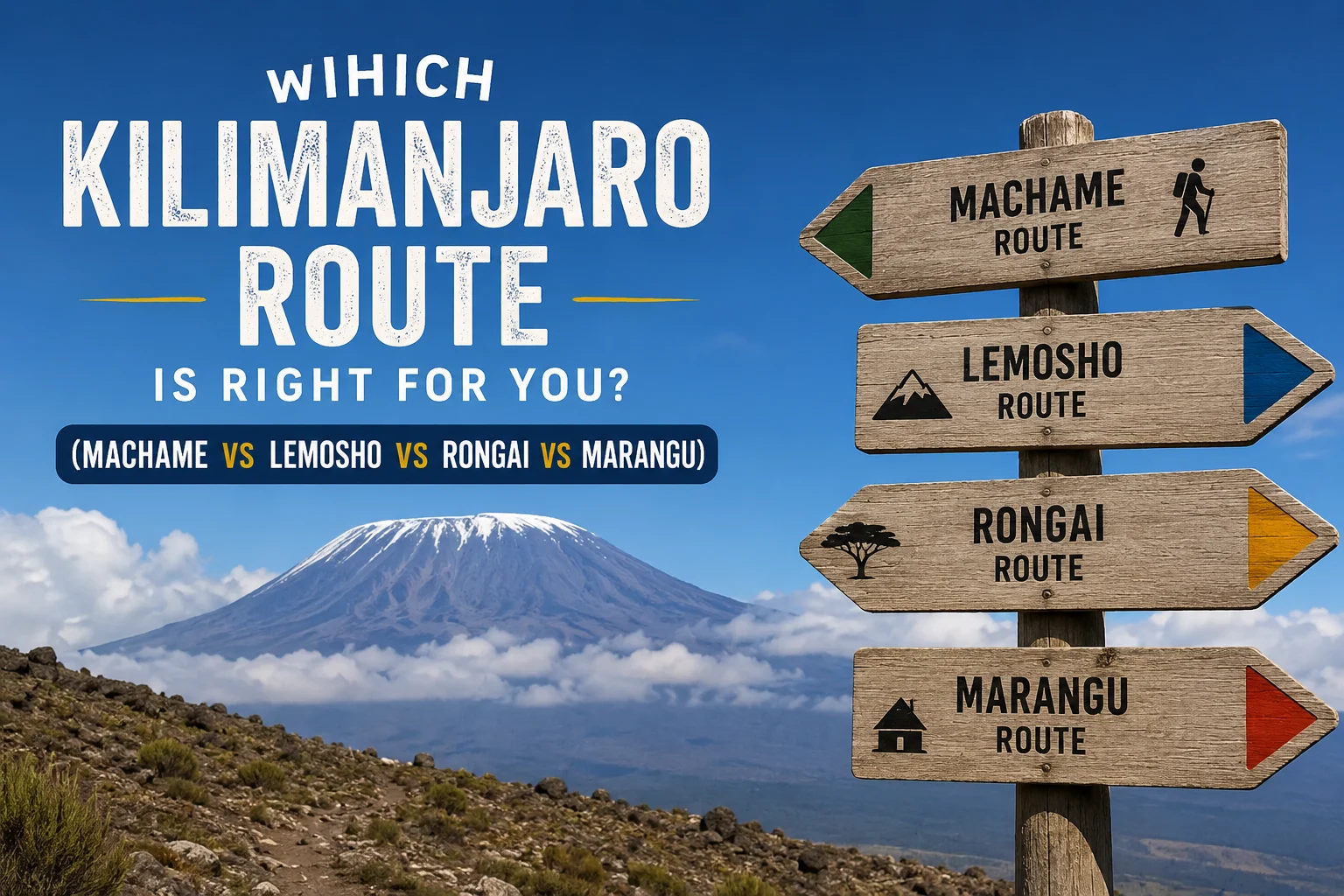
The short answer: the best Kilimanjaro route for most climbers is the 8-day Lemosho Route. It has the highest summit success rate (around 90%), the best acclimatisation profile, the lowest foot traffic on the lower slopes, and the cleanest views on the western approach.
But “most climbers” is not “every climber.” If you have a tight budget, a rainy-season departure, hut-only sleeping preferences, or fewer than six days off work, your best route changes. That is the honest answer. The rest of this guide is how to pick yours.
I am Tumaini, a Tanzania Wildlife Management Authority (TWMA) certified mountain guide based in Moshi. I have personally led 108 successful summits on Kilimanjaro across all five park-approved routes. I am also a Wilderness First Responder (WFR), which matters more than people realise when something goes wrong above 4,500m. Everything below is what I tell clients sitting across the desk from me at our Moshi office — not what looks good in a brochure.
The 5 Kilimanjaro Routes
There are six official approaches to Uhuru Peak, but only five are commercially climbed: Lemosho, Machame, Rongai, Marangu, and Umbwe. (The Northern Circuit is technically a sixth, but it is a longer variant of Lemosho rather than a distinct trailhead.)
Here is how they compare on the things that actually matter — success rate, length, difficulty, and price — based on figures from Kilimanjaro National Park and the booking data we keep at AIT across 1,200+ climbs:
| Route | Days | Distance | Difficulty | Avg. Success Rate | Best For | Starts From |
|---|---|---|---|---|---|---|
| Lemosho | 7–8 | ~70 km | Moderate | ~90% (8-day) | First-timers, best overall | $2,000 |
| Machame | 6–7 | ~62 km | Moderate–Hard | ~85% (7-day) | Scenery on a budget | $2,000 |
| Rongai | 6–7 | ~73 km | Moderate | ~80% (7-day) | Rainy season, quiet trail | $2,000 |
| Marangu | 5–6 | ~72 km | Moderate | ~65% (6-day) | Hut sleepers, tight budget | $1,700 |
| Umbwe | 6 | ~53 km | Hard | ~70% | Experienced trekkers only | On request |
Two numbers in that table do most of the work in this decision: days on the mountain and success rate. They are linked. The longer you take, the better your body acclimatises, and the more likely you are to stand on Uhuru Peak.
Lemosho Route: The Best Kilimanjaro Route for Most Climbers
If a client asks me, “Tumaini, just pick one for me” — I pick the 8-day Lemosho Route. Every time.
Why Lemosho wins:
- It approaches from the west, so you walk across the mountain before going up. That sideways traverse — Shira Plateau, Lava Tower, Barranco Camp — drags your body through acclimatisation rotations the shorter routes simply cannot offer.
- Climb high, sleep low is built into the itinerary. Day 4 takes you up to Lava Tower (~4,630m) for lunch, then drops you to Barranco Camp (~3,960m) for the night. That single day is worth a 20% jump in your summit odds.
- The lower slopes are quiet. Lemosho starts at Londorossi Gate, which sees roughly a third of the foot traffic of Machame Gate. You will not be queuing for a campsite on day one.
- It joins the southern circuit at Shira Camp, so from day three onwards you see all of the Machame Route’s famous landmarks — Barranco Wall, Karanga Camp, Barafu — without the day-one crowds.
Who should not pick Lemosho:
- Anyone with fewer than 7 nights free for the climb itself.
- Anyone on a strict sub-$2,000 budget — Lemosho is not the cheapest option because of the extra park days.
- Anyone climbing in April or May. The western approach turns into a swamp in the long rains.
The route itself, day by day:
Day 1 starts in rainforest — colobus monkeys, mossy trees, knee-deep mud after rain. Day 2 climbs onto Shira Plateau, a wide volcanic shelf at 3,500m where you sleep under the sharp shadow of Kibo for the first time. Day 3 is the long traverse to Moir Hut, an excellent acclimatisation camp most operators skip. Day 4 is Lava Tower day. Day 5, Barranco Wall — a fun, hands-on scramble that looks scarier from below than it is up close. Day 6, Karanga to Barafu. Day 7 is summit night and descent. Day 8, exit through Mweka Gate.
If you can spare 8 days, book the 8-day Lemosho Route. It is the single biggest decision you can make in your favour before you even land in Tanzania.
Machame Route: Best Scenery-to-Cost Ratio
The Machame Route — nicknamed the “Whiskey Route” for being tougher than the easier “Coca-Cola” Marangu — is the most popular route on the mountain. About 35% of all Kilimanjaro climbers take Machame.
Why people pick it:
- The scenery is nearly identical to Lemosho. Machame joins the same southern circuit from Shira Camp onwards, so days 3–7 are the same views — Barranco Wall, Karanga Valley, Barafu Camp.
- One day shorter than 8-day Lemosho. That is one fewer day of park fees, one fewer day off work, and a meaningful cost saving.
- Strong success rate on the 7-day version. I run roughly 85% on 7-day Machame departures with my groups.
The honest trade-offs:
- Day one starts at Machame Gate, which is the busiest trailhead on the mountain. On a peak-season morning in July or August, you will sign in alongside 200+ other climbers.
- The 6-day version drops success below 73%. Skipping a day on Machame is a real summit risk, not a money-saving tip.
- Day three to Lava Tower is steeper than Lemosho’s traverse, which puts some climbers into mild altitude sickness sooner.
When clients tell me “I want the best views, I have 7 days, and I want to keep the cost reasonable” — I send them to the 7-day Machame Route.
Rongai Route: The Best Kilimanjaro Route for the Rainy Season
The Rongai Route is the only route that approaches Kilimanjaro from the north — from the Kenyan side. That single fact makes it the right answer to a very specific question: “I have to climb in April, May, or November. What route should I take?”
Why Rongai is the rainy-season choice:
- The northern side of Kilimanjaro is in a rain shadow. The southern and western slopes catch the moisture coming off the Indian Ocean. The north stays drier — sometimes dramatically drier.
- Lower foot traffic. Rongai sees maybe 10–12% of Kilimanjaro climbers. In the long rains, the trail is often empty.
- Easier underfoot for the first three days. The northern approach is more gradual than Machame or Umbwe.
The trade-offs to know:
- Less dramatic scenery on the lower slopes. The northern flank does not have the Shira Plateau or the rainforest gauntlet of the south.
- You sleep on the south side from day 4 onwards. The route crosses to Kibo Hut on the saddle, then summits via Gilman’s Point.
- Acclimatisation is decent but not Lemosho-grade. Expect ~80% success on the 7-day version.
My honest take: Rongai is not the best route in the dry season. In June through October, take Lemosho or Machame. But if your job, school holidays, or budget puts you on the mountain in March–May or November, the 6 or 7-day Rongai Route is the safest pick. I have summited in heavy April rain on Rongai when the Machame trail was, in places, a calf-deep brown river.
Marangu Route: The Budget & Hut-Sleeping Choice
The Marangu Route is the oldest established route on Kilimanjaro and the only one with hut accommodation instead of tents. It is also the cheapest, starting from $1,700 per person at AIT.
What Marangu does well:
- Wooden A-frame huts at Mandara, Horombo, and Kibo. Real beds, real mattresses, a proper roof. If you genuinely cannot sleep in a tent — knee pain, claustrophobia, severe back issues — Marangu is your only option.
- Lowest cost per climber. Fewer days, no camping gear logistics, more group-sharing on huts.
- Gentle gradient on days 1 and 2. The Marangu trail rises through rainforest at a forgiving pace.
What Marangu does poorly:
- The 5-day version has a summit success rate around 45%. Less than half. If anyone offers you 5-day Marangu, the price is not a deal, it is a refund waiting to happen.
- You ascend and descend on the same trail. No variety, no “climb high, sleep low” rotations.
- Huts are shared dormitory-style. If you booked a private climb expecting a private room, you will be disappointed.
My recommendation: if you are taking Marangu, take the 6-day version, not 5. The extra acclimatisation day at Horombo Huts pushes success up to roughly 65%. Still lower than Lemosho or Machame, but the route is now defensible.
Umbwe Route: For Experienced Climbers Only
The Umbwe Route is the shortest, steepest, and most direct route up Kilimanjaro. It is also the one I most often talk clients out of taking.
The hard facts on Umbwe:
- 53 kilometres total — the shortest of all routes.
- Climbs ~3,000m of elevation in the first three days, which is brutal for unacclimatised bodies.
- Success rate around 70% on the 6-day version, but with a significantly higher incidence of altitude sickness compared to Lemosho.
- No gentle build-up. Day 1 ends with you already in the heath zone. Day 2 lands you near Barranco at 3,960m.
Who Umbwe is genuinely right for:
- Experienced high-altitude trekkers (you have summited above 4,500m before).
- Climbers training for technical mountains like Aconcagua or Denali.
Who Umbwe is wrong for:
- First-time high-altitude climbers. Full stop.
- Anyone over 55 unless they have a strong trekking history.
In 11 years, I have seen Umbwe break strong, fit climbers who would have summited easily on Lemosho. The mountain rewards patience. Umbwe punishes the lack of it.
How to Choose YOUR Best Kilimanjaro Route
Forget the route names for a minute. Answer these five questions honestly, and the right route picks itself.
1. How many days can you spend on the mountain?
- 8 days: Lemosho (best overall)
- 7 days: Machame or 7-day Lemosho
- 6 days: Marangu (6-day) or Rongai
- 5 days: Don’t climb. Take a day trip from Moshi and come back when you have a real week off.
2. What month are you climbing?
- June–October or January–February: Lemosho or Machame
- March, April, May, November: Rongai
- December: Lemosho or Machame, but expect Christmas-week crowds
3. What is your budget per person?
- $1,700–$2,000: Marangu 6-day
- $2,000–$2,500: Machame 7-day or Rongai
- $2,500+: Lemosho 8-day
4. Have you slept above 3,500m before?
- No: Lemosho 8-day. Do not negotiate down to a shorter version.
- Yes, comfortably: Machame, Rongai, or Lemosho work.
- Multiple times above 4,500m: All routes are open to you, including Umbwe.
5. Can you sleep in a tent for 6+ nights?
- Yes: Any route except Marangu.
- No: Marangu 6-day is your only option.
If you ran through those five questions and you are still unsure, that is what I am here for. Send me your situation on WhatsApp at +255 740 453 344 and I will tell you the route I would book my own brother on.
Why Days on the Mountain Matter More Than the Route
I want to be very direct about this: the single biggest predictor of whether you summit Kilimanjaro is not which route you pick — it is how many days you spend on it.
Kilimanjaro National Park’s own published data, and our internal AIT booking records across 1,200+ summits, show the same pattern:
- 5-day Marangu: ~45% success
- 6-day Marangu: ~65% success
- 6-day Machame: ~73% success
- 7-day Machame: ~85% success
- 7-day Lemosho: ~85% success
- 8-day Lemosho: ~90%+ success
Look at what just adding one extra day does. Going from 5-day Marangu to 6-day Marangu adds 20 percentage points to your summit odds. Going from 7-day Lemosho to 8-day adds another 5–7. That extra day is the single best dollar you can spend on this climb.
The mechanism is altitude acclimatisation. Your body needs time at intermediate elevations to produce more red blood cells and adapt to lower oxygen pressure. You cannot brute-force this with fitness. The fittest marathon runner with five days on the mountain will summit at lower rates than an average hiker with eight days.
When a budget operator offers you a “cheaper” 5-day Marangu climb at $1,400, what they are really offering you is a coin flip on a $1,400 plane ticket. As a TATO (Tanzania Association of Tour Operators) member operator, we will not run those itineraries. They damage clients and they damage the mountain’s reputation.
What a Kilimanjaro Climb Actually Costs
Rehema, our Safari Operations Manager, processes the actual park fee payments at AIT every week — so I asked her to break down what your money is paying for on a typical 7-day Lemosho climb at the entry-level $2,000 price point.
Per climber, per 7-day Lemosho:
- Conservation fee (TANAPA): $70/day × 7 = $490
- Camping fee: $50/night × 6 = $300
- Rescue fee: $20 (one-time)
- Crew salaries (guide, assistant guide, cook, 3–4 porters): ~$420
- Food, fuel, equipment, transport, lodge in Moshi: ~$500
- VAT (18% on park fees): ~$145
- Operator margin (training, insurance, certifications, office costs): ~$125
Total: ~$2,000 per person at minimum.
If a quote comes in below $1,500, something on that list is being cut — and it is almost never the operator’s margin. It is the porter wages, the food quality, the safety equipment, or the rescue insurance. None of which you want missing at 5,200m on summit night.
For a full cost breakdown by route, see the main Kilimanjaro climbing page — or message Rehema directly through our contact page for a real quote on your specific dates.
The Mistakes I See People Make Choosing a Route
After 108 summits, here are the four route-selection mistakes I see clients make most often.
Mistake 1: Picking on price alone. The cheapest route on paper (5-day Marangu) is the most expensive route in practice because half the people on it do not summit. A $1,400 failed climb is more expensive than a $2,500 successful one.
Mistake 2: Picking on “ease.” Marangu is called the “easiest” route because of the huts. But its success rate is lower than Machame or Lemosho. Comfortable sleeping does not equal a higher chance of summit.
Mistake 3: Picking the same route as a friend without checking fitness. Your friend who summited on 6-day Machame had two years of European Alps hiking behind them. You have a treadmill membership. Pick the route that fits your preparation, not their story.
Mistake 4: Booking the wrong season for the route. Lemosho in April is a mud-swim. Rongai in August is a fine route but you are missing better options. Match the season to the route, not the other way round.
Which is the easiest Kilimanjaro route?
The Marangu Route is technically the easiest underfoot — gentle gradient, hut accommodation, no scrambling. But “easiest” does not mean “highest success rate.” Marangu has the lowest summit success of the five routes because it does not give your body enough time to acclimatise. The route that combines easy hiking with the best summit odds is actually the Lemosho Route on its 8-day itinerary — moderate gradient, strong acclimatisation, ~90% success.
Which Kilimanjaro route has the highest success rate?
The 8-day Lemosho Route has the highest summit success rate of any commercial Kilimanjaro itinerary — roughly 90% based on Kilimanjaro National Park and AIT booking data. The 7-day Machame Route is second at around 85%. The 6-day Marangu Route trails at around 65%, and 5-day Marangu drops to roughly 45%. Days on the mountain matter more than the route itself.
Lemosho vs Machame — which should I choose?
If you have 8 days, take Lemosho. If you have 7 days, both routes give you ~85% success, and the deciding factor becomes traffic preference. Lemosho is quieter on days 1–2; Machame is busier from the trailhead. They merge at Shira Camp and share the same southern circuit for the rest of the climb. Lemosho costs slightly more because of the extra park day. Machame costs slightly less and gives almost identical views. There is no wrong answer here.
How many days should I spend climbing Kilimanjaro?
Eight days is ideal. Seven days is acceptable. Six days is the absolute minimum for first-time climbers. Five-day itineraries have summit success rates below 50% and we do not recommend them at AIT. Every extra day on the mountain adds measurable percentage points to your chance of standing on Uhuru Peak. If you can take 8 days off work, take 8.
Is the Rongai Route harder than Machame?
No — Rongai is slightly gentler underfoot than Machame, especially in the first three days. The terrain is more gradual and less scrambly. The trade-off is that Rongai’s acclimatisation profile is not quite as strong as Machame’s southern circuit, which is why Rongai’s success rate (~80% on 7-day) is a few points below Machame (~85% on 7-day). Rongai’s main advantage is rain shadow — it is the right route for March, April, May, and November departures.
What is the cheapest Kilimanjaro route?
The 6-day Marangu Route is the cheapest commercially viable route on Kilimanjaro — starting from $1,700 per person at Affordable International Travel. The savings come from one fewer day of park fees, hut accommodation instead of tents, and shared dormitory sleeping. If your budget is genuinely tight and you cannot stretch to $2,000, Marangu 6-day is the honest answer. Just do not go below $1,500 — at that price, safety standards start getting cut.
Can I summit Kilimanjaro without prior climbing experience?
Yes. Kilimanjaro is a trek, not a technical climb. You do not need ropes, harnesses, or mountaineering skills. About 60% of the climbers I have guided to Uhuru Peak had never been on a high-altitude mountain before. What you do need is decent cardiovascular fitness, a willingness to walk 5–8 hours a day, and the discipline to follow your guide’s pacing (the famous “pole pole” — slowly, slowly). Train for 8–12 weeks before your climb with hiking, stair climbing, and cardio.
What route should I take in April or May?
Take the Rongai Route. April and May are Kilimanjaro’s long rainy season, and the southern and western slopes — where Lemosho, Machame, and Umbwe all run — get drenched. Rongai’s northern approach sits in a rain shadow and stays significantly drier. You will also have the trail mostly to yourself. Pack waterproof layers, gaiters, and a proper rain cover for your daypack regardless.
Ready to Book Your Climb?
The best Kilimanjaro route is the one that matches your time, budget, season, and experience — not the one with the most marketing behind it. After 108 summits, the route I would put my own brother on for his first Kilimanjaro climb is 8-day Lemosho in July. That is the truth.
But your situation is yours. If you want a real, no-sales-pressure recommendation for your dates and your fitness level, I am the person you talk to.
Three ways to plan your climb:
- WhatsApp Tumaini directly on +255 740 453 344 — I usually reply within a couple of hours. Tell me your dates and your goal route, and I will tell you honestly if it is the right call.
- Get a free quote through our planning form — Rehema on the operations team will send you a costed itinerary within 24 hours.
- Browse all 5 Kilimanjaro routes on our main climbing page if you want to compare side by side first.