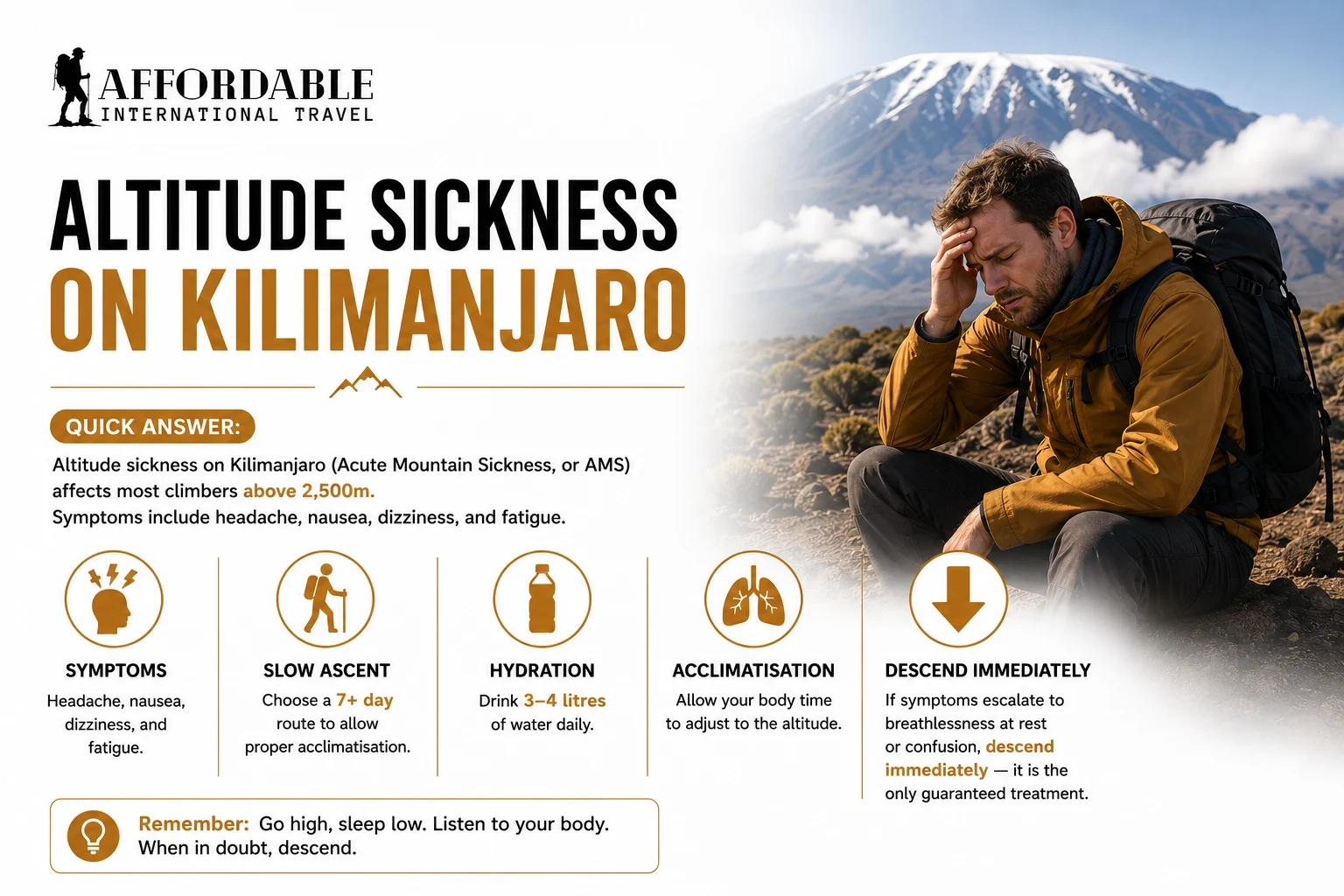
Quick Answer: Altitude sickness on Kilimanjaro (Acute Mountain Sickness, or AMS) affects most climbers above 2,500m. Symptoms include headache, nausea, dizziness, and fatigue. Prevention relies on a slow ascent (7+ day route), drinking 3–4 litres of water daily, and proper acclimatisation. If symptoms escalate to breathlessness at rest or confusion, descend immediately — it is the only guaranteed treatment.
Nearly everyone who contacts Affordable International Travel before booking asks some version of this: “Will I get altitude sickness on Kilimanjaro?”
My honest answer after 11 years and 108 summits: probably some degree of it, yes. At 5,895 metres, Kilimanjaro is the highest freestanding mountain on Earth. Above 3,000 metres your body is working against oxygen levels it was never designed for at speed. Most climbers feel mild symptoms at some point. Many feel nothing serious. A small number must descend early.
What separates those three groups is not age, fitness level, or how much you spent on gear. It is the quality of preparation, the pace of ascent, and whether you have a guide who recognises early warning signs and acts on them before they become emergencies.
This guide covers what altitude sickness actually is, what each stage feels like, and exactly how to reduce your risk. If you are planning a Kilimanjaro climb with us, this is the most important thing you will read before boarding that flight.
What is altitude sickness, and why does Kilimanjaro make it worse?
The science in plain language
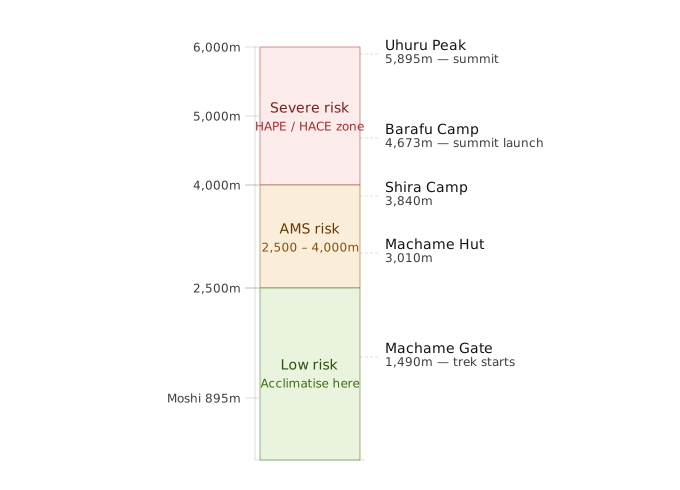
Altitude sickness happens when you ascend faster than your body can adapt to thinner air. At sea level, each breath delivers a standard density of oxygen into your lungs. At 3,000 metres — around Shira Camp on the Machame Route — there are roughly 30% fewer oxygen molecules per breath. At Uhuru Peak at 5,895 metres, that figure drops closer to 50%.
Your body responds by increasing breathing rate and heart rate to compensate, and over 24–48 hours it begins producing more red blood cells to carry whatever oxygen is available. This adaptation is called acclimatisation, and it simply takes time. Rush it, and your body starts failing in specific, predictable ways.
According to the CDC Yellow Book on High-Altitude Travel, AMS affects 25% of all visitors sleeping above 2,500 metres — and Kilimanjaro places you well above that threshold for most of the climb.
Why Kilimanjaro is a particular challenge
What makes this mountain unusual is the speed of ascent relative to how it is typically packaged. Standard 5–6 day packages push climbers from the Machame Gate at 1,490m to Barafu Camp at 4,673m in three to four days. That is a sleeping altitude gain of over 3,000 metres in a very short window.
In 11 years guiding this mountain, the clients I have seen struggle most are those who chose the shortest route to save money, then found themselves descending early anyway. A 5-day route saved them nothing.
The three types of altitude illness you need to know
Altitude illness sits on a spectrum of three clearly defined conditions:
Acute Mountain Sickness (AMS) is the most common form — a headache-led syndrome that feels like a hangover. It typically appears 6–12 hours after reaching a new altitude and includes nausea, fatigue, dizziness, and disturbed sleep. Mild AMS does not require descent. Rest, hydration, and no further upward movement usually resolves it within 24 hours.
High-Altitude Pulmonary Edema (HAPE) is a medical emergency in which fluid accumulates in the lungs. It causes progressive breathlessness even at rest, a bubbling or crackling cough, extreme fatigue, and bluish lips or fingertips. HAPE is the leading cause of altitude-related death worldwide and can develop within 24–48 hours of reaching high altitude.
High-Altitude Cerebral Edema (HACE) is the most severe form. Fluid builds up in the brain, producing confusion, loss of coordination, hallucinations, and ultimately loss of consciousness. A person with HACE cannot accurately self-assess. Guides and climbing partners must recognise it and act immediately.
The NHS Fit for Travel guidelines, citing the Wilderness Medical Society, recommend sleeping no more than 500m higher than the previous night once above 2,500m. On a 5-day Kilimanjaro route, this guideline is routinely breached.
What are the symptoms of altitude sickness on Kilimanjaro?
The critical skill on the mountain is knowing the difference between normal hiking tiredness — which everyone feels — and early AMS. The table below maps each severity level to its symptoms and the correct response.
| Severity | Condition | Key symptoms | What to do |
|---|---|---|---|
| Mild | AMS | Headache, nausea, fatigue, loss of appetite, poor sleep | Rest. Stop ascending. Drink water. Ibuprofen for headache. |
| Moderate | Worsening AMS | Headache unresponsive to ibuprofen, vomiting, dizziness at rest, breathlessness on exertion | Descend 300–500m. Do not wait overnight. |
| Severe | HAPE | Breathlessness at rest, gurgling cough, pink frothy sputum, extreme fatigue, cyanotic lips | Emergency descent + oxygen. Evacuate. |
| Critical | HACE | Confusion, staggering gait (ataxia), disorientation, unconsciousness | Emergency evacuation. No delay under any circumstances. |
The field test for HACE is simple and takes ten seconds: ask the person to walk heel-to-toe in a straight line. If they stagger or cannot complete it, treat it as HACE and descend immediately.
Who is most at risk on Kilimanjaro?
Fitness does not protect you. I have guided marathon runners who buckled at Barafu Camp and 62-year-old retirees who reached Uhuru Peak feeling strong. Cardiovascular fitness helps you handle the physical demands of the trail but does not accelerate acclimatisation.
What genuinely increases your risk:
- Previous AMS — if you have had it before, you are more susceptible. Tell your guide on Day 1.
- Short routes — 5-day routes correlate directly with higher AMS rates. Our Kilimanjaro packages default to 7 days or more for this reason.
- Flying from sea level with no acclimatisation time — arriving in Moshi and starting the climb within 24 hours is a setup for problems.
- Dehydration on the trail — arriving already dehydrated makes every AMS symptom worse and blurs the diagnostic picture.
- Pre-existing heart, lung, or neurological conditions — these all affect your response to altitude. Get medical clearance before you book.
How to avoid altitude sickness on Kilimanjaro — 6 strategies that actually work
1. Choose a route of 7 days or more
This is the single most important decision you will make. Longer routes build in nights at moderate altitude before the summit push, and several include natural “acclimatisation days” — short hikes to a higher point followed by a return to sleep lower. The Lemosho Route at 7–8 days consistently outperforms the 5-day Marangu Route on summit success rates for this exact reason.
When our certified mountain guides recommend an 8-day route over a 5-day, this is not upselling. It is the difference between a safe summit attempt and a difficult early descent on Day 4.
2. Pole pole — and actually mean it
Pole pole (poh-lay poh-lay) means “slowly, slowly” in Swahili. Every guide says it on Day 1. Most clients nod and then set off at their normal hiking speed.
After 108 summits, here is what I tell clients the night before Day 1: the goal is to be the slowest you have ever hiked in your life. You should be able to hold a complete conversation without any breathing effort whatsoever. If you are too breathless to talk easily, you are going too fast. Set your ego aside for Day 1 — it will pay you back at Uhuru Peak.
3. Drink 3–4 litres of water every single day
Dehydration mimics many AMS symptoms — headache, fatigue, dizziness — and makes genuine altitude sickness significantly worse. Most clients underestimate how much fluid they lose at altitude through increased breathing rate and the cold, dry air. Aim for 3 litres daily at lower camps, and 4 litres on summit approach days.
A simple check: your urine should be pale yellow. If it is dark amber, drink more before you take another step upward.
4. Follow the “climb high, sleep low” principle
The Lemosho and Machame routes build this principle into their itineraries naturally. You hike to a higher elevation during the day, then return to sleep at a lower camp. This exposes your body to the altitude without committing your sleeping altitude to it. It is one of the most effective acclimatisation tools available without medication.
5. Eat, even when you do not feel like it
Loss of appetite is one of the earliest AMS symptoms, and the temptation is to skip dinner when you feel queasy at 4,000m. Resist this. Your body requires calories to run its acclimatisation process. Eat small portions regularly. The rice, beans, and soup your camp cook prepares every evening are not incidental — they are part of the safety system.
6. Talk to your doctor about Diamox before you leave home
Diamox (acetazolamide) is the most widely prescribed medication for altitude sickness prevention. It works by acidifying your blood, which drives your body to breathe faster and deeper — effectively speeding up acclimatisation. The CDC recommends it for medium and high-risk altitude climbs, which Kilimanjaro qualifies as.
The standard dose is 125–250mg twice daily, started 1–2 days before ascending above 2,500m. Common side effects: increased urination (actually helpful), tingling in fingers and toes, and mild visual changes. Diamox is not appropriate for people with sulpha drug allergies or certain kidney and cardiac conditions — which is why a doctor’s consultation is not optional.
Roughly 40% of the clients I guide take Diamox. Many report feeling substantially better during the first three days of altitude gain. Start the conversation with your GP at least four weeks before travel.
What to do if altitude sickness hits during the climb
Mild AMS — rest and hold your altitude
If you develop a mild headache above 3,000m, tell your guide immediately. Do not push to the next camp. Rest at your current altitude, take ibuprofen or paracetamol for the headache, and drink water. The rule is simple: do not ascend to a higher sleeping altitude until the headache has fully resolved.
“The mistake I see most often is the client who says ‘I’m fine, let’s push on’ when they clearly are not. On this mountain, pushing through mild symptoms is how people end up in medical emergencies two days later. Tell your guide. That is exactly why we are here.” — Tumaini Elias Mwangi
Moderate to severe symptoms — descend now
If any of these occur, descend immediately and without negotiation:
- Headache that does not improve after rest, water, and ibuprofen
- Vomiting that prevents you from rehydrating
- Breathlessness at rest
- Confusion, staggering, or inability to walk a straight heel-to-toe line
- Gurgling or crackling sounds when breathing
Do not wait for morning. Do not sleep on it and see how you feel. Descending even 300–500 metres can produce rapid, dramatic improvement in minutes. The mountain will still exist next year. Your life is not renewable.
AIT’s emergency protocol on every climb
As a TWMA (Tanzania Wildlife Management Authority) certified operator, every AIT Kilimanjaro team carries:
- A portable pulse oximeter for blood oxygen saturation monitoring at every camp
- Supplemental oxygen canisters for emergency use
- A Gamow bag (portable hyperbaric chamber) available on request for high-risk clients
- At least one Wilderness First Responder (WFR)-certified guide on every climb
We take pulse oximetry readings at each camp and record them. A SpO₂ reading below 80% at Barafu Camp (4,673m) is a serious warning flag. Below 70% at any camp triggers immediate descent protocol regardless of how the client says they feel — because at that point, self-assessment is compromised.
How AIT’s approach gives you the best chance of summit
Our 94% Kilimanjaro summit success rate — across 340+ climbs and over 600 travellers from 38 countries — does not happen by accident. It comes from two decisions made before the climb starts: route selection and honest briefing.
We recommend routes of 7 days or more as standard. We brief every client on AMS symptoms the night before Day 1 so they know exactly what to report and when. And we hold a firm policy: no AIT guide will push a client to continue when their safety is in doubt. Summit day is not worth a life.
If you are planning your Kilimanjaro climb and want to know which route gives you the best acclimatisation profile for your fitness level and travel window, contact us on WhatsApp and ask for Tumaini directly. He will walk you through it honestly — no sales pressure, just straight guidance.
Can you get altitude sickness below 3,000m on Kilimanjaro?
Technically, yes — AMS can begin as low as 2,500m. However, serious symptoms below 3,000m are uncommon. The riskiest transition on Kilimanjaro is pushing your sleeping altitude above 3,500m, which occurs on Day 3–4 of most routes. Some climbers with high sensitivity do feel mild headaches at Machame Hut (3,010m) on their first night there. Report it to your guide; it is not a crisis, but it is a signal to slow down the following day.
Does fitness level affect altitude sickness risk on Kilimanjaro?
No — and this genuinely surprises people. Cardiovascular fitness helps you manage the physical demands of hiking, but it does not speed up acclimatisation. Your body’s response to reduced atmospheric pressure is physiological, not athletic. I have guided elite athletes who had severe AMS responses and sedentary climbers who felt nothing above 4,000m. Train for the trail distances, but do not assume fitness is a shield against altitude illness.
How long does altitude sickness last?
Mild AMS typically improves within 24 hours if you stop ascending and rest at your current altitude. Symptoms usually peak during the first night at a new elevation and ease by the following afternoon. If symptoms persist or worsen after 24 hours without further ascent, that is a signal to descend. Moderate to severe AMS — particularly HAPE and HACE — does not resolve without descent.
Is Diamox safe to take on Kilimanjaro?
For most people, yes. The key contraindications are sulpha drug allergy, certain blood pressure medications, and kidney conditions. The most common side effects are frequent urination and tingling in the hands and feet. Consult your GP or a travel medicine specialist before your trip — do not start Diamox without a prescription or medical guidance. The dose and timing matter, and your medical history determines whether it is appropriate.
What is the difference between AMS, HAPE, and HACE?
AMS is the mild entry-level form — headache, nausea, fatigue. HAPE is fluid in the lungs causing breathlessness, cough, and extreme fatigue — it is a medical emergency requiring immediate descent and oxygen. HACE is fluid on the brain causing confusion, loss of coordination, and unconsciousness — it is life-threatening and requires evacuation. AMS can progress to HAPE or HACE if ignored, though they do not always develop in sequence. The absence of AMS does not mean HAPE or HACE cannot occur.
How does an AIT guide identify altitude sickness during a climb?
TWMA-certified guides monitor climbers at every rest stop using pulse oximetry, breathing rate observation, the heel-to-toe coordination test, mental clarity checks, and skin colour. All AIT guides carry portable oximeters and log readings at each camp. At Barafu Camp (4,673m), a blood oxygen saturation below 80% is a serious warning; below 70% at any camp triggers immediate descent protocol, regardless of how the client self-reports feeling.
Which Kilimanjaro route has the best acclimatisation profile?
The Lemosho Route at 7–8 days is consistently the strongest for acclimatisation — it has the longest duration, the most variation in altitude profile, and a quieter approach from the west that allows a slower pace. The Machame Route at 7 days also builds in a natural acclimatisation day on Day 4. The Marangu Route at 5 days and the Umbwe Route both have steeper acclimatisation curves and are harder to manage safely. Read about all our Kilimanjaro routes →
Can you attempt Kilimanjaro again if you failed to summit due to altitude sickness?
Yes, absolutely — and many climbers do. Previous AMS makes you more susceptible, not disqualified. The adaptations are: choose a longer route than your first attempt, discuss Diamox prophylaxis seriously with your doctor, and be completely transparent with your guide from Day 1 about your history. I have personally guided returning climbers who previously turned back due to AMS and reached Uhuru Peak on their second attempt. Route selection and pace made the difference.