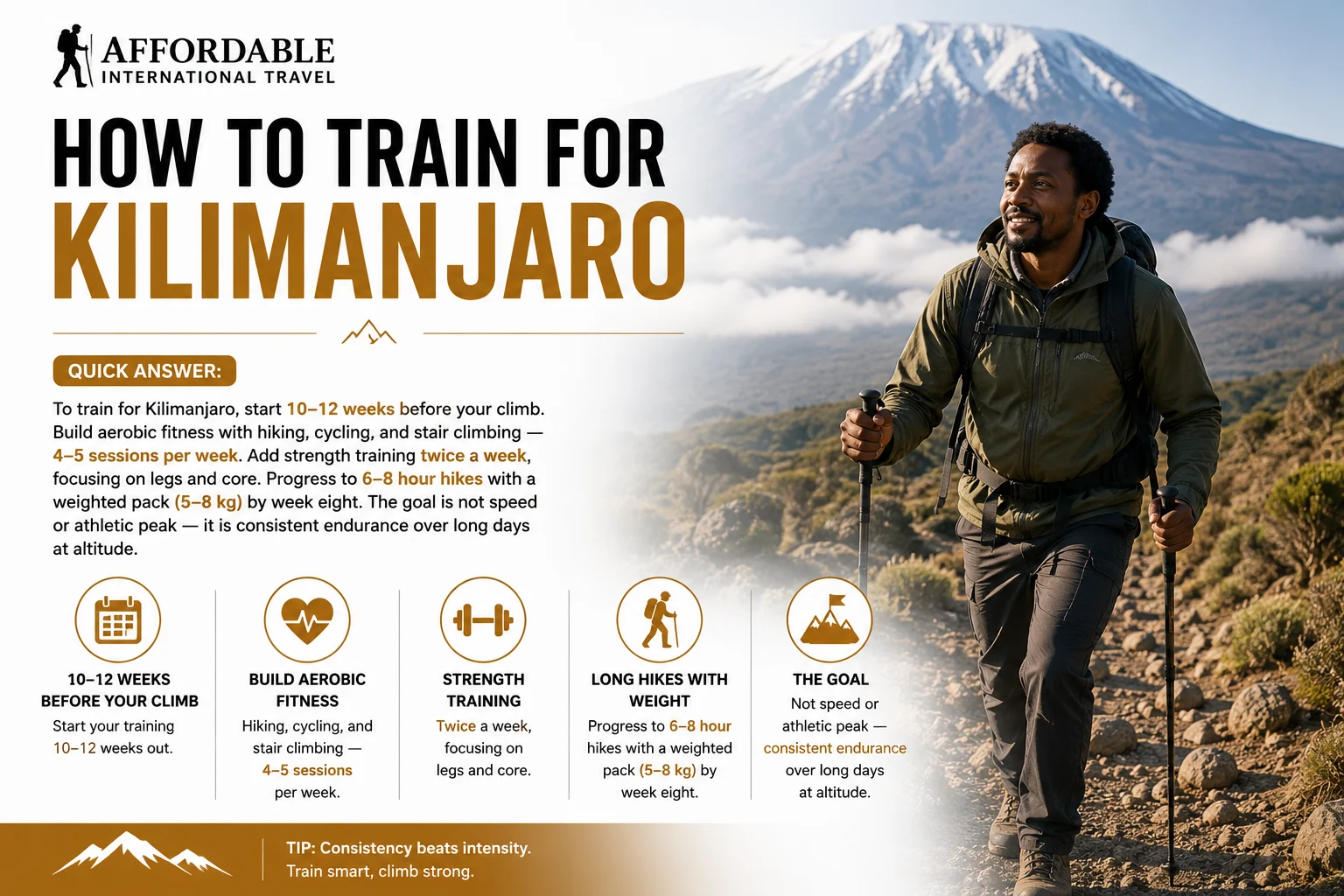
Quick Answer: To train for Kilimanjaro, start 10–12 weeks before your climb. Build aerobic fitness with hiking, cycling, and stair climbing — 4–5 sessions per week. Add strength training twice a week, focusing on legs and core. Progress to 6–8 hour hikes with a weighted pack (5–8 kg) by week eight. The goal is not speed or athletic peak — it is consistent endurance over long days at altitude.
You Don’t Need to Be an Athlete. But You Do Need to Prepare.
Tumaini Elias Mwangi
Most people who ask me how to train for Kilimanjaro are not athletes. They are teachers, accountants, parents in their 40s, and first-time hikers who decided one day that standing on the Roof of Africa is something they need to do. That is exactly who this mountain is for.
But here is what I tell every single one of them on their first call: Kilimanjaro is not technical. You do not need ropes or crampons. What will turn you around before the summit — and it happens to people every week — is not lack of skill. It is lack of aerobic base, underprepared legs, and a body that has never spent six consecutive hours on its feet.
In 11 years guiding and 108 successful Kilimanjaro summits, I have watched fit-looking people struggle and ordinary-looking people fly. The difference, almost every time, comes down to the quality of their preparation in the 10–12 weeks before they landed in Moshi.
This guide gives you the exact framework I share with clients of Affordable International Travel before they start their climb. Follow it, and your legs and lungs will be ready. The altitude — that we handle together on the mountain.
How Fit Do You Actually Need to Be to Climb Kilimanjaro?
The honest answer: you need to be consistently active, not impressively fit.
The physical demands of Kilimanjaro are not explosive. Your average hiking day covers 10–16 km over 5–8 hours. Summit night on a route like Machame adds another 6–8 hours on top. The gradient is steady, not vertical. The pace is slow — pole pole in Swahili, meaning “slowly, slowly” — and that is not a suggestion. It is strategy.
What will break you down, if anything does, is cumulative fatigue across 6–8 consecutive days. So the fitness benchmark is simple:
- Can you hike for 6 hours without stopping?
- Can you do it three days in a row?
- Can you do it with a 5–7 kg daypack on your back?
If the answer is not yet, this training plan will get you there.
A Simple Self-Assessment Before You Start
Before week one, honestly answer these:
- Cardio baseline: Can you walk briskly for 45 minutes without losing your breath?
- Leg strength: Can you do 20 consecutive bodyweight squats without knee discomfort?
- Hike history: Have you done any hike over 3 hours in the last 12 months?
If you said no to the first two, start at week one with lighter outputs than those listed and give yourself 14 weeks instead of 12. If you said yes to all three, you can start at the intensity levels listed below.
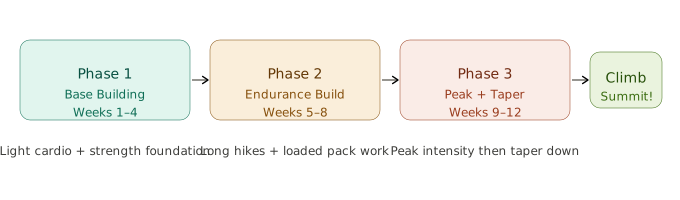
Plan for 10–12 weeks of structured training. Less than 8 weeks is genuinely risky — not dangerous, but you will feel it by day four and it can affect your summit outcome. The ideal preparation window is 8–12 weeks, which allows your body to adapt gradually, build endurance safely, and reduce the risk of injury. I tell every client: if you have 12 weeks, use all 12.
If your climb is less than 8 weeks away, shorten Phase 1 and spend more time in Phase 2. Do not skip the taper.
The 12-Week Kilimanjaro Training Plan
Phase 1: Base Building (Weeks 1–4)
The goal here is not intensity — it is consistency. Your body needs to learn what it feels like to move for 45–60 minutes at a stretch, day after day. Most people who start this phase too hard injure themselves by week three. Start easier than you think you should.
Weekly structure, weeks 1–4:
- Cardio (3–4 sessions): Brisk walking, light jogging, cycling, or swimming. Start at 30–40 minutes per session. By week 4, push to 50–60 minutes. Aerobic exercises should be done 2–4 times a week for at least 40 minutes per session, with gradual increases in intensity and duration.
- Strength training (2 sessions): Focus on your legs and core. Squats, lunges, step-ups, glute bridges, planks, and single-leg deadlifts. Two sets of 12–15 reps per exercise. Keep it light — you are building a foundation, not competing.
- Weekend walk (1 session): One walk per week of 60–90 minutes on varied terrain. Bring a light daypack with 2–3 litres of water. Hills are better than flat pavement.
- Rest (1–2 days): Non-negotiable. Muscles adapt when they recover.
What you should feel by week 4: 60-minute cardio sessions feel moderate, not hard. Your legs are not sore for two days after a walk. You have a rhythm.
Phase 2: Endurance Build (Weeks 5–8)
This is where the real work happens. You are extending your time on your feet, adding weight to your pack, and introducing multi-hour hikes that genuinely simulate a Kilimanjaro day.
Weekly structure, weeks 5–8:
- Cardio (4–5 sessions): 50–70 minutes per session. If you have access to a treadmill, incline walking at 8–12% grade is excellent Kilimanjaro simulation. Power walks on a treadmill at a high incline are one of the best ways for sea-level climbers to prepare, with a focus on increasing cardiovascular capacity. Browneyedflowerchild
- Strength training (2–3 sessions): Add weight or resistance to your leg exercises. Step-ups on a knee-height box with a weighted pack (5 kg) directly mimic the kind of effort you will face going uphill with your daypack.
- Long hike (1–2 sessions): The centrepiece of Phase 2. Start at 3–4 hours in week 5. Build to 5–6 hours by week 8. Carry a pack of 5–6 kg. Find hills. The more elevation gain, the better.
- Stair climbing (1 session, optional but powerful): If you live near stairs or have gym stair access, 30–45 minutes of sustained stair climbing two to three times per week is arguably the best single training activity for Kilimanjaro. It targets the exact muscle groups — quads, glutes, calves — that bear the load on ascent.
By week 8, you should be able to hike for 5–6 hours with a loaded pack and feel tired but functional at the end — not destroyed.
Phase 3: Peak Training and Taper (Weeks 9–12)
Weeks 9–10 are your hardest weeks. You push to your peak output. Then weeks 11–12, you reduce volume deliberately — this is called a taper, and it is when your body actually consolidates all the gains you have made.
Weeks 9–10 (peak):
- One long hike of 6–8 hours with a 6–8 kg pack. If you can find a multi-day hike nearby and complete two days back to back, that is the single best simulation of Kilimanjaro conditions available to you.
- Cardio sessions continue at 60–70 minutes.
- Strength training scaled back to 2 sessions — maintenance, not progression.
Weeks 11–12 (taper):
- Cut long hike duration to 3–4 hours. Keep the pack weight but reduce time.
- Cardio drops to 30–40 minutes, 3–4 sessions per week.
- No new strength exercises. Focus on mobility — hip flexors, calves, IT band.
- Prioritise sleep. Seriously. Eight hours minimum. Your summit chances are higher when you arrive rested than when you arrive peaked.
Field note: The most common mistake I see in the week before a climb is over-training. Clients feel anxious and try to squeeze in one last hard workout. Do not. Nothing you do in week 12 improves your fitness. All it can do is tire your legs before you even board the plane.
The 5 Best Exercises for Kilimanjaro Training
Not all cardio is equal for Kilimanjaro. Some forms of exercise translate directly to the demands of the mountain; others are good general fitness but limited transfer. Here is where to spend your time.
1. Loaded Hill Hiking (highest transfer)
Nothing prepares you for Kilimanjaro like walking uphill with a pack. If there are hills within 30 minutes of your home, this is where your weekends should go. Regular gym workouts combined with actual walks — especially with a daypack carrying at least three litres of water or three kilograms — simulate the relevant conditions you will encounter on the mountain.
2. Stair Climbing and Stair Master
Consistent stair work builds quad and glute endurance in a way that flat cardio cannot replicate. Aim for 30–45 continuous minutes. The incline setting on a treadmill at 12–15% gives a similar benefit if stairs are not available.
3. Cycling (gym bike or outdoors)
Low-impact, high aerobic output. Excellent for recovery days and for people with knee sensitivity. Use a resistance-heavy setting and maintain a steady 70–80 rpm cadence — this mimics the sustained, rhythmic effort of a long Kilimanjaro day.
4. Strength Work: Legs and Core
Specifically: squats, lunges, step-ups, single-leg deadlifts, and Romanian deadlifts for the posterior chain. Core work: planks, dead bugs, and side bridges. Functional exercises like squats, lunges, and deadlifts prepare your muscles for carrying a backpack and improve balance and stability on uneven terrain.
5. Long Slow Distance Running (moderate transfer)
Running builds cardiovascular capacity well, but it is higher-impact and can cause knee problems if you ramp up quickly. If you run regularly, keep it in your plan. If you do not run, do not start a running programme 10 weeks before Kilimanjaro — stick to hiking and cycling. The movement patterns are not identical and running-related injuries are a real risk when introduced suddenly.
How Altitude Affects Your Body — and What Training Can Do About It
This is where I need to be completely honest with you, because altitude is the one variable that training cannot fully solve.
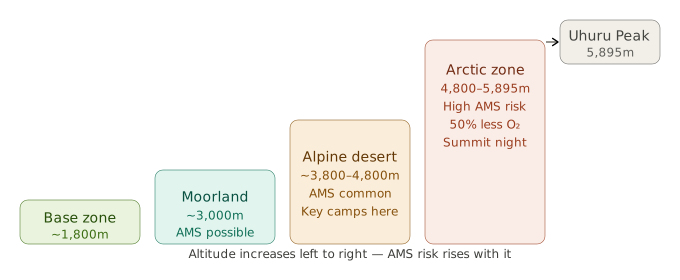
At Kilimanjaro’s summit, the oxygen available is approximately 49% less than at sea level — not because the percentage of oxygen in air changes, but because barometric pressure drops significantly with altitude, reducing the concentration of oxygen molecules per breath.
What training does is build a cardiovascular system efficient enough to extract maximum use from the oxygen that is available. A trained heart and set of lungs handle altitude better than an untrained ones. But no one can train themselves immune to AMS — it can affect elite athletes and sedentary people equally, with no reliable predictor.
Can You Train for Altitude at Home?
If you live at sea level, you cannot fully replicate altitude conditions. But you can do three things that help:
- Maximise your VO2 max — the amount of oxygen your body can use per minute. Interval training (alternating hard effort with easy effort) is the most effective way to do this.
- Build aerobic base volume — more hours in Zone 2 (conversational effort cardio) means your body becomes more efficient at oxygen use at any altitude.
- Pre-acclimatize if possible — if you can spend 2–3 nights at 2,000–3,000m in the weeks before your climb, it gives your body a head start on producing extra red blood cells.
If you are based anywhere near moderate elevation — the Kenyan highlands, the Ethiopian plateau, or upland regions of East Africa — you have a significant natural advantage over sea-level climbers.
Should You Take Diamox (Acetazolamide)?
This is a medical decision, not a guiding decision — speak to your doctor before your climb. Diamox has been shown to up-regulate the body’s natural acclimatisation processes and can help speed things up, but it is not a substitute for proper pacing and a longer route with acclimatization time built in.
The Himalayan Rescue Association has detailed, evidence-based information on altitude medications that I recommend every climber read before making this decision.
What to Do in the Final Week Before Your Kilimanjaro Climb
The week before you fly to Kilimanjaro should not be a training week. It should be a preparation week.
- Training: 2–3 light 30–40 minute walks. Nothing longer. Nothing intense.
- Gear: Walk in your actual summit boots for at least three of those sessions. Blisters discovered in Moshi are manageable. Blisters discovered on day two at 3,700m are not.
- Hydration: Increase your daily water intake. Kilimanjaro requires 3–4 litres per day on the mountain. Start the habit early.
- Sleep: Prioritise it. Every night of the final week should be 7–8 hours minimum.
- Alcohol: Minimise or eliminate in the final two weeks. Alcohol dehydrates you and impairs sleep quality — both are costly at altitude.
- Medical: Confirm any prescriptions you need (Diamox, travel insurance, travel vaccinations). Check the Tanzania National Parks Authority (TANAPA) website for any current entry or park regulation updates.
If you are flying from Europe, North America, or Australia, arrive in Moshi at least one full day before your climb starts. Jet lag combined with altitude on day one is a combination I have seen cost good climbers their summit.
How Your Route Choice Changes How Hard You Need to Train
Not every Kilimanjaro route makes the same physical demands. The route you choose with AIT has a direct bearing on how fit you need to be — and how aggressively you should train.
| Route | Duration | Difficulty | Who it suits |
|---|---|---|---|
| Machame | 6–7 days | Moderate–challenging | Most popular; good acclimatisation |
| Lemosho | 7–8 days | Moderate | Best success rate; longer approach |
| Rongai | 7 days | Moderate | Remote northern approach; good for less-trained climbers |
| Marangu | 5–6 days | Moderate | Only hut route; shorter acclimatisation window |
| Umbwe | 5–6 days | Challenging | Steep and fast; experienced hikers only |
Longer routes like Lemosho and Northern Circuit offer better acclimatisation and higher summit success rates. Short 5–6 day itineraries increase altitude-sickness risk and reduce summit success — longer means safer.
If you are training for Machame or Umbwe, do not skip the longer hikes in Phase 2. If you are on Lemosho or Rongai, your extra acclimatization days give your body more buffer — but the training standard is the same. Your legs still need to carry you 8 hours on summit night regardless of route.
Browse the full breakdown of our Kilimanjaro climb packages to see which route matches your timeline and fitness level. If you are unsure, message the team directly — picking the right route for your body is half the battle.
If you are combining your Kilimanjaro climb with a Tanzania safari before or after, the wildlife side of the trip is completely different physically — but planning both together affects how you pace your recovery. See our Tanzania safari packages and we can build an itinerary that works for both.
How long does it take to train for Kilimanjaro?
Plan for 10–12 weeks of structured preparation. Eight weeks is the absolute minimum for someone with a reasonable fitness base. If you have more time, use it — building a deeper aerobic base over 14–16 weeks significantly improves your summit odds and makes the experience more enjoyable. Begin with shorter sessions and progressively increase duration and load each week.
Can I climb Kilimanjaro with no hiking experience?
Yes, but you need compensating preparation. No prior hiking experience means your body has not adapted to sustained downhill strain, uneven terrain, or carrying a loaded pack. If you have not hiked before, spend extra time in Phase 2 on long hikes over varied terrain with a weighted daypack. Your joints and connective tissue need more time to adapt than your cardiovascular system.
Is running good training for Kilimanjaro?
Running builds cardiovascular fitness, but the movement pattern is different from uphill hiking. If you already run regularly, keep it in your plan and supplement with loaded hikes. If you do not run, do not start a running programme less than 12 weeks before Kilimanjaro — running-related injuries like IT band syndrome are common in new runners and can derail your preparation entirely.
Do I need to train at altitude before climbing Kilimanjaro?
No — most climbers prepare at sea level and summit successfully. What altitude training does is give your body a head start on producing additional red blood cells. If you live near or can spend time at 2,000–3,000m before your climb, take that opportunity. If not, focus on maximising your aerobic fitness at whatever elevation you have access to.
What should I do if I have knee problems?
Switch your primary cardio from running and stair climbing to cycling and swimming, which are low-impact. Continue leg strength work — strong quads actually reduce stress on the knee joint on descents. On the mountain, trekking poles (which AIT provides) dramatically reduce knee load on the way down. Many climbers with chronic knee issues complete Kilimanjaro without problems when properly prepared.
What should I eat while training for Kilimanjaro?
Focus on whole, nutrient-dense food rather than a specific diet. Prioritise protein (for muscle repair), complex carbohydrates (for sustained energy), and iron-rich foods (which support red blood cell production — relevant given the altitude demands). Stay well hydrated throughout training. In the two weeks before your climb, reduce alcohol and processed food, which impair sleep and recovery.
How heavy should my training pack be?
Start with 2–3 kg in weeks 3–4. Build to 5–6 kg by week 6. Reach 6–8 kg in your peak long hikes in weeks 9–10. On the actual climb, your daypack will be around 5–7 kg (water, layers, snacks, camera). Your crew carries your main kit bag — so your training pack should match your summit day load, not a full expedition weight.
Can older climbers (50s and 60s) complete Kilimanjaro?
Absolutely. Some of my most composed, steady clients have been in their 60s. The mountain rewards patience and pacing — qualities that often come with experience. Older climbers should allow a slightly longer training window (14 weeks rather than 12), prioritise strength and flexibility training, and choose a longer-duration route like Lemosho or Rongai to maximise acclimatisation time. Consult your GP before starting training if you have any cardiovascular or joint concerns.
Start Training, Then Start Planning
Kilimanjaro is achievable. I know that because I have guided 108 people to the summit — people from all walks of life, all fitness levels, all ages. The common thread was never athletic ability. It was showing up for their training consistently, pacing themselves on the mountain, and trusting the process.
The training plan in this guide will get your body ready. The route choice, acclimatisation strategy, and summit pacing — that is where Affordable International Travel comes in. As a TWMA-certified operator (Tanzania Wildlife Management Authority) with a 94% Kilimanjaro summit success rate across 340+ completed climbs, we have built every part of our Kilimanjaro programme around one outcome: getting you to Uhuru Peak.
Here is what your next step looks like:
- Choose your Kilimanjaro route and dates
- Start week one of this training plan
- Message Tumaini directly on WhatsApp — he will answer any question about preparation, gear, or route fitness: +255 740 453 344
You can also meet the full AIT team or get in touch via the contact page to request a detailed quote.
If you are visiting Tanzania and want to warm up your legs before the mountain, consider one of our day trips from Moshi — Materuni Waterfall and Chemka Hot Springs are both accessible hikes that double as excellent pre-acclimatisation outings.