
A shared road safari is significantly cheaper than a flying safari in Tanzania. A shared 5-day northern circuit safari typically costs $1,800–$2,500 per person, while a comparable fly-in safari runs $3,000–$6,000+ per person. The difference is almost entirely explained by domestic flight costs, which add $250–$500 per person per flight leg. However, a flying safari buys back travel time — replacing a 6-hour road journey with a 45-minute flight — making it worth the premium for travellers with very limited days or specific remote destinations.
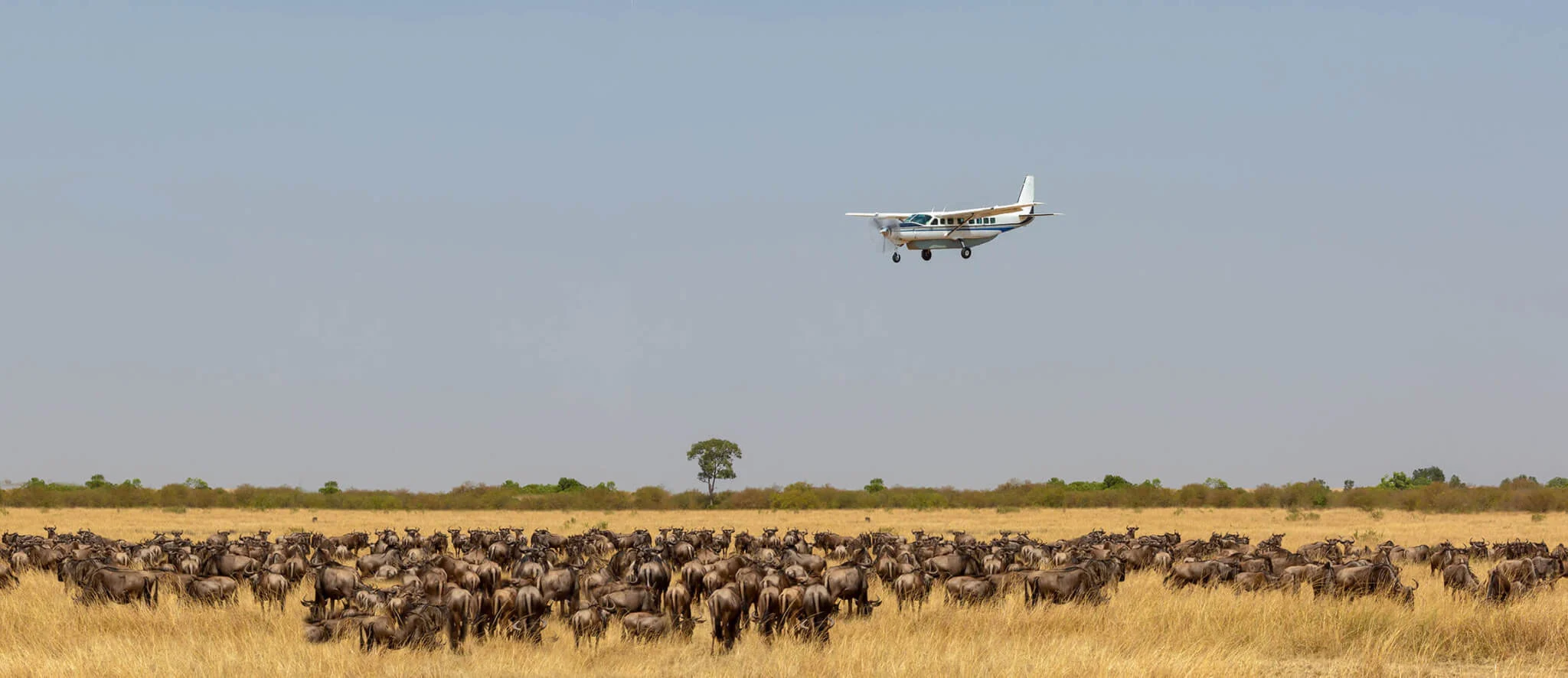
When you start planning a Tanzania safari, you will quickly encounter two very different ways of getting between parks: the 4WD Land Cruiser that rolls out of Arusha at first light, and the small propeller aircraft that drops onto a bush airstrip an hour later while wildebeest scatter across the landing strip.
Both are genuinely thrilling in their own right. Both deliver you to the same lions, the same elephants, the same Serengeti sunrises. But one costs roughly two to three times more than the other — and the travel industry does not always explain clearly what that extra money actually buys, or whether it is worth it for your specific trip.
This guide answers that question with precision. We will walk you through the complete cost of each format, explain exactly what changes and what stays the same, tell you which type of traveller benefits most from each option, and show you how to make the decision that fits your budget, your days available, and your safari priorities.
At Affordable International Travel Ltd, we run both shared road safaris and fly-in packages across Tanzania’s northern and southern circuits. We have been doing this long enough to know when a road safari is the smarter choice and when a flight genuinely changes the experience — and we will give you that honest perspective here.
Understanding the Two Safari Formats
Before diving into costs, it is worth being precise about what these two formats actually involve, because the terminology can be confusing.
What Is a Shared Road Safari?
A shared road safari places you in a 4WD safari vehicle — typically a Toyota Land Cruiser with a pop-up roof — along with other independently travelling tourists. You travel between parks and accommodation by road, sharing the vehicle and all logistics costs with your fellow passengers.
All game drives take place from the vehicle. Accommodation is at lodges, tented camps, or public campsites reached by road. Transfers between Arusha and the parks, and between parks, are all handled as part of the package.
The vast majority of Tanzania’s northern circuit safaris operate this way. It is the backbone of the country’s safari industry, the format that makes Tanzania’s parks accessible to travellers at a wide range of budgets, and the reason our packages at Affordable International Travel Ltd start from $700 per person.
What Is a Flying Safari?
A flying safari replaces the road transfer between destinations with a domestic flight aboard a small propeller aircraft — typically a 12-to-19-seater Cessna or similar operated by Tanzanian domestic carriers. These aircraft connect Arusha’s small domestic terminal directly to airstrips inside or adjacent to the national parks: Seronera in central Serengeti, Kogatende in northern Serengeti, Grumeti in the western corridor, and others.
Once at the park airstrip, a vehicle from the lodge or camp receives you for game drives. These game drives are usually conducted in the lodge’s own vehicles, which means a flying safari is typically more closely tied to a specific lodge rather than the flexible routing of a road safari.
The game drives themselves are broadly similar in experience. The fundamental difference is how you get there — and what that costs.
The Full Cost of a Shared Road Safari
What Drives the Cost?
The cost components of a shared road safari are:
- Park entrance fees (non-negotiable, per person per day regardless of transport method)
- Shared vehicle (Land Cruiser, cost divided among passengers — typically 4–6 people)
- Fuel (substantial on longer routes like Arusha to Serengeti at 335 km)
- Driver-guide fees (divided among passengers in a shared vehicle)
- Accommodation (per person per night, your largest variable cost)
- Meals, full board (included in package pricing)
- Airport/hotel transfers (included in package pricing)
The Road Distance Reality
Understanding Tanzania’s road distances is essential to evaluating whether a flight adds real value:
| Route | Distance | Drive Time |
|---|---|---|
| Arusha → Tarangire | 118 km | ~2 hours |
| Arusha → Lake Manyara | 126 km | ~2 hours |
| Arusha → Ngorongoro Crater rim | 180 km | ~3.5 hours |
| Arusha → Central Serengeti (Seronera) | 335 km | ~6–7 hours |
| Arusha → Northern Serengeti (Kogatende) | ~450 km | ~8–9 hours |
| Tarangire → Serengeti (via Ngorongoro) | ~250 km | ~5 hours |
| Ngorongoro → Central Serengeti | ~145 km | ~2–3 hours |
The road from Arusha to the central Serengeti passes through the Ngorongoro Conservation Area, meaning most travellers pay the NCA entry fee on their way through — which our packages at Affordable International Travel Ltd incorporate into the itinerary as a legitimate value stop rather than a pure transit cost.
Shared Road Safari Cost Breakdown: 5-Day Northern Circuit
This covers Tarangire, Central Serengeti, and Ngorongoro — Tanzania’s iconic northern trio.
| Cost Component | Shared Group (6 Passengers) Per Person |
|---|---|
| Park fees (5 days: Tarangire 2 days, Serengeti 2 days, Ngorongoro 1 day) | ~$306 |
| Ngorongoro crater descent (vehicle, shared ÷ 6) | ~$33 |
| Safari vehicle + fuel (shared ÷ 6) | ~$80–$120 |
| Driver-guide (shared ÷ 6) | ~$40–$60 |
| Accommodation (4 nights, budget to mid-range) | $400–$800 |
| Meals, full board | Included |
| All transfers | Included |
| Government taxes | Included |
| Estimated total per person | $1,800–$2,500 |
Our real-world pricing reflects this directly. Our 5-day Lake Manyara, Serengeti, and Ngorongoro safari starts from $2,000 per person, and our 5-day Tarangire, Ngorongoro, and Serengeti safari starts from the same price — both fully inclusive by road.
For shorter trips, a 4-day Tarangire, Ngorongoro, and Serengeti package starts from $1,800 per person, and a 4-day Ngorongoro and Serengeti safari starts from $1,891 per person.
The Full Cost of a Flying Safari
What Are Domestic Flights in Tanzania?
Tanzania’s domestic aviation network connects Arusha Airport (ARK) with a series of bush airstrips inside the national parks. Key routes for safari travellers include:
| Flight Route | Approximate One-Way Cost Per Person |
|---|---|
| Arusha → Serengeti (Seronera, Central) | $250–$300 |
| Arusha → Northern Serengeti (Kogatende) | $280–$350 |
| Arusha → Ruaha National Park | $350–$450 |
| Arusha → Nyerere (Selous) | $350–$450 |
| Serengeti → Zanzibar | $200–$280 |
| Between Serengeti airstrips (hops) | $100–$200 |
A round-trip flight from Arusha to the Central Serengeti therefore costs approximately $500–$650 per person. This flight cost is in addition to all the other safari components — park fees, accommodation, guide, and vehicle — which remain identical to the road safari.
Carriers operating Tanzania’s domestic bush routes include Coastal Aviation, Auric Air, Regional Air, and Safari Air Link. These are scheduled services using small propeller aircraft, typically 12–19 seats, with baggage limits of 15 kg per passenger in soft bags — an important practical consideration for packing.
Flying Safari Cost Breakdown: 3-Day Northern Serengeti (Fly-In)
This is the fly-in format at its most compelling — specifically designed for travellers targeting the Great Migration river crossings in the northern Serengeti, which are not practical to reach by road in under 3 days.
| Cost Component | Per Person |
|---|---|
| Return flight Arusha → Northern Serengeti | $560–$700 |
| Park fees (3 days Serengeti) | $210 |
| Accommodation (2 nights, mid-range lodge) | $300–$600 |
| Game drives (lodge vehicle, included in accommodation) | Included |
| Meals, full board | Included |
| Government taxes | Included |
| Estimated total per person | $1,270–$1,510 |
Our 3-day Serengeti Great Migration Fly-In Safari starts from $1,511 per person for groups of 10+ — a fully packaged fly-in safari that delivers guests directly to Kogatende airstrip in the northern Serengeti, positioned for the Mara River crossings. For smaller groups of 2–4 people, the price is $1,600 per person, and for a solo traveller it is $1,800 — reflecting the flight cost shared across fewer passengers.
Flying Safari Cost Breakdown: 5-Day Multi-Park Fly-In
For a longer fly-in itinerary covering the Serengeti plus another park, the cost profile changes significantly:
| Cost Component | Per Person |
|---|---|
| Flights (Arusha → Tarangire + Tarangire → Serengeti + Serengeti → Arusha) | $700–$1,000 |
| Park fees (5 days across 3 parks) | ~$306 |
| Accommodation (4 nights, mid-range) | $600–$1,200 |
| Game drives (lodge vehicles, included) | Included |
| Meals, full board | Included |
| Estimated total per person | $3,000–$5,500 |
The comparison is stark. A 5-day fly-in safari costs roughly $1,000–$3,000 more per person than the equivalent road safari. That gap is entirely accounted for by the domestic flights — the park fees, accommodation, and game drives are structurally identical.
Direct Cost Comparison: Shared Road vs Flying Safari
5-Day Northern Circuit Head-to-Head
| Cost Category | Shared Road Safari | Flying Safari |
|---|---|---|
| Park fees (5 days) | ~$306 | ~$306 |
| Domestic flights | $0 | $700–$1,000 |
| Safari vehicle + guide | ~$120–$180 (shared) | Included in lodge rates |
| Accommodation (4 nights) | $400–$800 | $600–$1,200 |
| Total transfers/road fuel | Included in package | N/A |
| Total per person (approx.) | $1,800–$2,500 | $3,000–$5,500 |
| Premium for flying | — | +$1,000–$3,000 per person |
3-Day Serengeti-Only Trip
| Cost Category | Shared Road Safari | Flying Safari |
|---|---|---|
| Park fees (3 days) | $210 | $210 |
| Domestic flights | $0 | $560–$700 |
| Vehicle + guide | ~$80 (shared) | Included in lodge |
| Accommodation (2 nights) | $200–$400 | $300–$600 |
| Total per person (approx.) | $1,000–$1,300 | $1,270–$1,511 |
| Premium for flying | — | +$200–$500 per person |
The 3-day comparison is the most interesting — and the reason our fly-in safari package is priced competitively.
For a very short Serengeti trip targeting the northern migration area, flying cuts out an 8–9 hour road journey each way that would consume almost the entire available days on a 3-day itinerary.
In this specific context, the flight cost premium purchases genuine additional safari time.
What You Actually Get Differently: The Honest Trade-Off Analysis
What a Flying Safari Gives You
More effective safari days. This is the clearest and most legitimate benefit. On a 3-day Serengeti trip by road, the first and last half-days are consumed by the drive to and from Arusha.
By flying, you arrive at the park within an hour and begin game drives immediately. On a tight itinerary, this can meaningfully increase your wildlife hours.
Access to remote parks without long overland journeys. For Tanzania’s southern circuit parks — Ruaha National Park and Nyerere (Selous) — a flight is not just a comfort upgrade; it is a practical necessity for most itineraries.
Both parks sit 400–500 km south of Arusha, requiring an 8–12 hour road journey from Dar es Salaam. Flying from Arusha or Dar cuts this to 1–2 hours and opens up the entire southern circuit to travellers who would otherwise be priced out by the time cost.
The flight experience itself. There is something genuinely special about the bush flight approach to a Serengeti airstrip.
Flying low over open savannah at dawn, spotting herds from the window, and landing on a dirt strip as zebras scatter — it is a memorable experience that has no road equivalent.
Reduced fatigue on longer itineraries. A 5-park fly-in safari covering Arusha, Tarangire, Serengeti, Ngorongoro, and Zanzibar can cover enormous geographic variety in relatively few days without the cumulative fatigue of long road journeys.
For travellers over 60 or those with physical mobility considerations, this is a genuine quality-of-life benefit.
What a Shared Road Safari Gives You
Dramatically lower cost. The $1,000–$3,000 per-person saving on a 5-day road versus flying safari is not trivial. It represents additional parks, more accommodation nights, a Zanzibar extension, or a second safari entirely.
The scenic journey as part of the experience. The road from Arusha to the Serengeti passes through some of Tanzania’s most spectacular and varied landscapes — the highlands of the Ngorongoro Conservation Area, sweeping views across the Rift Valley, Maasai communities, and the extraordinary moment when the savannah of the Serengeti opens before you at the Naabi Hill Gate. This journey is genuinely part of the safari experience and one that flying travellers never have.
Flexibility and adaptability. Road safaris are not locked to specific flight schedules. Your guide can respond to wildlife reports, adjust the day’s route, and take detours that an aircraft itinerary simply cannot accommodate. If a leopard is reported near a kopje an hour off your planned route, a road safari can make that happen. A fly-in schedule cannot.
Game viewing from the vehicle en route. The Ngorongoro Conservation Area, which every road traveller passes through on the way to the Serengeti, is itself a wildlife-rich landscape. Elephants on the road, baboon troops, flamingos on Ndutu — the NCA transit is a bonus game drive that flying travellers pay for separately if they want it at all.
More budget for everything else. A traveller who saves $1,500 per person by choosing a road safari can direct that money toward a Kilimanjaro climb, a Zanzibar beach extension, more park days, or simply arriving home with money to spare. Our Kilimanjaro packages start from $2,000 per person — a combination safari and mountain trek becomes far more accessible when you are not also paying for domestic flights.
When a Flying Safari Is the Right Decision
Despite the clear cost advantage of road safaris, there are specific scenarios where flying genuinely makes sense — and our team at Affordable International Travel Ltd will always tell you honestly when that is the case.
You have 5 or fewer total days in Tanzania and specifically want the northern Serengeti. The northern Serengeti — where the Mara River crossings happen during the Great Migration — is approximately 450 km from Arusha.
By road, reaching it and returning takes two full driving days, leaving only three days of actual safari in a 5-day trip. Flying deposits you there in 60 minutes. For this specific situation, our 3-day Serengeti Great Migration Fly-In Safari from $1,511 per person is explicitly designed as the cost-effective solution. The flight cost is justified by the safari time it recovers.
You are travelling to the southern circuit. Ruaha National Park and Nyerere are remote parks that reward visitors willing to make the journey — but the road options require either a very long drive from Dar es Salaam or a multi-day overland trip that consumes a significant portion of most travellers’ available time.
Flying to Ruaha from Arusha (via Dar, approximately 1.5–2 hours) or from Dar directly (approximately 45 minutes to 1 hour) is the practical way to access southern Tanzania’s extraordinary wilderness for most international visitors.
You are travelling with elderly passengers or family members with mobility considerations. A 6-hour road journey is well within the comfort range of most travellers, but for elderly guests or those with back conditions, the rougher sections of the road approaching the Serengeti from Ngorongoro can be tiring. In these cases, a fly-in option for the Serengeti leg genuinely improves the experience.
You are on a combined multi-destination itinerary that would otherwise require 3+ driving days. If your itinerary includes the Serengeti, Zanzibar, and Kilimanjaro in under 10 days, strategic use of domestic flights — particularly a Serengeti-to-Zanzibar flight — can make the itinerary logistically viable without eating all your time in transit.
When a Road Safari Is the Smarter Choice
For the majority of travellers, a road safari is the smarter choice — and the reasons go beyond cost.
You have 5+ days and are focusing on the northern circuit. The classic northern circuit — Tarangire, Lake Manyara, Central Serengeti, Ngorongoro — is designed for road travel. The parks are well-connected by tarmac and graded dirt roads, the distances are manageable, and the road journey itself through the Ngorongoro highlands is genuinely spectacular. Five days covers this circuit very comfortably by road at a fraction of fly-in pricing.
You are a first-time safari traveller. The 4WD road safari experience — the early morning departures, the evolving landscape out the windows, picnic lunches inside the park, arriving at a rim-top camp as the crater spreads out below — is the quintessential Tanzania safari. Flying bypasses too many of these connecting moments for a first visit.
Budget is a meaningful consideration. A saving of $1,000–$3,000 per person on a 5-day trip is substantial. That money can fund more nights, more parks, a second safari, or a Zanzibar extension that costs a fraction of additional safari nights.
Our 3-day Tarangire, Lake Manyara, and Ngorongoro safari starts from just $1,100 per person by road — a price point that puts three iconic Tanzanian parks within reach of travellers who would find the flying equivalent far beyond their budget.
You want guide flexibility and route adaptability. Road safaris with experienced local guides can respond to real-time wildlife information, make detours based on morning sighting reports, and spend extended time at a sighting without any flight schedule pressure. This adaptability is one of the most underappreciated advantages of the road format.
The Hybrid Approach: Getting the Best of Both
The savviest Tanzania itineraries sometimes combine road and air travel strategically — using road transfers where distances are manageable and wildlife is roadside, and flying only where the time or access genuinely requires it.
Some examples of smart hybrid itineraries:
Road from Arusha through Tarangire, Lake Manyara, and Ngorongoro → Fly from Ngorongoro to Northern Serengeti for the migration crossings. This captures all the northern circuit’s variety by road (where it makes perfect sense), then uses a single flight leg to access the one destination — the northern Serengeti — where road access is genuinely prohibitive on a short trip.
Road safari for the northern circuit → Fly Serengeti to Zanzibar. Several airlines operate direct flights from Serengeti airstrips to Zanzibar, typically taking 45–60 minutes. Adding this single flight leg at the end of a road safari combines the best of Tanzania’s wildlife and beach experiences without requiring a return drive to Arusha.
Fly into Ruaha or Nyerere from Dar es Salaam after a Zanzibar beach stay. For travellers doing a beach-first, safari-second itinerary, flying into the southern circuit parks from Dar or Zanzibar is the practical approach to accessing remote wildlife without a multi-day overland commitment.
At Affordable International Travel Ltd, we design hybrid itineraries for travellers whose wildlife and budget priorities call for them. Talk to our team and we will map out the best combination for your specific trip.
Baggage Limits: An Important Practical Note
Tanzania’s domestic bush flights impose strict baggage limits that many travellers underestimate. Most scheduled services on small propeller aircraft — Coastal Aviation, Auric Air, Regional Air, and others — enforce a limit of 15 kg per passenger in soft bags only (no hard suitcases). Excess baggage is charged at $1–$3 per extra kilogram, and hard bags are sometimes refused entirely.
This limit has practical implications for packing. Road safari travellers have no such restriction — your bags go in the Land Cruiser’s luggage compartment and you can bring whatever you need comfortably. Flying safari travellers need to pack specifically for the limit, using duffle bags or soft travel packs.
For families with young children, the 15 kg limit per person can be challenging. Road safaris eliminate this consideration entirely.
Our Shared Road Safari Packages: Every Budget Covered
At Affordable International Travel Ltd, our shared road safari portfolio covers the full range of trip lengths and park combinations. All packages are fully inclusive — park fees, vehicle, licensed guide, full-board accommodation, transfers, and water — with no hidden extras.
Short itineraries (2 days, from $700 per person):
- 2 Days Tarangire and Lake Manyara Safari
- 2 Days Lake Manyara and Ngorongoro Crater Safari
- 2 Days Tarangire and Ngorongoro Crater Safari
3-day itineraries (from $1,100 per person):
- 3 Days Tarangire, Lake Manyara, and Ngorongoro Safari
- 3 Days Arusha, Tarangire, and Ngorongoro Safari
- 3 Days Game Drive, Culture, and Bush Walk in Tarangire and Ngorongoro
- 3 Days Ngorongoro Rim Walk and Empakaai Crater Hike
4-day itineraries (from $1,800 per person):
- 4 Days Lake Manyara, Serengeti, and Ngorongoro Safari
- 4 Days Tarangire, Ngorongoro, and Serengeti Safari
- 4 Days Ngorongoro Crater and Serengeti Safari
5-day itineraries (from $2,000 per person):
- 5 Days Lake Manyara, Serengeti, and Ngorongoro Safari
- 5 Days Tarangire, Ngorongoro, and Serengeti Safari
Flying safari:
- 3 Days Serengeti Great Migration Fly-In Safari — from $1,511 per person (10+ people)
What the Tanzania Safari Industry’s Most Experienced Travellers Say
Travellers who have been on multiple Tanzania safaris — the ones who have done both road and fly-in formats — consistently report the same finding: the road journey through the Ngorongoro highlands is one of their most vivid memories.
The transition from the agricultural highlands above Karatu, through the forest cloud zone on the NCA escarpment, and out onto the open Serengeti plain is a landscape sequence that no in-country flight can replicate.
This is not a reason to choose road over fly-in by itself. But it is a reminder that the 4WD Land Cruiser is not merely a transport tool — it is a viewing platform, a moving part of the safari, and a way of reading Tanzania’s geography that has real experiential value.
The Tanzania Tourism Board notes that the northern safari circuit is among the world’s most comprehensively developed overland safari routes — a reflection of the fact that the roads, the distances, and the park layout genuinely suit road travel in a way that many other African safari destinations do not.
Frequently Asked Questions
How much does a domestic flight cost in Tanzania for a safari?
A one-way scheduled domestic flight from Arusha to the central Serengeti (Seronera) costs approximately $250–$300 per person. To the northern Serengeti (Kogatende, for the migration crossings), expect $280–$350 one-way. Return flights therefore add $500–$700 per person to a Serengeti safari versus a road transfer. Flights between parks (hops) within an itinerary cost $100–$200 per leg. These are per-person costs on shared scheduled services — private charter aircraft are substantially more expensive.
Is it worth flying to the Serengeti for a short trip?
Yes, for trips of 3 days or fewer where the northern Serengeti is the target. The round-trip road journey from Arusha to the northern Serengeti is 16–18 hours of driving over two days. On a 3-day trip, that road time consumes the majority of your itinerary. Flying from Arusha to Kogatende takes approximately 60–90 minutes (including possible intermediate stops) and preserves almost all three days for actual game drives. Our 3-day Serengeti Great Migration Fly-In Safari from $1,511 per person is built precisely around this logic.
Can I do a road safari to the northern Serengeti to save money?
Yes, but it requires planning. The northern Serengeti is 450 km from Arusha — roughly 8–9 hours by road including the NCA transit. For a 7-day+ itinerary that includes central Serengeti before moving north, road access is practical and significantly cheaper than flying. For a 3–4 day trip targeting the northern Serengeti exclusively, the road time consumed makes the itinerary impractical for most travellers.
Do flying safaris include game drives in the price?
In most fly-in packages, game drives are conducted in the lodge’s own vehicles and are included in the accommodation rate rather than separately charged. However, this means your game drive vehicle and departure times are tied to the lodge’s schedule rather than your personal preferences — unlike a private road safari where your guide adapts the day entirely to your group.
Can solo travellers save money on a fly-in safari by joining a group flight?
Yes. Tanzania’s domestic flight prices are per person on shared scheduled services, meaning a solo traveller pays the same per-seat price as anyone else. The cost does not increase for solo travellers in the same way that a private vehicle does. This is one reason why a fly-in safari can occasionally be more cost-competitive for solo travellers than a private road safari: the per-person flight cost is fixed, while the per-person private vehicle cost on a road safari is high when shared between only one person.
Which parks are best reached by flight versus road in Tanzania?
By road (practical and cost-efficient): Tarangire, Lake Manyara, Ngorongoro, Central Serengeti — all well within 2–7 hours from Arusha on good roads. By flight (recommended or near-necessary): Northern Serengeti (for migration crossings on short trips), Ruaha National Park, Nyerere (Selous) — all remote enough that flying saves meaningful travel days.
Conclusion: Road Wins on Value, Flying Wins on Time
The answer to this guide’s central question is straightforward: shared road safaris are cheaper — significantly so — and for most travellers, they deliver an equivalent or superior overall experience.
The $1,000–$3,000 per-person premium of a flying safari purchases one specific thing: time saved in transit. For the majority of Tanzania safari travellers — those with 4 or more days available and an itinerary focused on the accessible northern circuit — that time saving is not worth the cost.
The road journey is part of the safari. The landscapes change through the windscreen. The Ngorongoro highlands feel different when you have risen through them slowly. The moment the Serengeti opens before you after the last ridge is better earned on wheels than by landing strip.
For a specific subset of travellers — those with 3 or fewer days, those targeting the remote northern Serengeti for the migration crossings, or those travelling to the southern circuit’s remote parks — a flight is not a luxury.
It is the practical solution that makes the itinerary work. Our 3-day Serengeti Great Migration Fly-In Safari from $1,511 per person exists specifically for those travellers, and we price it to be as accessible as the flight cost allows.
At Affordable International Travel Ltd, we have been matching travellers to the right Tanzania safari format for years. Whether your budget points firmly toward the road or your itinerary genuinely calls for a flight, we will build the right package around your priorities — with zero hidden fees and full transparency on every cost.
Request your free, no-obligation Tanzania safari quote today →
Explore Our Tanzania Safari Packages
- All Tanzania Safari Tours — Browse by duration and price
- All Tanzania Safari Destinations
- 3 Days Serengeti Migration Fly-In Safari — from $1,511/person
- 3 Days Tarangire, Lake Manyara, and Ngorongoro — from $1,100/person
- 4 Days Tarangire, Ngorongoro, and Serengeti — from $1,800/person
- 4 Days Ngorongoro and Serengeti Safari — from $1,891/person
- 5 Days Lake Manyara, Serengeti, and Ngorongoro — from $2,000/person
- 5 Days Tarangire, Ngorongoro, and Serengeti — from $2,000/person
- Ruaha National Park Safari
- Climbing Mount Kilimanjaro
- Contact Us — Talk to a Safari Expert