- From $2,000 /person
- 6 or 7 days
- Price Includes
About This Activity
Duration: 6 or 7 days (7 days strongly recommended)
Difficulty Level: Very Challenging (steep, direct ascent)
Accommodation: Camping (tents)
Nickname: “The Whiskey Route”
Success Rate:
6 Days: ~60–70%
7 Days: ~75–85%
Distance: ~53 km
Best For:
Experienced hikers
Adventure-focused travelers
Fit climbers seeking solitude
Budget travelers who value experience over comfort
Starting Point: Umbwe Gate
Ending Point: Mweka Gate
Highest Point: Uhuru Peak (5,895 m)
Why Choose the Umbwe Route?
The Umbwe Route is not about shortcuts — it’s about intensity, solitude, and raw mountain beauty.
Choose Umbwe if you:
Prefer a direct, no-nonsense climb
Enjoy steep forest trails and dramatic ridges
Are physically fit and mentally prepared
Want a true mountaineering feel on a budget
Umbwe is not recommended for first-time high-altitude trekkers unless paired with a longer itinerary (7 days) and proper preparation.
Overview
The Umbwe Route is widely regarded by professional Kilimanjaro guides as the steepest, most direct, and most physically demanding route to the summit of Mount Kilimanjaro.
From the very first day, the trail rises sharply from Umbwe Gate, cutting straight through thick, untouched rainforest with minimal switchbacks.
This rapid elevation gain is what gives Umbwe its reputation — and also why it demands proper planning and experienced leadership.
One of Umbwe’s most defining characteristics is its extreme sense of isolation.
Unlike Machame or Marangu, which see heavy daily traffic, Umbwe remains quiet and uncrowded, especially during the first two days.
The trail is narrow, often enclosed by forest, and feels raw and untamed — offering a genuine wilderness experience that many seasoned trekkers value.
From an acclimatization standpoint, Umbwe is initially aggressive, which is why at Affordable International Travel, we strongly recommend a 6 or 7-day itinerary.
This allows climbers to safely adapt to altitude once the route joins the Machame Route at Barranco Camp.
This strategic merge is a major advantage: it slows the ascent, introduces natural acclimatization points, and significantly improves summit success rates.
Another key difference is accommodation.
Umbwe is a fully camping route, meaning climbers sleep in high-quality mountain tents rather than huts.
This not only enhances flexibility and safety but also creates a true expedition-style climb, where your support team manages camp setup, meals, and logistics — allowing you to focus fully on the climb.
In short, Umbwe is unique because it combines:
A challenging, direct ascent
Minimal crowds and pristine scenery
A safer acclimatization phase later in the climb
Gallery
What to Expect
Hotel Pickup → Umbwe Gate → Umbwe Camp
Altitude: 1,600 m → 2,850 m
Distance: ~11 km
Trekking Time: 5–6 hours
Your Kilimanjaro adventure begins with an early hotel pickup from Moshi or Arusha. After a friendly briefing and final gear check, you’ll drive through lush farmlands and local villages toward Umbwe Gate, one of the quietest entry points on the mountain.
At the gate:
You register with Kilimanjaro National Park authorities
Porters carefully weigh and organize gear
Your guides review the day’s pace and safety plan
The excitement finally sets in
Once the trek begins, there’s no gentle warm-up — Umbwe climbs immediately.
The trail dives straight into dense rainforest:
Towering trees block out much of the sky
Thick roots and muddy paths demand focus
Moss hangs heavily from branches
Bird calls echo through the forest
The route is steep, narrow, and quiet, with very few other climbers. It feels wild and untouched.
By mid-to-late afternoon, you arrive at Umbwe Camp, tucked deep in the forest. After settling into camp, a hot dinner is served as mist rolls through the trees.
The night is cool, quiet, and deeply atmospheric.
Umbwe Camp → Barranco Camp
Altitude: 2,850 m → 3,900 m
Distance: ~6 km
Trekking Time: 4–5 hours
Today is shorter in distance but still demanding. The trail continues climbing steeply as the rainforest slowly gives way to giant heather and moorland vegetation.
As you gain altitude:
The air becomes cooler and thinner
Forest sounds fade into silence
Views open toward deep valleys below
By late morning, you reach Barranco Camp, dramatically set beneath the imposing Barranco Wall. This is a major milestone — and a turning point in the climb.
Here, the Umbwe Route merges with the Machame Route, improving acclimatization and safety. You’ll enjoy panoramic views of glaciers, ridges, and the southern icefields of Kilimanjaro.
Afternoons here are relaxed:
Rest and hydrate
Stretch tired legs
Watch clouds rise and fall through the valleys
Barranco Camp → Karanga Camp
Altitude: 3,900 m → 4,035 m
Distance: ~5 km
Trekking Time: 4–5 hours
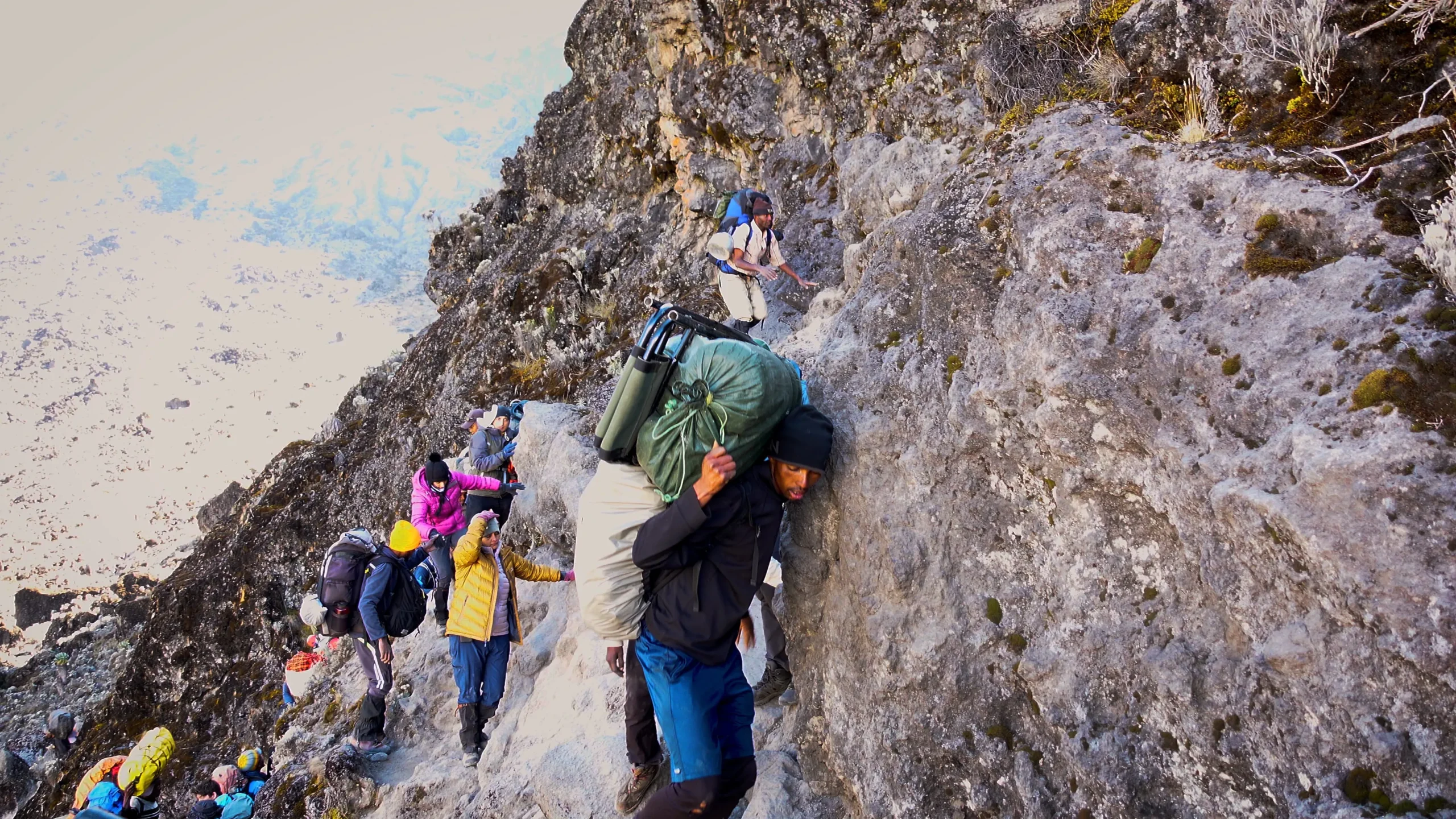
After breakfast, you face one of Kilimanjaro’s most famous features — the Barranco Wall.
Despite its intimidating appearance, it’s a fun, non-technical scramble:
Hands are used for balance, not climbing
Guides assist and choose safe lines
Views expand with every step upward
Reaching the top of the wall is energizing. From here, the trail crosses ridges and valleys, offering constant photo opportunities.
You arrive at Karanga Camp by early afternoon, giving your body time to rest and acclimatize. This shorter day is intentional and plays a key role in summit success.
Karanga Camp → Barafu Camp
Altitude: 4,035 m → 4,673 m
Distance: ~4 km
Trekking Time: 3–4 hours
Today you enter the alpine desert zone.
The landscape becomes stark and dramatic:
No vegetation
Volcanic rock and dust
Strong winds
Vast open views
The walk is slow and deliberate. Every step reminds you how high you are.
By early afternoon, you reach Barafu Camp, your base for the summit attempt. Barafu means “ice” in Swahili — and the name is well earned.
After an early dinner:
Your guides brief you on summit night
Gear is prepared and checked
Headlamps are tested
You rest as much as possible
Sleep comes lightly. Excitement and nerves fill the air.
Summit Night: Barafu Camp → Stella Point → Uhuru Peak
Altitude: 4,673 m → 5,895 m
Distance: ~6 km ascent
Trekking Time: 6–8 hours
You’re awakened around 11:00 PM.
The night is bitterly cold. Stars fill the sky in a way few places on Earth can offer.
The climb begins slowly:
Short steps
Deep breaths
Silent determination
The trail zigzags up loose scree, demanding patience more than strength.
As dawn approaches, the sky transforms — deep blues fade into fiery reds and golds behind Mawenzi Peak. Many climbers say this moment alone makes the climb worthwhile.
Reaching Stella Point (5,756 m) is a major achievement. From there, the path eases as you follow the crater rim past ancient glaciers to Uhuru Peak (5,895 m).
Standing at the top of Africa is overwhelming:
Thin air
Endless views
Deep pride
Quiet reflection
This is your Kilimanjaro moment.
Descent: Uhuru Peak → Barafu Camp → Mweka Camp
Distance: ~12 km
Trekking Time: 5–6 hours
After photos and celebration, you descend carefully back to Barafu Camp. After a short rest and lunch, the descent continues down to Mweka Camp.
The scree allows for fast movement, almost like sliding on sand. Oxygen levels improve quickly, and energy slowly returns.
By late afternoon, you arrive at camp, exhausted but victorious.
Final Day: Mweka Camp → Mweka Gate → Hotel Drop-Off
Distance: ~10 km
Trekking Time: 3–4 hours
Your final walk descends through lush rainforest. The air is warm, rich, and full of life once again.
At Mweka Gate:
You sign out with park authorities
Receive your official Kilimanjaro certificate
Green (Stella Point)
Gold (Uhuru Peak)
A hot lunch and cold drinks await before your driver takes you back to the hotel — where a shower, rest, and celebration feel better than ever.
Price 6 Days Climb
Price 7 Days Climb
Price Includes
- All Transfers
- Accomodations
- Camping Equipment
- Meals on Climbing
- Proffesional Guides and Porters
- Oxgen Tanks
- GPS Trackers
- Fully-loaded medical kits
- All park fees and taxes
- Dedicated support team
FAQ About Umbwe Route Kilimanjaro
Is the Umbwe Route suitable for beginners?
The Umbwe Route is not recommended for beginners or first-time high-altitude trekkers. It is the steepest and most physically demanding route on Mount Kilimanjaro, with rapid elevation gain during the first two days.
However, very fit beginners who:
Train properly
Choose a 6 or 7-day itinerary
Climb with experienced, safety-focused guides
may still succeed. If you are new to high altitude, we usually recommend Machame or Marangu instead.
What is the best time of year to climb Umbwe Route?
Best climbing seasons:
January to March (quieter, cooler, some snow)
June to October (dry, popular season)
We generally avoid April–May due to heavy rains, which make Umbwe’s steep trails slippery and dangerous.
Why is Umbwe considered the hardest Kilimanjaro route?
Umbwe is considered the hardest route because of:
Very steep ascent from Day 1
Minimal switchbacks, especially in the rainforest
Fast altitude gain in the early stages
Limited acclimatization opportunities if rushed
This is why itinerary length and guide experience are critical on Umbwe.
How many days are best for the Umbwe Route?
We strongly recommend 6 or 7 days, with 7 days being ideal.
6 Days: Suitable for strong, experienced hikers
7 Days: Best balance of safety, acclimatization, and success
Shorter itineraries significantly increase the risk of altitude sickness and summit failure.
What kind of accommodation is used on Umbwe Route?
Umbwe is a fully camping route.
We provide:
High-quality mountain tents
Sleeping mats
Mess tent with table and chairs
Dining equipment
All tents are set up and packed by our trained mountain crew. You only carry a light daypack.
What fitness level is required for Umbwe Route?
Umbwe is a fully camping route.
We provide:
High-quality mountain tents
Sleeping mats
Mess tent with table and chairs
Dining equipment
All tents are set up and packed by our trained mountain crew. You only carry a light daypack.
What gear is most important for Umbwe Route?
Critical items include:
Waterproof hiking boots
Trekking poles (very important for steep sections)
Insulated down jacket
High-quality sleeping bag (-10°C or lower)
Headlamp with spare batteries
We provide a detailed packing list before your climb.
How does Umbwe compare to Machame and Marangu?
Umbwe: Steepest, quietest, most challenging
Machame: Scenic, balanced, best for most climbers
Marangu: Hut-based, gradual, beginner-friendly
Umbwe is chosen for challenge, not comfort.