Lake Manyara is generally the cheaper safari option when measured by time spent inside the park — it can be thoroughly explored in a single full day, meaning you pay one day of park fees ($53.10) and one night’s accommodation. Tarangire covers a larger area and rewards 2–3 full days, making it slightly more expensive in total spend. However, for pure wildlife value per dollar, both parks are among Tanzania’s best budget safari options — and combining them costs from just $700 per person.
If you’re planning a Tanzania safari but want to keep costs under control, two parks often come up in the conversation:
Tarangire National Park and Lake Manyara National Park.
Both parks are located in northern Tanzania and are commonly included in affordable safari itineraries from Arusha. They are much cheaper than destinations like Serengeti while still offering incredible wildlife experiences.
But travelers frequently ask an important question:
Which safari is actually cheaper — Tarangire or Lake Manyara?
The answer depends on several factors, including:
- Park entrance fees
- Travel distance
- Safari duration
- Wildlife viewing value
- Accommodation options
In this complete guide, we’ll compare Tarangire and Lake Manyara in detail so you can decide which park fits your budget and safari goals.
You’ll learn:
- Which park has lower safari costs
- Which park offers better wildlife viewing
- Which destination delivers the best value for money
- When to visit each park for the best experience
If you’re planning a Tanzania safari and want expert help creating an affordable itinerary, Affordable International Travel Ltd specializes in designing budget-friendly safari packages. You can explore options and request a quote here:
What Is the Difference Between Tarangire and Lake Manyara?
Before comparing costs, it helps to understand what you are actually comparing. These two parks sit in the same region and share the same greater ecosystem, but they offer quite different safari experiences.
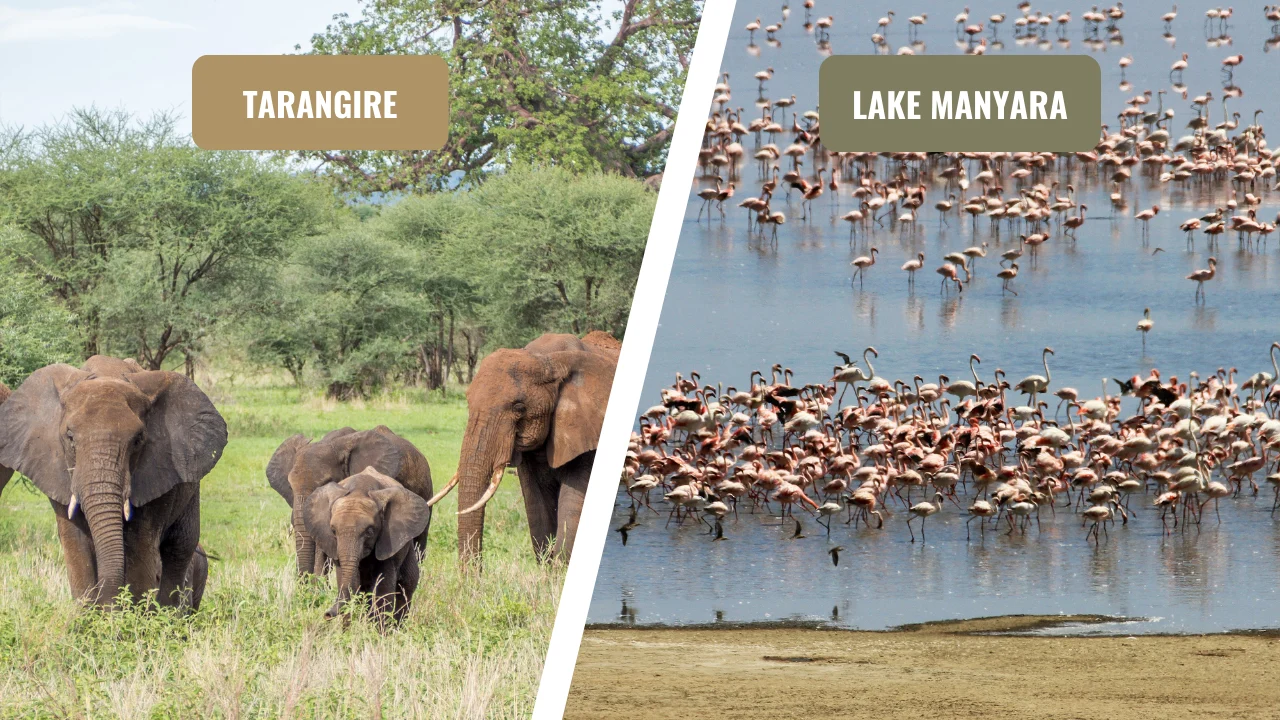
Tarangire National Park covers 2,850 square kilometres — making it Tanzania’s sixth-largest park. Its defining feature is the Tarangire River, the only permanent water source across a vast stretch of semi-arid land. During the dry season, this creates one of the most extraordinary wildlife concentrations in Africa, with elephants numbering in the thousands, alongside lions, leopards, cheetahs, buffalo, zebra, wildebeest, and over 550 recorded bird species. Ancient baobab trees — some over a thousand years old — tower across the landscape in a way that is found almost nowhere else on Earth.
Lake Manyara National Park covers just 330 square kilometres, but it packs an astonishing variety of habitats into that modest footprint. Entering through dense groundwater forest, you move into open acacia woodland, grassy floodplains, and finally the shimmering alkaline shores of Lake Manyara itself — a Great Rift Valley lake that turns flamingo-pink in the wet season. The park is globally famous for its tree-climbing lions, and it hosts over 400 bird species, large elephant herds in the forest, hippos in the river pools, and one of Africa’s largest baboon populations.
In simple terms: Tarangire is bigger, wilder, and more time-intensive. Lake Manyara is smaller, more diverse in its ecosystems, and highly rewarding in a short visit.
How Much Does a Tarangire Safari Cost?
Park Entrance Fees
The Tanzania National Parks Authority (TANAPA) charges $53.10 per adult per day for non-resident visitors to Tarangire National Park. Children aged 5–15 pay $26.55 per day; children under 5 enter free.
Because Tarangire is a large park with a lot of ground to cover — and because the best wildlife areas require proper exploration — most travellers spend 2 full days inside the park to get genuine value. That means park fees alone of $106.20 per adult for a 2-day visit.
Accommodation Costs at Tarangire
Tarangire has a well-developed range of accommodation at every price point:
- Budget camping (public campsites): $30–$60 per person per night
- Mid-range lodges and tented camps: $120–$280 per person per night (full board)
- Upmarket luxury camps: $400–$800+ per person per night
For a traveller using mid-range accommodation over 2 nights, accommodation adds roughly $240–$560 to the per-person cost.
Total Estimated Cost: Tarangire Solo Safari (2 Days)
| Item | Estimated Cost (Per Person) |
|---|---|
| Park fees (2 days) | $106.20 |
| Accommodation (2 nights, mid-range) | $240–$360 |
| Safari vehicle + guide (shared) | Included in package |
| Transfers from Arusha | Included in package |
| Total (approx.) | $350–$470 (land cost, shared group) |
When booked as part of a full package from Affordable International Travel Ltd, all meals, transfers, park fees, and driver-guide costs are included. A standalone Tarangire safari typically forms part of a broader itinerary — our 4-day Tarangire, Ngorongoro, and Serengeti safari starts from $1,800 per person fully inclusive.
How Much Does a Lake Manyara Safari Cost?
Park Entrance Fees
Lake Manyara charges the same daily rate as Tarangire: $53.10 per adult per day for non-residents. However — and this is the key cost difference — Lake Manyara can be thoroughly explored in a single full day. The park covers only 330 square kilometres, and a competent driver-guide can take you through all its major habitat zones (forest, woodland, floodplain, lakeshore) in one long game drive.
That means park fees for a full Lake Manyara safari experience come to just $53.10 per adult — roughly half the park fee cost of a 2-day Tarangire visit.
Accommodation Costs at Lake Manyara
Most travellers stay just one night when visiting Lake Manyara. Options include:
- Budget guesthouses and campsites near the park: $30–$70 per person per night
- Mid-range lodges (Manyara region): $100–$220 per person per night (full board)
- Upmarket lake-view lodges: $300–$600+ per person per night
Total Estimated Cost: Lake Manyara Solo Safari (1 Day)
| Item | Estimated Cost (Per Person) |
|---|---|
| Park fees (1 day) | $53.10 |
| Accommodation (1 night, mid-range) | $100–$220 |
| Safari vehicle + guide (shared) | Included in package |
| Transfers from Arusha | Included in package |
| Total (approx.) | $153–$270 (land cost, shared group) |
On a pure cost comparison, Lake Manyara wins clearly for the shortest and cheapest possible safari experience. It is the most budget-efficient way to spend a day and a night in a Tanzania national park.
Direct Cost Comparison: Tarangire vs Lake Manyara
| Cost Factor | Tarangire (2 Days) | Lake Manyara (1 Day) |
|---|---|---|
| Park fee (adult/day) | $53.10/day | $53.10/day |
| Recommended days inside park | 2 days | 1 day |
| Total park fees per adult | $106.20 | $53.10 |
| Nights accommodation needed | 2 nights | 1 night |
| Mid-range accommodation (per night) | $120–$180/person | $100–$220/person |
| Distance from Arusha | 118 km (2 hrs) | 126 km (2 hrs) |
| Internal flight needed? | No | No |
| Estimated total per person (package) | $350–$470 | $153–$270 |
Verdict on cost: Lake Manyara is cheaper for a standalone, single-park visit. Tarangire costs more in total but delivers more safari time, more ground covered, and a higher chance of big-ticket wildlife sightings — particularly elephants, big cats, and rare species like greater kudu and fringe-eared oryx.
Which Park Offers Better Wildlife Value for Money?
Price is only one half of the value equation. The other half is what you actually see. Here is how the two parks compare on wildlife:
Elephants
Tarangire wins decisively. Tarangire hosts the largest elephant concentration in northern Tanzania — during the dry season, you may encounter herds of 50, 100, even 200 elephants at a single water point. It is one of the most extraordinary elephant experiences anywhere in Africa. Lake Manyara also has elephants — large herds in the groundwater forest — but the density and drama of Tarangire’s dry-season concentrations is in a different league.
Lions and Big Cats
Lake Manyara has the edge for unusual sightings. The tree-climbing lions of Lake Manyara are one of Africa’s genuine wildlife curiosities — lions lounging in the branches of fig and acacia trees, something rarely observed elsewhere on the continent. Tarangire also has excellent lion sightings, particularly around the river areas, but lacks this unique behaviour. For leopard, both parks offer reasonable chances; Tarangire slightly better due to its size.
Birds
Tarangire wins on numbers. With 550+ recorded species versus Lake Manyara’s 400+, Tarangire is one of Africa’s finest birdwatching destinations. However, Lake Manyara’s flamingo flocks during the wet season are visually spectacular in a way that Tarangire simply cannot match — thousands of birds turning the lake shore a vivid coral pink.
Unique Species
Tarangire wins for rare mammals. It is one of the only parks in Tanzania where you have a realistic chance of seeing fringe-eared oryx, greater kudu, and gerenuk — slender, long-necked antelope that are absent from most other northern circuit parks. Lake Manyara’s one genuine speciality is the tree-climbing lion; Tarangire has multiple unique draws.
Overall Diversity
Lake Manyara wins for ecosystem variety per kilometre. In a single day you move through dense forest, open savannah, hippo pools, and a flamingo-lined soda lake. This compressed diversity is remarkable for a park its size, and it means even a short visit feels rich and varied.
Wildlife Value Summary
| Wildlife Category | Winner |
|---|---|
| Elephant herds | Tarangire |
| Tree-climbing lions | Lake Manyara |
| Bird species count | Tarangire |
| Flamingo spectacle | Lake Manyara |
| Rare mammals (kudu, oryx) | Tarangire |
| Ecosystem diversity | Lake Manyara |
| Big cat variety | Roughly equal |
| Crowd levels | Lake Manyara (fewer tourists) |
Which Safari Is Better for First-Time Visitors?
This is one of the most common questions our team at Affordable International Travel Ltd receives, and the answer depends on what you are hoping for.
Choose Lake Manyara if:
- You have only 1–2 days available for a safari
- You are travelling on a tight budget and want the most value from a single park day
- You are a birdwatcher or particularly interested in flamingos
- You want a variety of habitats and experiences in a compact, manageable park
- You are combining a short safari with a longer Kilimanjaro climb or Zanzibar beach trip
- You are a first-time visitor who wants a taste of Tanzanian safari without a large commitment
Choose Tarangire if:
- You have at least 2 full days to dedicate to one park
- Elephants are high on your priority list — you want to see big herds, not just individuals
- You are a serious birder targeting rare species
- You want a wilder, more open landscape with baobab scenery
- You are willing to spend slightly more to get a richer, more varied big game experience
- You want a genuine sense of being in untamed African bush
Our honest recommendation: If you can possibly do both, do both. A 2-day combination of Tarangire and Lake Manyara is one of the most cost-effective, diverse, and satisfying safari itineraries in all of East Africa. Our 2-day Tarangire and Lake Manyara safari starts from just $700 per person — fully inclusive of park fees, accommodation, meals, transfers, and your driver-guide. For many travellers, this two-park combination outperforms a single Serengeti day in terms of variety and bang for buck.
How Far Are Tarangire and Lake Manyara from Arusha?
Both parks are easily accessible from Arusha — Tanzania’s northern safari hub — without any internal flight, which is a significant cost saving compared to southern circuit parks.
| Park | Distance from Arusha | Drive Time |
|---|---|---|
| Tarangire National Park | 118 km | Approximately 2 hours |
| Lake Manyara National Park | 126 km | Approximately 2 hours |
| Between Tarangire and Manyara | Approximately 70 km | Approximately 1.5 hours |
The two parks are close enough to each other that combining them in a single 2-day itinerary is completely practical and adds almost no extra drive time. This is precisely why the Tarangire–Manyara combination is one of our most popular entry-level safari packages.
If you are flying into Kilimanjaro International Airport (JRO), Arusha is a 45-minute drive from the terminal. From Moshi it is a similar distance to both parks.
What Is the Best Time to Visit Tarangire vs Lake Manyara?
Both parks are part of the same greater Manyara–Tarangire ecosystem and follow broadly similar seasonal patterns. But they each have distinct seasonal highlights.
Tarangire: Best Time to Visit
Peak season (June–October): This is when Tarangire is at its most extraordinary. The Tarangire River dries to a fraction of its wet-season volume, and animals from across a vast area converge on it as their only water source. Elephant herds of hundreds are common. Lions are active. The landscape is dry and golden, with low vegetation that makes spotting wildlife easy.
Shoulder season (November–February): The short rains arrive in November and transform the park into lush green scenery. Migratory birds arrive in vast numbers. Prices drop by 20–40% at most lodges. Wildlife is still plentiful but more dispersed across the newly watered landscape.
Low season (March–May): The long rains bring the heaviest vegetation and some mud on tracks. Wildlife viewing is more challenging but the park is at its most private — you may have entire areas to yourself. Lodge prices hit their annual lows.
Lake Manyara: Best Time to Visit
Peak season (June–October): Clear skies, dry conditions, and good visibility across the park. Tree-climbing lions are more active and easier to spot in the drier canopy. Wildlife gathers near the lake edge.
Wet season highlights (November–April): Lake Manyara comes spectacularly alive during and after the rains. The lake fills up, flamingo flocks arrive in their thousands, and the groundwater forest turns deep emerald. Birdwatching is at its absolute best. This is arguably the most visually stunning time to visit Manyara, and accommodation rates are at their lowest.
Seasonal Verdict
| Season | Better Park for Wildlife | Better Park for Value |
|---|---|---|
| June – October (dry) | Tarangire (elephant peak) | Both similar |
| November – February | Lake Manyara (flamingos, birds) | Lake Manyara |
| March – May (wet) | Lake Manyara (accessible year-round) | Lake Manyara |
Can You Do Both Parks in One Trip? (Yes — Here Is How)
Absolutely, and we strongly recommend it. Combining Tarangire and Lake Manyara in a single 2-day safari is one of the smartest travel decisions a budget-conscious safari traveller can make. Here is how the itinerary flows:
Day 1 — Tarangire National Park: Depart Arusha or Moshi early morning. Spend the full day inside Tarangire — game drives along the Tarangire River, into the baobab forests, and across the open swamp areas. Lunch at a picnic site inside the park. Overnight at a mid-range lodge or campsite in the Manyara region.
Day 2 — Lake Manyara National Park: Morning game drive through the groundwater forest and on to the open floodplains and lake shore. Tree-climbing lion search, flamingo spotting, hippo pools. Picnic lunch inside the park. Return to Arusha or Moshi by late afternoon.
This itinerary covers two distinct and complementary ecosystems, gives you two full days of game driving, and costs from $700 per person with Affordable International Travel Ltd — including all park fees, accommodation, meals, vehicle, and your guide. There is genuinely no cheaper way to get two proper Tanzanian national park experiences.
View full details of our 2-day Tarangire and Lake Manyara safari →
How to Save Money on a Tarangire or Lake Manyara Safari
Our team has helped travellers from over 50 countries find the best possible value on Tanzania safaris. Here is what actually saves money without cutting the experience short:
Travel in the shoulder or low season. November, March, and May all offer meaningful price reductions at lodges in both parks — sometimes 30–50% below peak rates — with perfectly good game viewing, especially at Lake Manyara where the flamingos and birdlife are actually better in the green season.
Book a combined itinerary. Our 2-day Tarangire and Lake Manyara package at $700 per person works out cheaper per park than booking each separately because vehicle and transfer costs are shared across both days.
Join a group departure. Solo travellers and couples who join a small group safari share the vehicle cost across 4–6 people. This can reduce per-person costs significantly while maintaining an intimate, personalised experience.
Book directly with a local Tanzanian operator. Every international platform that sits between you and your safari adds margin. Booking directly with Affordable International Travel Ltd — a 100% Tanzanian-owned operator — means that money goes to your guides, parks, and communities rather than to overseas booking fees.
Consider camping. Public campsites inside or adjacent to both parks are a fraction of lodge prices and genuinely immersive. Waking up surrounded by the sounds of the African bush is an experience no hotel lobby can replicate.
If you are planning a longer northern circuit itinerary, our 4-day Lake Manyara, Serengeti, and Ngorongoro safari from $1,800 per person is one of our most popular packages — it includes Manyara as part of a broader circuit, which is always better value than visiting it in isolation.
What Does a Full Package from Affordable International Travel Ltd Include?
Every safari package we offer — whether it is a 2-day Tarangire–Manyara combination or a 10-day grand circuit — includes the following with no hidden extras:
- All national park and conservation area entrance fees
- Airport and hotel pickup and drop-off transfers
- All game drives in a 4WD safari vehicle with a pop-up roof hatch
- An experienced, licensed, English-speaking Tanzanian driver-guide
- Full-board meals (breakfast, packed lunch, and dinner)
- Bottled drinking water throughout
- All government taxes and levies
What is not included: international flights, travel insurance, tips for your guide (discretionary but always appreciated), and personal expenses. We will be clear about this upfront — always.
Browse all our Tanzania safari packages →
Frequently Asked Questions
Is Tarangire or Lake Manyara better for a one-day safari?
Lake Manyara is the better choice for a single-day safari. At 330 square kilometres it is compact enough to experience all its major habitats — forest, grassland, floodplain, and lakeshore — in one full game drive day. Tarangire is significantly larger and more rewarding over two days. If you only have one day and one park entry fee to spend, Lake Manyara gives you more variety for that single day. That said, both parks together in two days is always our first recommendation.
Do Tarangire and Lake Manyara have the same park fees?
Yes. Both parks charge $53.10 per adult per day for non-resident visitors. The cost difference comes from how many days you need inside each park to get the full experience — one day for Lake Manyara, two days for Tarangire — rather than from any difference in daily fees.
Can I do Tarangire and Lake Manyara without an internal flight?
Yes, absolutely. Both parks are accessible by road from Arusha in approximately two hours, and they sit roughly 70 kilometres apart from each other. There is no need for a domestic flight to visit either park — this is one of the key reasons they are among Tanzania’s most cost-effective safari options. The entire 2-day Tarangire and Lake Manyara itinerary is done by road.
What is the best age for visiting these parks with children?
Both Tarangire and Lake Manyara are excellent for families with children of all ages. The road conditions are good (particularly in the dry season), the park sizes are manageable, and the wildlife variety — elephants, giraffes, zebra, flamingos, monkeys, and baboons — tends to be highly engaging for young visitors. Children aged 5–15 pay half the adult park fee, and children under 5 enter free. Affordable International Travel Ltd regularly arranges family safaris in both parks.
Are there walking safaris available at Tarangire or Lake Manyara?
Tarangire permits walking safaris in certain areas, which is an exceptional and immersive way to experience the bush beyond the standard game drive. Lake Manyara does not permit walking safaris inside the park. If a walking safari is important to you, Tarangire is your park — or consider extending your itinerary to include Ruaha National Park, which has some of Tanzania’s finest walking safari experiences.
How does the Tarangire–Manyara combination compare to the Serengeti on price?
A 2-day Tarangire and Lake Manyara package starts from $700 per person with Affordable International Travel Ltd. A comparable 2-day Serengeti safari would typically cost $1,200–$2,000 per person once you factor in the higher Serengeti park fees ($70/day), greater accommodation costs, and the logistics of reaching the Serengeti from Arusha. The Tarangire–Manyara combination is therefore roughly 50–65% cheaper than a comparable Serengeti itinerary — and for many travellers delivers an equally rich wildlife experience.
Which park is better for photography?
Both parks are highly photogenic, but they reward different photographic styles. Tarangire offers dramatic wide-angle shots: elephant herds against towering baobabs, golden savannah stretching to the horizon, lions in the riverine landscape. Lake Manyara rewards more intimate and varied photography: tree-climbing lions framed by fig tree branches, flamingo reflections on still water, baboon families in the forest, hippos in green pools. If you are serious about photography, visiting both parks gives you a far richer portfolio than either alone.
Can I extend a Tarangire or Manyara trip to include the Serengeti or Ngorongoro?
Yes — and it is one of the most natural itinerary extensions possible. Both parks sit at the beginning of Tanzania’s northern safari circuit, and both are standard entry points for longer itineraries. Our 4-day Tarangire, Ngorongoro, and Serengeti safari from $1,800 per person, and our 5-day Lake Manyara, Serengeti, and Ngorongoro safari from $2,000 per person, are both popular choices for travellers who want to start with these accessible parks and build out into a fuller Tanzania experience.
Conclusion: Which Safari Should You Choose?
Here is the straight answer: if cost is your single deciding factor, Lake Manyara is cheaper. One day, one park fee, one night of accommodation — it is the most budget-efficient way to experience a genuine Tanzanian national park.
But if you are asking which safari gives you more, the answer becomes more nuanced. Tarangire’s elephant herds, baobab landscapes, and rare species offer a depth and drama that a single Lake Manyara day cannot fully match. And if you are genuinely weighing one against the other, the best decision you can make is to choose neither exclusively — and do both instead.
Our 2-day Tarangire and Lake Manyara safari at $700 per person is one of the most compelling pieces of value in African travel. Two parks, two ecosystems, two days of world-class game driving — with everything included and nothing to organise.
At Affordable International Travel Ltd, we are 100% Tanzanian-owned, locally guided, and built around the belief that an extraordinary safari should not cost an extraordinary amount. We have been helping international travellers navigate exactly this kind of decision for years, and we are always happy to help you plan the itinerary that fits your budget, timeframe, and wildlife priorities perfectly.
Talk to a safari expert or request your free quote today →
You Might Also Be Interested In
- Tarangire National Park Safari — Full details and pricing
- Lake Manyara Safari — Full details and pricing
- 2 Days Tarangire & Lake Manyara Safari — from $700/person
- 4 Days Tarangire, Ngorongoro & Serengeti — from $1,800/person
- 5 Days Lake Manyara, Serengeti & Ngorongoro — from $2,000/person
- All Tanzania Safari Destinations