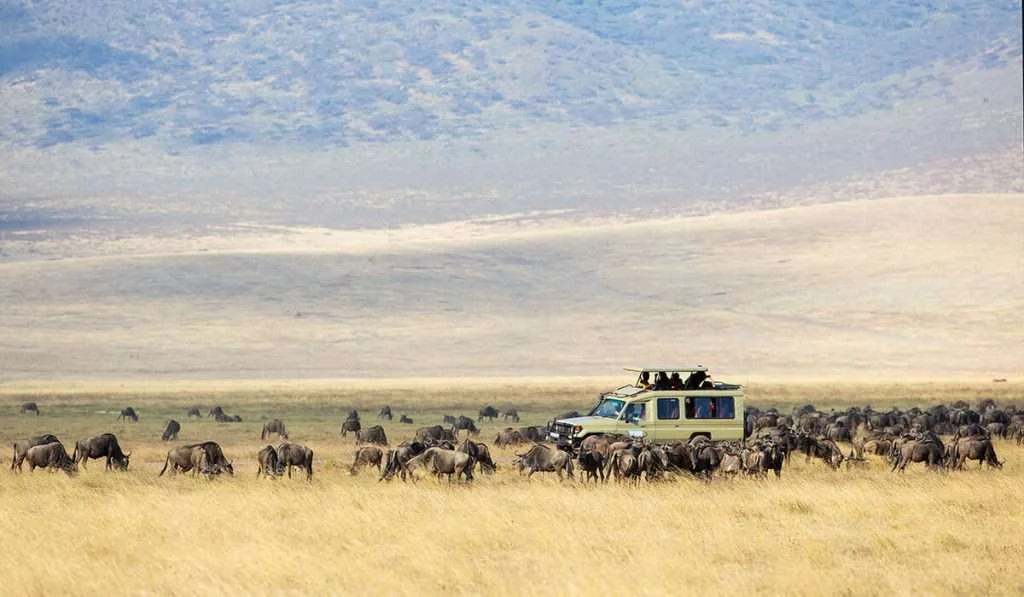
A Tanzania safari typically costs $350–$700+ per person per day for mid-range experiences, but you can reduce it to $250–$450 by traveling in the low/shoulder season (March–May or November), joining group tours, choosing camping or budget lodges, booking driving transfers instead of flights, and working with local operators. These methods maintain high-quality game drives, expert guides, and access to key parks like Serengeti and Ngorongoro while delivering excellent value for international travelers.
If you’re an international traveler dreaming of an African safari in Tanzania, the excitement of seeing lions, elephants, and the Great Migration up close is hard to resist. But those price tags often $400–$800 per person per day—can make it feel out of reach.
The good news? You don’t need to choose between an unforgettable experience and staying on budget.
At Affordable International Travel Ltd, we’ve spent years crafting safaris for travelers from the US, Europe, Australia, and beyond. We’ve helped couples, families, and solo adventurers enjoy world-class wildlife encounters in the Serengeti and Ngorongoro Crater while cutting costs by 20–40% or more.
This mega guide shares 11 proven ways to reduce safari costs in Tanzania. We’ll break down real costs for 2026, explain what drives prices up, and give practical, actionable tips based on our hands-on experience.
You’ll learn how to balance savings with quality, safety, and comfort—so you can focus on the magic of the African bush.
Whether you’re planning a first-time safari or a return trip, this guide will help you create an affordable, high-value adventure. Let’s dive in and make your Tanzania safari dreams more accessible.
11 Proven Ways to Reduce Safari Costs in Tanzania
Here are the most effective strategies we’ve used successfully with our clients at Affordable International Travel Ltd;
Table of Contents
1. Travel During Shoulder Season (Save 30-50%)
What is Shoulder Season in Tanzania?
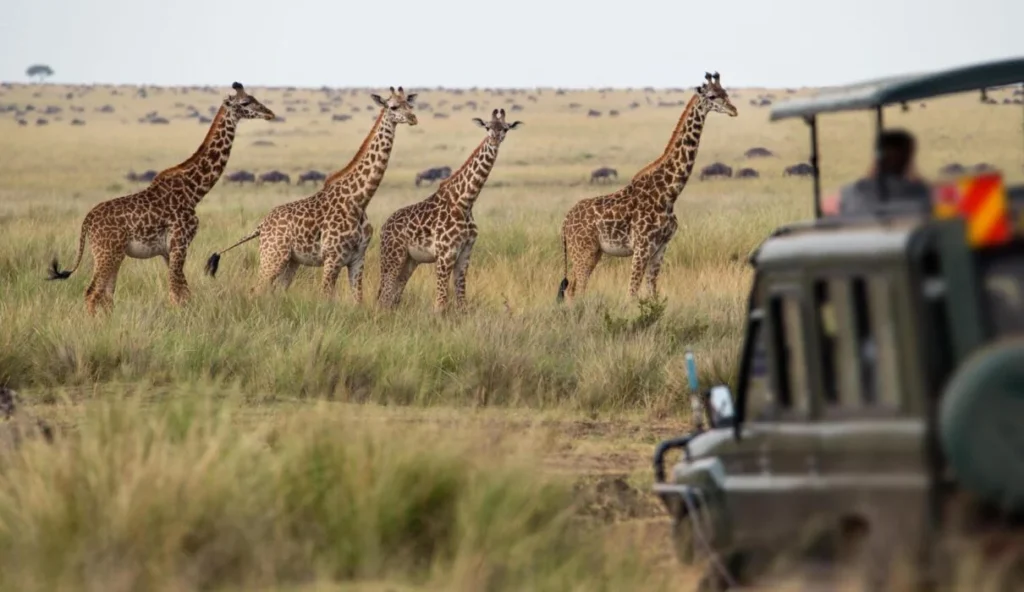
Shoulder seasons are the periods between peak tourist times when parks are less crowded but wildlife viewing remains excellent. In Tanzania, these windows fall during March through May (long rains) and November (short rains).
Why Shoulder Season Offers Better Prices
Safari operators, lodges, and camps slash rates during these periods to maintain occupancy. You’ll find the same accommodations and guides that cost $600-$800 per night in July dropping to $300-$400. Group safari rates can fall from $350 to $180 per person per day.
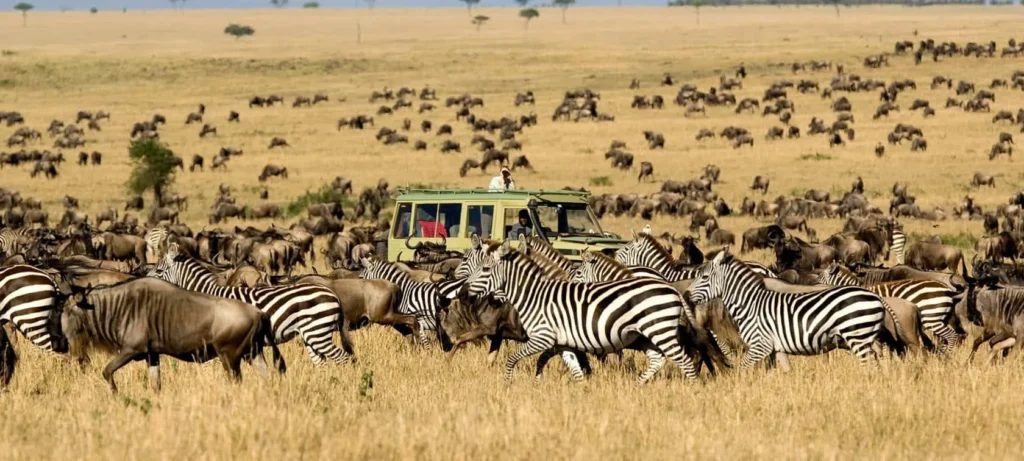
The wildlife doesn’t disappear during these months. The Serenganu ecosystem hosts resident animals year-round, and the Great Migration actually passes through the southern Serengeti during February-March, offering spectacular calving season viewing with far fewer vehicles.
Practical Tips for Shoulder Season Travel
Book accommodations that offer all-weather game viewing. Some budget camps close during heavy rains, but established mid-range and luxury properties remain open with covered vehicles and experienced guides who know how to navigate wet conditions.
March through May brings afternoon showers but typically clear mornings—prime game viewing time. November’s short rains are brief and sporadic, barely impacting safari schedules.
Pack quick-dry clothing and a waterproof jacket. Roads can be muddy, making some remote areas inaccessible, but major parks like Serengeti, Ngorongoro, and Tarangire remain fully operational.
The trade-off is simple: occasional rain and greener landscapes versus 30-50% savings and half the tourists. For most visitors, it’s an easy choice.
2. Join a Group Safari Instead of Going Private
How Group Safaris Work
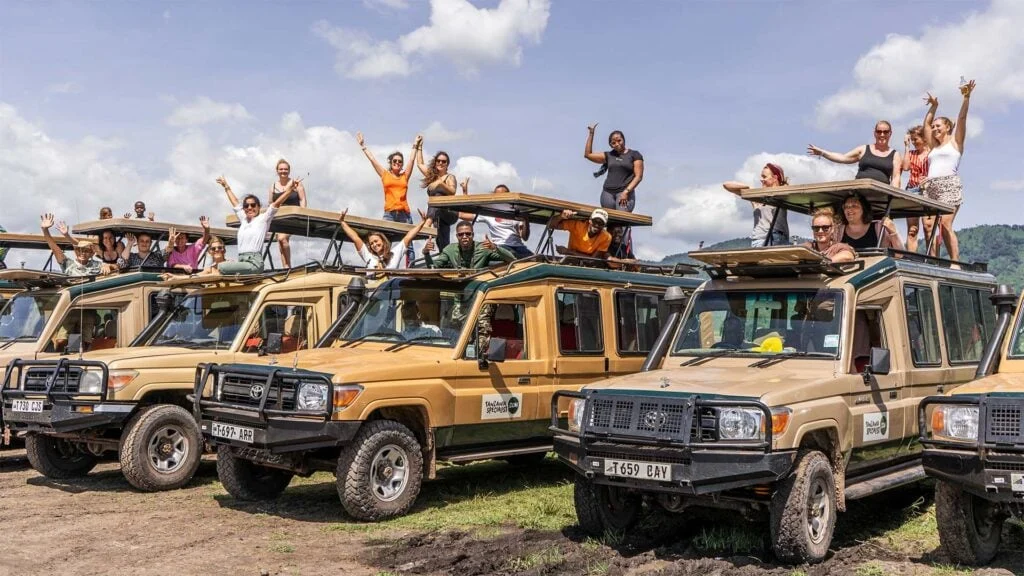
Group safaris combine 4-7 travelers who don’t know each other into a single vehicle with a shared guide and itinerary. Departures follow fixed schedules—typically weekly or bi-weekly—and visit standard routes like the Northern Circuit (Tarangire, Serengeti, Ngorongoro).
The Real Cost Difference
A private 5-day safari typically costs $2,000-$3,500 per person when traveling as a couple. The same itinerary on a group safari runs $900-$1,500 per person—a savings of $1,100-$2,000 per traveler.
This pricing difference exists because you’re sharing the largest expense: the 4×4 vehicle, driver-guide, and fuel. A safari vehicle costs operators roughly $150-$200 per day whether carrying two people or six. When split among six travelers, your share drops to $25-$35 per day instead of $75-$100.
When Group Safaris Make Sense
Group safaris work beautifully for solo travelers, couples on a budget, and anyone comfortable with structured itineraries and shared experiences. You’ll meet interesting people from around the world, and many travelers report that the social aspect enhanced their trip.
They’re less ideal if you want flexible timing, specific photography requirements, or complete control over how long you spend at each sighting. Private safaris allow you to linger at a leopard kill for an hour; group safaris operate on consensus and schedule.
Finding Quality Group Safaris
Work with Affordable International Travel Ltd or established local operators who run regular scheduled departures. Check recent reviews focusing on group dynamics, vehicle condition, and guide quality.
Confirm maximum group size (six is ideal, seven acceptable, eight or more becomes crowded in a safari vehicle). Ask about the window seat policy—reputable operators rotate seating daily so everyone gets equal photo opportunities.
Verify what happens if the group doesn’t fill. Some operators guarantee departures with a minimum of two people; others cancel and reschedule, which can disrupt your plans.
3. Choose Mid-Range Accommodations Over Luxury Lodges
Understanding Tanzania’s Accommodation Tiers
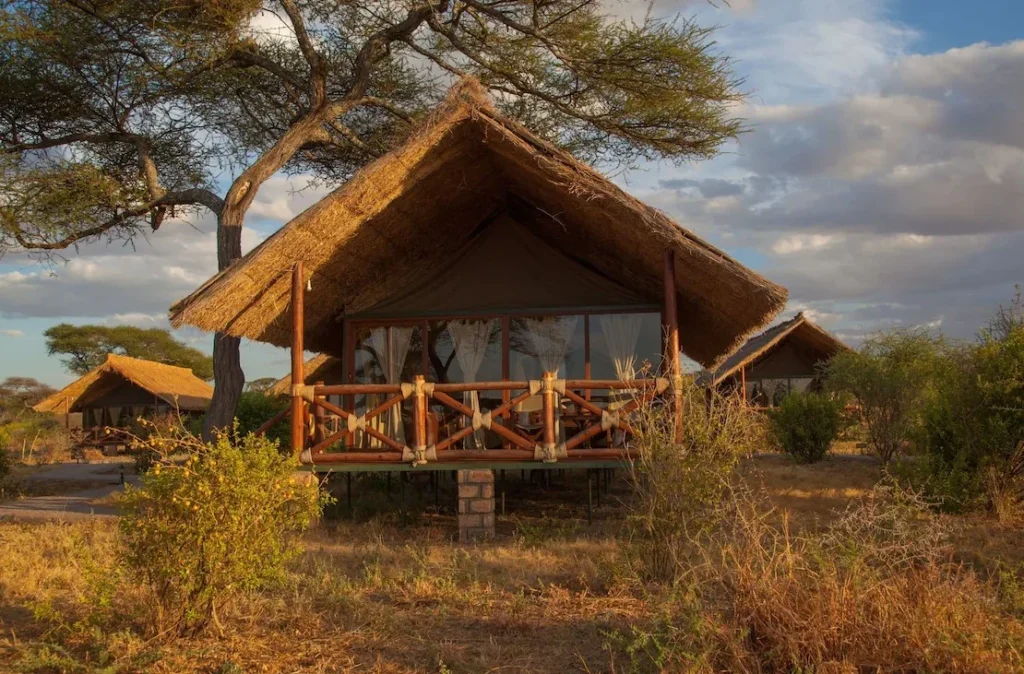
Tanzania’s safari lodges fall into distinct categories: budget camping ($30-$80 per person), mid-range tented camps and lodges ($150-$300 per person), and luxury properties ($400-$1,200+ per person). All prices include full board (meals).
What You Actually Get at Each Level
Luxury lodges offer swimming pools, spa services, fine dining, private decks, and prestigious locations. Mid-range properties provide comfortable beds, private bathrooms, good food, and the same park access. Budget camping means basic facilities and sleeping in tents.
Here’s the truth: you spend roughly 4-5 hours in your accommodation—sleeping and eating. The other 8-10 hours are on game drives seeing exactly the same wildlife as guests paying three times more.
Mid-Range Sweet Spots
Properties like Kati Kati Tented Camp in Serengeti, Ngorongoro Farm House near the crater, and Tarangire Simba Lodge deliver solid comfort at $180-$250 per person per night including meals. You’ll sleep well, eat satisfying food, and save $200-$600 per person nightly compared to luxury alternatives.
Many mid-range camps occupy excellent locations—sometimes better than luxury lodges. Kati Kati moves seasonally to follow the migration, placing you closer to the action than some fixed luxury properties.
What to Check Before Booking
Read recent reviews focusing on cleanliness, food quality, and hot water reliability. Look at photos uploaded by guests, not professional marketing images.
Confirm the lodge provides game drives (some accommodation-only properties require you to arrange vehicles separately, which becomes complicated and expensive).
Ask about generator hours. Some budget places run generators only 6pm-10pm, meaning no fan or charging during hot afternoons. Mid-range properties typically offer 24-hour power or reliable solar systems.
If traveling with children under 12, verify the minimum age policy—some camps don’t accept young children for safety reasons.
4. Book Directly with Local Tanzanian Operators

The Tourism Supply Chain
When you book through international agencies or your home country’s tour companies, your money passes through multiple hands. A U.S.-based agency marks up the local operator’s price by 25-40%. Online travel agencies (OTAs) add another 15-20% commission. By the time it reaches the actual service providers in Tanzania, you’ve paid thousands in middleman fees.
How Direct Booking Saves Money
Local Tanzanian operators like us eliminate these intermediary markups. The same 7-day safari that sells for $4,500 through an international agency often costs $2,800-$3,200 when booked directly.
You’re not sacrificing service or reliability. Reputable local operators provide the same vehicles, guides, accommodations, and park fees as international resellers—they just charge you the actual cost plus their reasonable margin rather than adding layers of markup.
Verifying Legitimate Local Operators
Check for Tanzania Tourist Board (TTB) licensing and membership in the Tanzania Association of Tour Operators (TATO). These credentials indicate proper insurance, vehicle standards, and ethical business practices.
Read TripAdvisor and Google reviews spanning multiple years. Look for consistent positive feedback about guide knowledge, vehicle condition, and responsive communication. Red flags include recent negative reviews about hidden costs, poor vehicle maintenance, or unresponsive customer service.
Request a detailed written quote breaking down all costs: accommodation, park fees, guide fees, vehicle, meals, and taxes. Legitimate operators provide transparent pricing. Be wary of unusually low quotes that don’t specify accommodation properties by name—they often involve last-minute downgrades.
Payment and Protection
Pay deposits (typically 30-50%) via bank transfer or credit card with buyer protection. Avoid operators demanding full payment months in advance via untraceable methods.
Ensure contracts specify accommodations by name, vehicle type, and what’s included. “Mid-range lodge” is too vague; “Tarangire Simba Lodge, garden view room” provides accountability.
Many reputable local operators offer payment plans, allowing you to spread costs over several months before travel—something international agencies rarely accommodate.
5. Combine Multiple Parks Efficiently
Why Park Combinations Affect Costs
Tanzania charges daily conservation fees for each national park: Serengeti ($71/adult per day), Ngorongoro ($71/adult per day), Tarangire ($50/adult), Lake Manyara ($50/adult). These fees don’t change, but travel time between parks does.
Poor routing creates “drive days” where you spend 6-8 hours in transit without wildlife viewing but still paying for vehicle, guide, and accommodation. Smart combinations minimize dead time and maximize game viewing.
The Northern Circuit Smart Loop
The most cost-effective Northern Circuit route runs: Arusha → Tarangire (2 hours) → Ngorongoro (2.5 hours) → Serengeti (2.5 hours) → return via Ngorongoro. This loop requires one long drive day but provides 4-5 full game viewing days on a 6-day safari.
Less efficient routing visits parks in scattered order, creating multiple long drives and reducing actual wildlife viewing time by 20-30%.
Skip the Extras When Appropriate
Lake Manyara National Park offers beautiful scenery and tree-climbing lions, but it’s small (you can see it thoroughly in 3-4 hours). Adding a full day and paying $50 in conservation fees for a few hours makes sense for 10+ day safaris but inflates costs on shorter trips.
Similarly, Olduvai Gorge (cradle of humankind) is fascinating for archaeology enthusiasts but requires 2-3 hours of your day. On a 5-day budget safari, that time is better spent in Serengeti.
Southern and Western Circuits for Better Value
If you’re flexible about location and want to avoid crowds, consider Tanzania’s less-visited parks. Ruaha National Park and Nyerere (Selous) offer comparable wildlife diversity to Serengeti at lower park fees and accommodation costs.
Ruaha hosts Tanzania’s largest elephant population and significant predator numbers with almost no tourist vehicles. Accommodation runs $120-$200 per person at mid-range camps versus $200-$350 in Serengeti equivalents.
The trade-off: longer flights from Dar es Salaam (about $200-$300 per person each way) and no Great Migration. For travelers prioritizing solitude and lower overall costs over witnessing the migration, it’s an excellent alternative.
6. Negotiate Multi-Day Packages
How Safari Operators Price Long Trips
Operators calculate daily rates based on fixed costs (vehicle, guide, fuel, park fees) and variable costs (accommodation, meals). On a 3-day safari, setup costs represent a larger percentage of the total. Spreading those fixed costs across 7-10 days creates room for per-day discounts.
The Price Break Points
Most operators offer better per-day rates at 5+ days and even deeper discounts at 7+ days. A typical 3-day safari might cost $320 per person per day, while a 7-day safari drops to $240-$260 per day—a savings of $420-$560 overall.
This happens because the expensive first and last days (vehicle preparation, briefings, gear checks, returns) get absorbed into more game viewing days.
Negotiation That Actually Works
Contact operators directly via email or WhatsApp. State your travel dates, group size, and preferred parks, then ask: “What per-day rate can you offer for a 7-day safari versus 5 days?”
Be straightforward about your budget. Something like: “Our budget is $2,000 per person for 7 days including mid-range accommodation. Can you work with this?” Professional operators appreciate honest budgets and will either create a suitable itinerary or explain what’s possible at that price point.
Book during low season (March-May, November) when operators have more flexibility. July-September is peak season with less negotiation room.
What Not to Do
Don’t negotiate park fees or expect operators to cut corners on safety. Park fees are government-mandated and non-negotiable. Vehicle insurance, guide licensing, and proper equipment aren’t areas where reputable operators will compromise.
Focus negotiation on accommodation level, number of game drives per day, and included extras like crater tour fees or cultural visits.
Avoid playing operators against each other for the absolute lowest price. The cheapest quote often comes from cutting quality—older vehicles, inexperienced guides, or accommodation downgrades not mentioned until arrival.
7. Consider Self-Drive Safaris
How Self-Drive Works in Tanzania
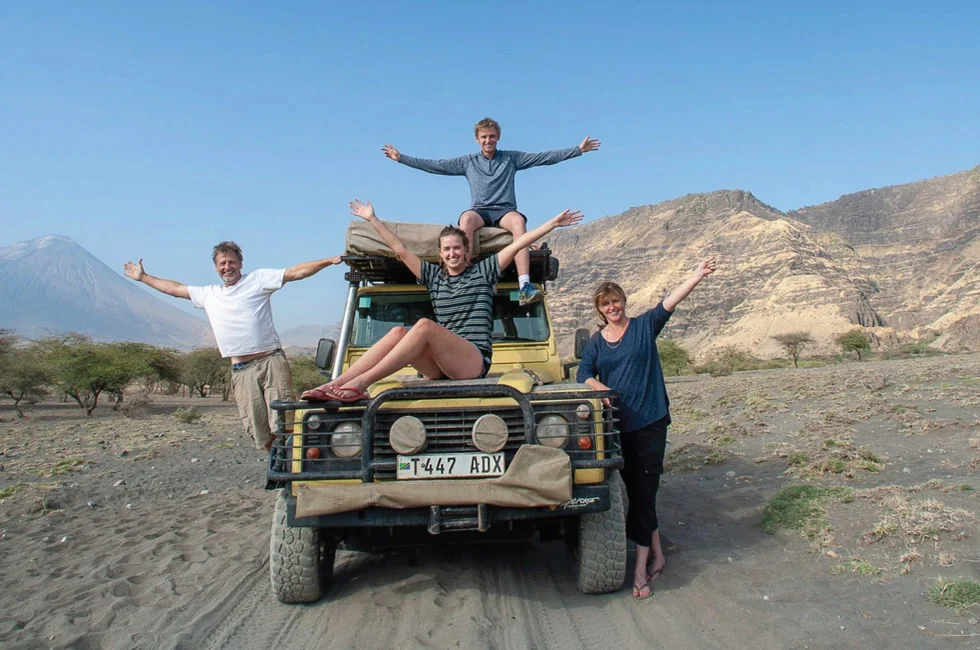
Self-drive safaris allow you to rent a 4×4 vehicle and explore parks independently. You pay vehicle rental ($100-$180 per day), fuel, park fees, and accommodation, but eliminate the $50-$80 daily guide fee.
It’s legal in most Tanzanian parks except Ngorongoro Conservation Area, which requires an authorized guide and vehicle.
Realistic Cost Savings
A couple on a 5-day self-drive safari to Tarangire and Lake Manyara might spend:
- Vehicle rental: $150/day × 5 = $750
- Fuel: ~$150
- Park fees: ($50 × 2 people × 3 days) = $300
- Mid-range accommodation: $200/night × 5 = $1,000
- Total: ~$2,200 for two people ($1,100 per person)
The same safari through an operator costs approximately $1,400-$1,600 per person—a savings of $300-$500 each.
Important Limitations
Self-drive only makes financial sense for couples or groups of 3-4. Solo travelers pay the full vehicle cost alone, eliminating savings.
You need genuine 4×4 experience. Tanzania’s park roads range from smooth gravel to challenging muddy tracks. Getting stuck costs time and potential rescue fees.
Wildlife knowledge matters significantly. Professional guides spot animals you’d drive past, understand behavior patterns, and know where to look based on seasonal movements. You’ll see less wildlife self-driving, especially predators and rare species.
Parks Best Suited for Self-Drive
Tarangire and Lake Manyara are manageable for experienced drivers with good road networks and clear signage. Serengeti’s vastness and complex road system make self-navigation challenging—you can drive for hours without seeing major wildlife if you don’t know the areas.
8. Camp Instead of Staying in Lodges
Public Campsite Costs
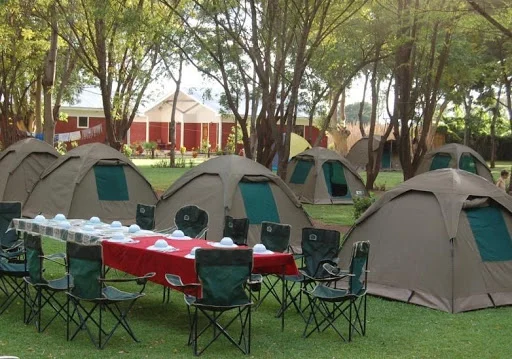
Tanzania’s national parks operate public campsites charging $30-$50 per person per night. You provide your own camping equipment or rent from operators ($15-$25 per person for tent, sleeping bag, and mat).
Total accommodation cost: $45-$75 per person versus $150-$300 at lodges—a savings of $105-$255 nightly.
What Camping Actually Involves
Public campsites provide basic toilets and sometimes cold showers. You’re truly camping—setting up tents, eating camp-cooked meals, and sleeping in wilderness with animal sounds around you.
This isn’t glamping. Expect basic conditions, potential rain, and occasional wildlife visits to camp (usually herbivores; rangers ensure safety protocols).
Many travelers find camping deepens the safari experience. Falling asleep to hyena calls and waking to sunrise directly from your tent creates immersion no lodge matches.
Camping Safari Operators
If you’re not providing your own equipment, book camping safaris through operators who supply everything. A 5-day camping safari costs $800-$1,200 per person all-inclusive—about half the price of lodge-based equivalents.
Affordable International Travel Ltd and similar operators provide tents, camping gear, experienced camp crews, and cook staff who prepare surprisingly good meals over camp stoves.
Who Camping Suits
Camping works beautifully for adventurous travelers, budget-conscious families with older children (many camps require kids to be 8+), and anyone who values authenticity over comfort.
It’s less suitable if you have mobility issues, need consistent hot showers, or want to fully relax after game drives. Camping requires some participation—helping with setup, being mindful of water usage, and adapting to basic facilities.
Special Campsites
For a middle ground, consider special campsites ($50-$70 per person). These private, secluded sites offer more privacy than public campgrounds and often include better facilities—sometimes hot bucket showers and cleaner toilets.
You’re still camping but with enhanced comfort and exclusivity. Your group is the only one in that specific area, creating a more intimate experience.
9. Travel in a Larger Group
The Group Size Economics
Safari costs divide into per-vehicle expenses (guide, fuel, vehicle) and per-person expenses (park fees, accommodation, meals). Increasing group size reduces everyone’s share of vehicle costs.
A private safari for 2 people might cost $1,400 per person for 5 days. The same safari for 6 people costs $950 per person—a savings of $450 each.
How This Works in Practice
Gather 4-6 friends or family members interested in traveling together. Contact operators with your group size and watch per-person rates drop significantly.
A standard safari vehicle comfortably seats 6 passengers with window access for everyone. This is the sweet spot—enough people to share costs, but not so many that the vehicle feels crowded.
Organizing Your Own Group
If you don’t have six friends available, consider posting in travel forums or Facebook groups like “Tanzania Safari” or “Africa Budget Travel.” Solo travelers and couples often look for others to split vehicle costs.
Establish clear expectations upfront: budget level, accommodation preferences, photography priorities, and daily schedule preferences. Mismatched expectations create friction during the trip.
Create a simple agreement covering deposits, payment deadlines, and cancellation policies. What happens if someone backs out two months before departure? Clear terms prevent disputes.
Managing Group Dynamics
Discuss priorities before booking. Some travelers want to spend two hours photographing a leopard; others prefer covering more ground. Find compatible travel styles.
Choose one point person to communicate with the operator. Too many people asking questions creates confusion and delays.
Build in flexibility. With six people, someone will need a bathroom stop or prefer different timing. Good-natured compromise makes group travel enjoyable rather than stressful.
10. Book Well in Advance for Early Bird Discounts
How Early Booking Saves Money
Safari operators and lodges offer early bird discounts of 10-30% for bookings made 6-12 months ahead. A $3,000 safari booked eight months early might drop to $2,400—a savings of $600.
This isn’t a marketing gimmick. Operators use early bookings to forecast revenue, manage cash flow, and secure lodge reservations during peak season. In exchange for your early commitment, they pass savings to you.
Optimal Booking Windows
For July-September travel (peak migration season), book 8-12 months ahead. Popular mobile camps and mid-range lodges fill up, and early booking secures both space and better rates.
For shoulder season (March-May, November), 3-6 months provides good discounts without requiring a year of advance planning.
December-February (green season) often has discounts available even 2-3 months out, though earlier booking still yields better rates.
What to Confirm Before Committing
Verify the cancellation policy. Some early bird rates are non-refundable or carry high cancellation fees. Others allow free cancellation until 60-90 days before travel.
Check if you’re locking in current prices or if the operator can increase costs closer to departure. Reputable operators guarantee the quoted price once deposit is paid.
Confirm what the deposit covers and when final payment is due. Standard practice is 30-50% deposit upon booking, with the balance due 60-90 days before travel.
Payment Plan Options
Many operators allow installment payments over the booking period. If traveling in August and booking in January, you might spread payments across six months rather than paying everything upfront.
This makes expensive safaris more manageable and reduces the financial risk if circumstances change.
Travel Insurance Considerations
Early booking makes trip insurance essential. If you book a $4,000 safari ten months ahead, unforeseen events (illness, job loss, family emergencies) could prevent travel.
Comprehensive travel insurance with “cancel for any reason” coverage typically costs 5-7% of trip price but protects your investment. Compare this to potential non-refundable deposits of 30-50%.
11. Avoid Peak Season (July-September)
Understanding Peak Season Pricing
July through September coincides with the Great Migration river crossings in northern Serengeti—the most dramatic wildlife spectacle on earth. Operators charge premium rates during these three months, with prices 40-70% higher than shoulder seasons.
A mid-range safari costing $220 per person daily in November jumps to $350-$380 in August. Accommodations that charge $200 per person in April ask $320-$400 in July.
Why Peak Season Costs More
Demand drastically exceeds supply. Tanzania has finite safari vehicles, licensed guides, and lodge beds. When thousands of international visitors converge during a three-month window, basic economics pushes prices up.
Lodges and camps can fill every room at premium rates, so they have no incentive to discount. Safari operators command higher prices because they’re guaranteed bookings.
Wildlife Viewing in Other Months
Here’s the industry secret: wildlife viewing quality remains excellent nearly year-round in Tanzania. The Serengeti ecosystem hosts resident lion prides, leopards, cheetahs, elephants, and giraffes throughout the year.
The Great Migration moves through different areas seasonally. December-March, it’s in southern Serengeti for calving season—witnessing 8,000 wildebeest births daily rivals the drama of river crossings. February-March offers incredible predator action with far fewer tourists.
April-May brings lush green landscapes and dramatic storm skies that create stunning photography. June and October provide excellent wildlife viewing with moderate crowds and pricing.
Finding Your Perfect Timing
If the Great Migration river crossings are non-negotiable, book a year ahead and accept premium pricing—it’s genuinely spectacular.
If you’re more flexible about seeing the migration at different stages or prioritize diverse wildlife over that specific event, traveling in February-March, June, or November delivers 90% of the experience at 50-60% of the cost.
Ask yourself: Would I rather spend 5 days in Serengeti during August for $3,500, or 8 days seeing calving season, Ngorongoro, and Tarangire in March for the same budget?
Additional Money-Saving Strategies
Skip Unnecessary Add-Ons
Hot air balloon safaris cost $550-$650 per person for a one-hour flight. They’re magical, but that’s equivalent to 2-3 full days of ground safari in mid-range accommodation.
Cultural village tours often cost $30-$50 per person. Some are authentic and enriching; others feel staged and touristy. Ask your operator which cultural experiences they genuinely recommend versus what they offer because tourists expect it.
Walking safaris and night drives provide unique perspectives but add $80-$150 per person to your costs. On budget-constrained trips, prioritize standard game drives that deliver the most wildlife sightings per dollar.
Bring Your Own Equipment
Binoculars rent for $5-$10 daily but cost $100-$200 to purchase. If you plan multiple safaris or will use them at home, buying makes sense.
Camera equipment rentals run $30-$80 daily for quality telephoto lenses. Rent only if you’re serious about photography and know how to use the equipment. Most travelers get excellent photos with modern smartphone cameras.
Safari clothing doesn’t require specialized purchases. Neutral-colored casual wear from your closet works perfectly. Skip expensive “safari outfits” marketed to tourists.
Fly Into Kilimanjaro Instead of Dar es Salaam
If visiting northern circuit parks (Serengeti, Tarangire, Ngorongoro), flying into Kilimanjaro International Airport (JRO) eliminates 8+ hours of driving from Dar es Salaam, saving a hotel night and long-distance transfer costs.
International flights to JRO cost roughly the same as those to Dar es Salaam’s Julius Nyerere International Airport (DAR).
Compare Package Deals vs. Custom Safaris
Some operators offer fixed-departure package safaris at set prices with predetermined itineraries and accommodation. These packaged trips cost 15-25% less than custom safaris because operators book accommodation in bulk and optimize vehicle usage across multiple groups.
The trade-off is zero flexibility. You get what’s included—no modifications for photography priorities, different accommodation preferences, or adjusted timing.
Packages work well for first-time safari travelers with standard expectations. If you have specific requirements, custom safaris justify the additional cost.
Common Mistakes That Increase Safari Costs
Booking Too Close to Departure
Last-minute bookings (4-8 weeks before travel) seem like they should yield discounts, but the opposite often happens. Available accommodation options shrink, popular lodges are fully booked, and you’re forced into whatever’s left—often more expensive properties or less convenient locations.
Operators have less flexibility to negotiate when they’re finalizing logistics for imminent departures.
Assuming All-Inclusive Means Everything
“All-inclusive safari” typically covers accommodation, meals, game drives, and park fees. It usually excludes:
- Tips for guides and lodge staff ($15-$20 per day per guide, $5-$10 daily for lodge staff)
- Drinks (alcohol, premium beverages)
- Optional activities (balloon safaris, cultural visits)
- Travel insurance
- Visa fees ($50-$100 depending on nationality)
- Flights to/from Tanzania
Budget an additional 15-20% beyond the quoted safari price for these extras. A $2,500 safari actually costs $2,875-$3,000 all-in.
Prioritizing Luxury When Budget Is Limited
If you have $3,000 to spend and want to experience Tanzania’s wildlife, five days in mid-range accommodation beats three days in luxury lodges.
More time in parks equals more wildlife sightings, varied landscapes, and comprehensive experiences. A shorter luxury safari might mean missing entire parks or rushing through areas that deserve full days.
Focus budget on extending duration and improving guides rather than upgrading from comfortable mid-range to luxury accommodation you’ll barely use.
Not Reading Reviews Carefully
Five-star ratings are meaningless without reading actual review content. Look for patterns in recent reviews (past 6 months):
- Consistent mentions of vehicle breakdowns or maintenance issues
- Guides described as inexperienced or disengaged
- Accommodation not matching descriptions or photos
- Hidden costs or pricing discrepancies
- Unresponsive communication when problems arise
One or two negative reviews happen to every operator. Ten similar complaints about the same issue represent a real problem.
What to Expect at Different Price Points
Budget Safaris ($800-$1,200 per person for 5 days)
Budget safaris use camping accommodation, older but functional 4×4 vehicles, and less experienced guides. You’ll see plenty of wildlife, but guides may lack the deep ecological knowledge that elevates wildlife sightings into educational experiences.
Expect basic meals, public campsites with minimal facilities, and longer drives due to less expensive accommodation located farther from parks.
This tier works for adventurous travelers who prioritize experiencing Tanzania’s wilderness over comfort and are comfortable with basic conditions.
Mid-Range Safaris ($1,400-$2,200 per person for 5 days)
Mid-range delivers the best value for most travelers. You get comfortable lodges or permanent tented camps with private bathrooms, hot water, good meals, and newer vehicles in better condition.
Guides are typically more experienced with stronger wildlife knowledge and better communication skills. English fluency is reliable at this tier.
Accommodation locations provide good park access without marathon drives. You’re sleeping comfortably and eating well while focusing your budget on wildlife experiences rather than luxury amenities.
Luxury Safaris ($3,000-$5,000+ per person for 5 days)
Luxury properties offer exceptional locations (sometimes inside parks), outstanding food, premium alcohol, swimming pools, spa services, and highly personalized service.
Guides are often the most experienced available with specialized knowledge in ornithology, ecology, or photography. Vehicles are newer Land Cruisers with superior suspension, pop-up roofs, and better viewing angles.
You’re paying for seamless logistics, attention to detail, and elevated comfort. Wildlife viewing quality doesn’t improve proportionally to cost—a lion in Serengeti looks the same whether you’re paying $200 or $800 per day.
Luxury makes sense when budget isn’t constrained and you value exceptional service and comfort alongside wildlife experiences.
Frequently Asked Questions
How much can I realistically save with these strategies?
Combining 4-5 of these strategies—shoulder season travel, mid-range accommodation, group safari, direct booking, and efficient park combinations—typically reduces costs by 40-60% compared to peak season luxury safaris booked through international agencies. A safari that would cost $4,500 through a U.S. tour company in August could cost $1,800-$2,500 when properly planned.
What’s the absolute minimum cost for a Tanzania safari?
A legitimate 4-day basic camping safari visiting Tarangire and Ngorongoro costs approximately $700-$850 per person with a reputable operator during shoulder season. This includes vehicle, guide, camping equipment, park fees, and basic meals. Anything significantly cheaper likely cuts corners on safety, insurance, or includes hidden costs revealed upon arrival.
Can I negotiate safari prices?
Yes, especially during low season, for longer trips (7+ days), or when booking well in advance. However, negotiate respectfully with realistic expectations. Park fees and vehicle costs are fixed. Negotiation focuses on accommodation level, package duration, and included extras. Expecting 50% off advertised rates isn’t realistic; 10-20% through professional discussion is achievable.
When is the cheapest time to safari in Tanzania?
March through May (long rains) offers the lowest prices—30-50% below peak season—while maintaining excellent wildlife viewing. April specifically sees the fewest tourists and deepest discounts. November (short rains) provides a second budget-friendly window with brief, sporadic rainfall that minimally impacts experiences.
How far in advance should I book to get the best price?
For peak season (July-September), book 8-12 months ahead for best availability and early bird discounts. Shoulder season trips benefit from 4-6 month advance booking. However, if your dates are flexible, last-minute availability during April-May sometimes yields significant discounts as operators fill remaining space.
Conclusion
Reducing safari costs in Tanzania isn’t about cutting corners—it’s about making informed, strategic choices. By traveling in the right season, selecting parks wisely, choosing value-driven accommodations, and working with experienced local experts, you can enjoy a world-class safari without overspending.
Thousands of travelers assume Tanzania is “too expensive” before understanding how the system works. Now you do.
If you’re planning a Tanzania safari and want expert guidance tailored to your budget, Affordable International Travel Ltd is here to help you design a safari that delivers unforgettable wildlife experiences—at a price that makes sense.
Smart planning turns dream safaris into achievable realities.